Five minutes together
Look. Wonder. Talk.
Our discovery: Compare natural and human-built landscape features and describe how one built feature relates to nature.
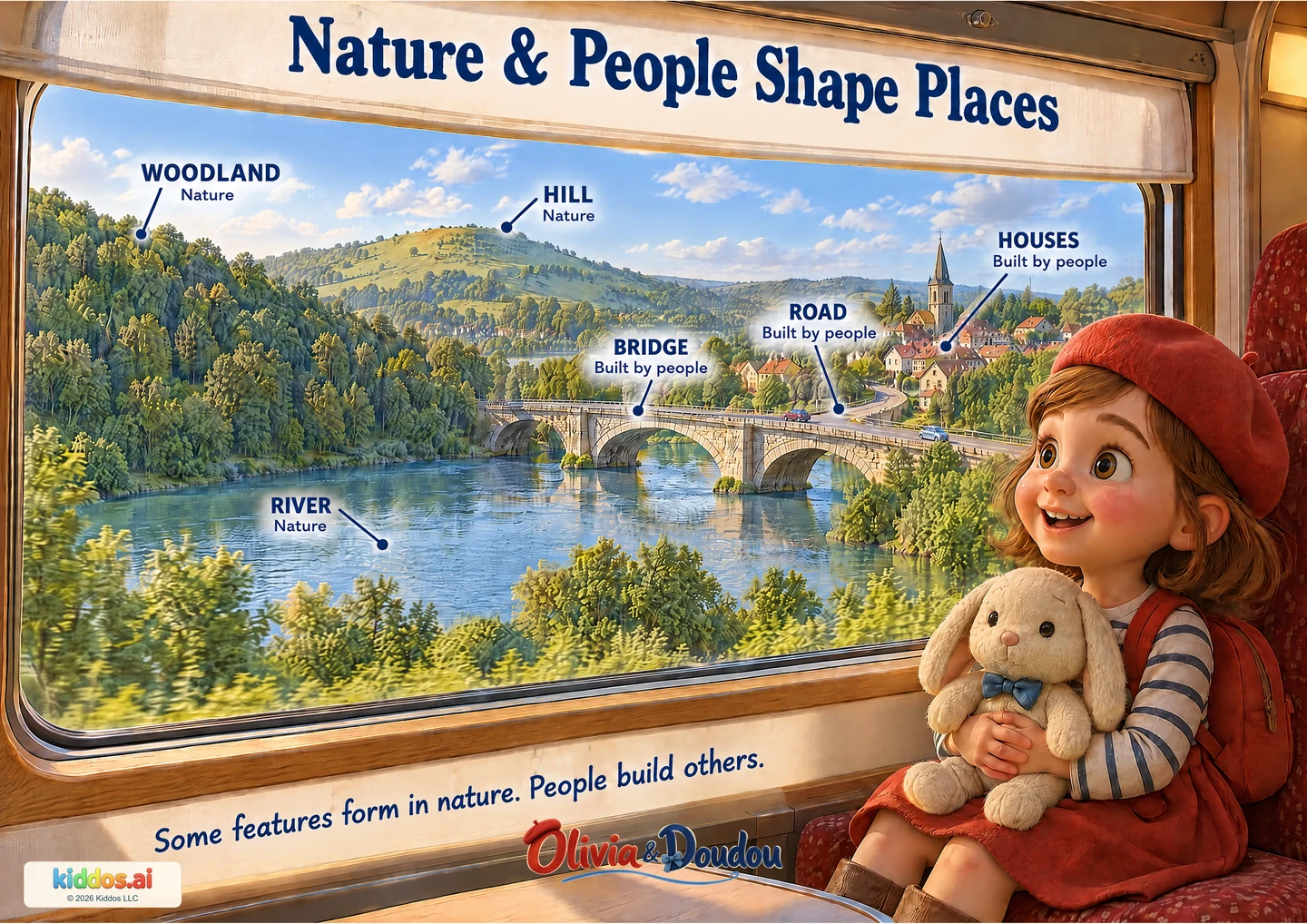
Look out of the train window with Olivia. Choose one feature people built and one that forms in nature.
Which labeled feature carries the road across the river?
Start here
Offer river versus bridge as the first pair.
Explore further
Discuss how people can change a natural feature without making it cease to matter.
Three questions to share
1Which labeled feature carries the road across the river?
Answer cue: The bridge. People built it to span the water.
2Which three labeled features belong to the nature group?
Answer cue: River, hill and woodland in this scene.
3How do a natural feature and a built feature meet here?
Answer cue: The bridge crosses the river; the road connects to it. Accept another accurate relation supported by the picture.
If your child is unsure: Offer river versus bridge as the first pair.
Something to try together
Add a bridge to a drawing
You’ll need: Paper and a pencil or crayon, or use pointing and spoken descriptions.
- Draw a river and a few houses on opposite sides.
- Add a bridge and a connecting road.
- Point out what represents nature and what people would build, and explain why the bridge helps.
What this can show
Can the child identify one natural and one built feature and describe their relationship? Stay together and use the picture or an indoor drawing. No trip, purchase, cutting, water access or real address is needed.
Return to it: If the bridge were missing, what would someone need to cross the water?
Get the guide and discovery recordFor teachers · About 20 minutes
A small lesson with room to explore.
Learning aim: Compare natural and human-built landscape features and describe how one built feature relates to nature.
Prepare: Read the picture and answer cues. Have the optional explorer’s notebook available. Paper and a pencil or crayon, or use pointing and spoken descriptions.
- 3 min
Notice
Look together: Look out of the train window with Olivia. Choose one feature people built and one that forms in nature.
- 4 min
Compare
Discuss: read one question and invite children to point to the evidence.
- 8 min
Try together
Draw a river and a few houses on opposite sides. Add a bridge and a connecting road. Point out what represents nature and what people would build, and explain why the bridge helps.
- 5 min
Explain
Try and explain: Draw a river and a few houses on opposite sides. Add a bridge and a connecting road. Point out what represents nature and what people would build, and explain why the bridge helps.
Check the idea together
Can the child identify one natural and one built feature and describe their relationship?
What to listen for
The bridge. People built it to span the water. River, hill and woodland in this scene. The bridge crosses the river; the road connects to it. Accept another accurate relation supported by the picture.
Read labels aloud and describe shape and position. Accept speech, signing, pointing or eye gaze; do not rely only on color.