Five minutes together
Look. Wonder. Talk.
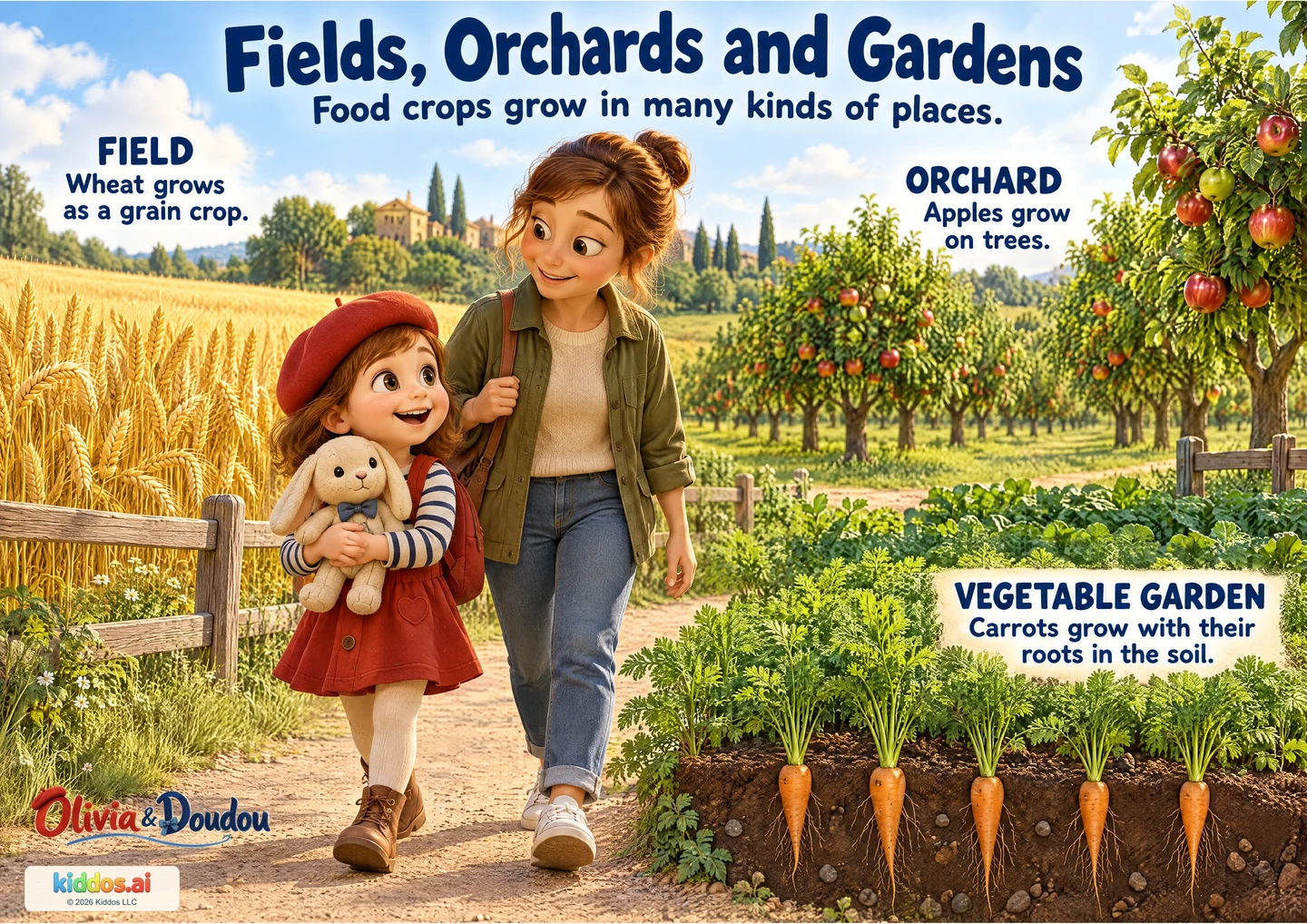
Our discovery: Match wheat, apples and carrots to three pictured growing places.
Follow the path through the growing places. Name the pictured crop, then look closely at where its edible part grows. This is a geography conversation about food-growing landscapes, with three examples rather than a complete food map.
What crop grows in the field here?
Start here
Match apples to a tree and carrots to the soil cutaway.
Explore further
Compare above-ground and below-ground edible parts, then explain a route between a growing place and a community.
Three questions to share
1What crop grows in the field here?
Answer cue: Wheat. Its grain develops in the heads at the tops of the stems. The poster calls it a grain crop.
2What makes this an apple orchard?
Answer cue: Several apple trees grow together. The apples are attached to branches above the ground.
3Which part of the carrot is under the soil?
Answer cue: The orange root. Its green leaves grow above the soil. The cutaway helps us see a part usually hidden underground.
If your child is unsure: Match apples to a tree and carrots to the soil cutaway.
Something to try together
Connect a growing place to a community
You’ll need: Paper and crayons, or the child’s pretend-place map.
- Choose wheat, apples or carrots and draw a place where the pictured crop grows.
- Add a route between that place and a pretend community.
- Tell how people could move the crop along the route. Keep this a pretend journey, without needing to handle real food.
What this can show
The child matches at least two crops with the growing places or positions shown and describes one connection. No tasting, harvesting, tools or farm visit are required. For a real visit, follow the grower’s rules and stay with the grown-up on permitted paths.
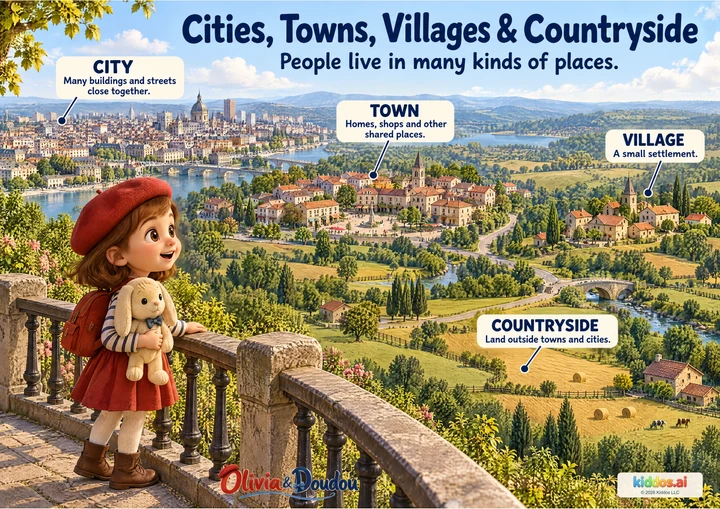
Return to it: Return to Cities, Towns, Villages & Countryside. Where might a growing place connect with a settlement?
Get the guide and discovery recordFor teachers · About 15 minutes
A small lesson with room to explore.
Learning aim: Match wheat, apples and carrots to three pictured growing places.
Prepare: Paper and crayons, or the child’s pretend-place map. Read the answer cues before sharing.
- 3 min
Notice
Look together and name one visible detail before introducing new words.
- 4 min
Compare
Use the three prompts to connect the pictured evidence with the lesson.
- 5 min
Try together
Choose wheat, apples or carrots and draw a place where the pictured crop grows. Add a route between that place and a pretend community. Tell how people could move the crop along the route. Keep this a pretend journey, without needing to handle real food.
- 3 min
Explain
The child matches at least two crops with the growing places or positions shown and describes one connection.
Check the idea together
The child matches at least two crops with the growing places or positions shown and describes one connection.
What to listen for
Wheat. Its grain develops in the heads at the tops of the stems. The poster calls it a grain crop. Several apple trees grow together. The apples are attached to branches above the ground. The orange root. Its green leaves grow above the soil. The cutaway helps us see a part usually hidden underground.
Use enlarged crop details and spoken descriptions. Children may point or choose a picture; no food handling or personal dietary disclosure is needed.