Five minutes together
Look. Wonder. Talk.
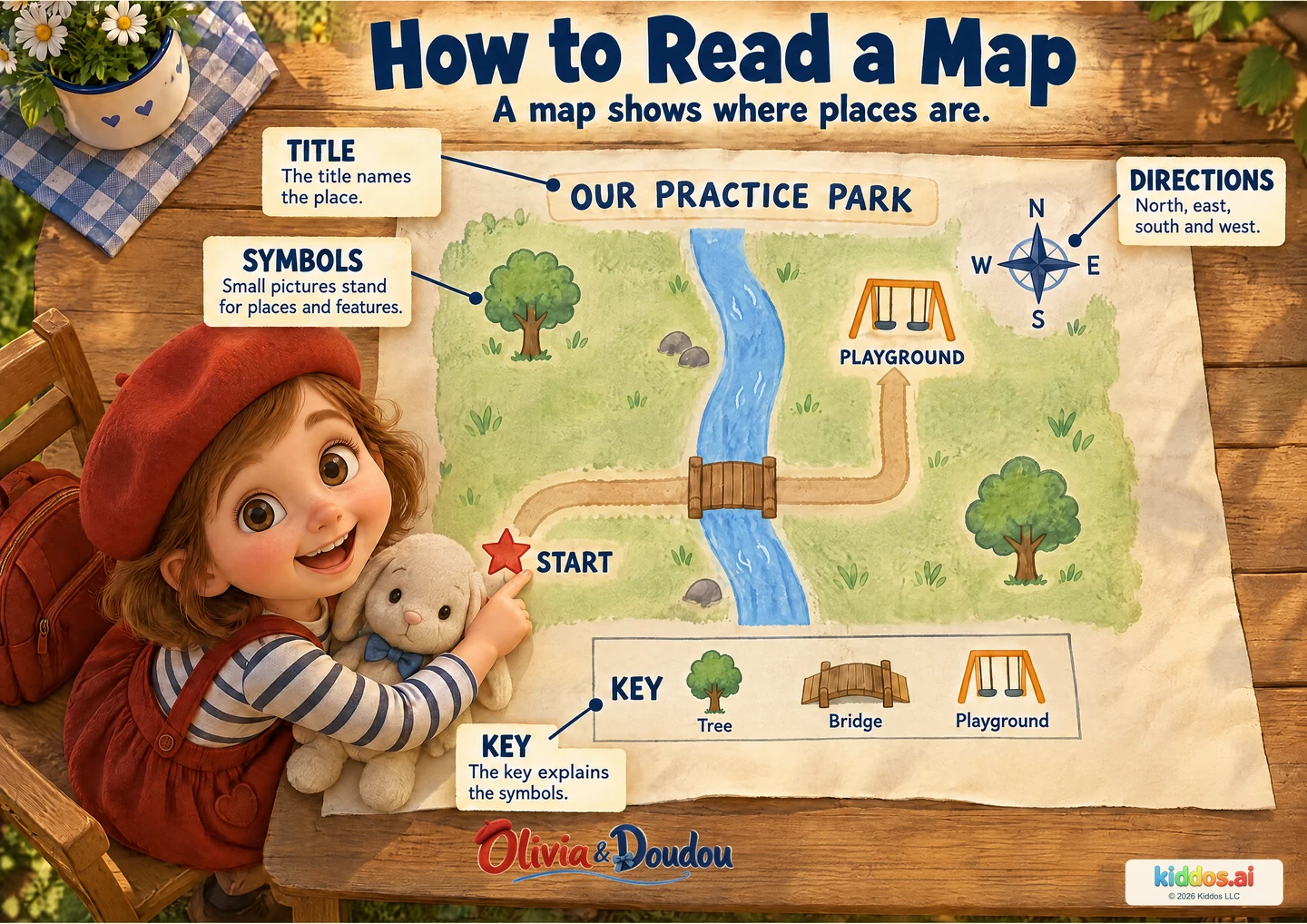
Our discovery: Use a title, key and compass rose to interpret a simple map and follow a connected path.
Pretend you and Olivia are reading this practice map together. Begin with its title, then choose one symbol in the key and find its match.
What does the title tell us?
Start here
Offer one symbol at a time and trace together.
Explore further
Ask the child to describe the path with east/north as shown by this map's compass rose.
Three questions to share
1What does the title tell us?
Answer cue: The map shows an imaginary practice park. It is for learning, not a real walking route.
2How does the key help you?
Answer cue: It explains what the tree, bridge and playground symbols mean. Find the same shapes on the map.
3How can you go from the star to the playground without crossing through the water?
Answer cue: Follow the path from START across the bridge, then continue along the path to the playground. Use the actual map path; it is not a real-world navigation instruction.
If your child is unsure: Offer one symbol at a time and trace together.
Something to try together
Make an imaginary park map
You’ll need: Paper and a pencil or crayon.
- Draw a made-up park with a path and two features.
- Choose a small symbol for each feature and repeat it in a key.
- Invite someone to match the symbols and trace your path.
What this can show
Can the child use a key symbol correctly and keep the route on the pictured path? Keep the map imaginary or of a public example. Do not ask the child to record or share a home address, school location or personal route.
Return to it: Ask a partner to find a symbol using only your key. What could make the match clearer?
Get the guide and discovery recordFor teachers · About 20 minutes
A small lesson with room to explore.
Learning aim: Use a title, key and compass rose to interpret a simple map and follow a connected path.
Prepare: Read the picture and answer cues. Have the optional explorer’s notebook available. Paper and a pencil or crayon.
- 3 min
Notice
Orient: read the map title and find north on its compass rose.
- 4 min
Compare
Match: compare each key symbol with the same symbol on the map.
- 8 min
Try together
Draw a made-up park with a path and two features. Choose a small symbol for each feature and repeat it in a key. Invite someone to match the symbols and trace your path.
- 5 min
Explain
Route: start at the star and follow the path across the bridge to the playground.
Check the idea together
Can the child use a key symbol correctly and keep the route on the pictured path?
What to listen for
The map shows an imaginary practice park. It is for learning, not a real walking route. It explains what the tree, bridge and playground symbols mean. Find the same shapes on the map. Follow the path from START across the bridge, then continue along the path to the playground. Use the actual map path; it is not a real-world navigation instruction.
Explain symbol shape and label together; color is additional information, not the only clue.