Five minutes together
Look. Wonder. Talk.
Our discovery: Explain one visible relationship between a home feature and its surroundings, without assigning one house type to an entire country.
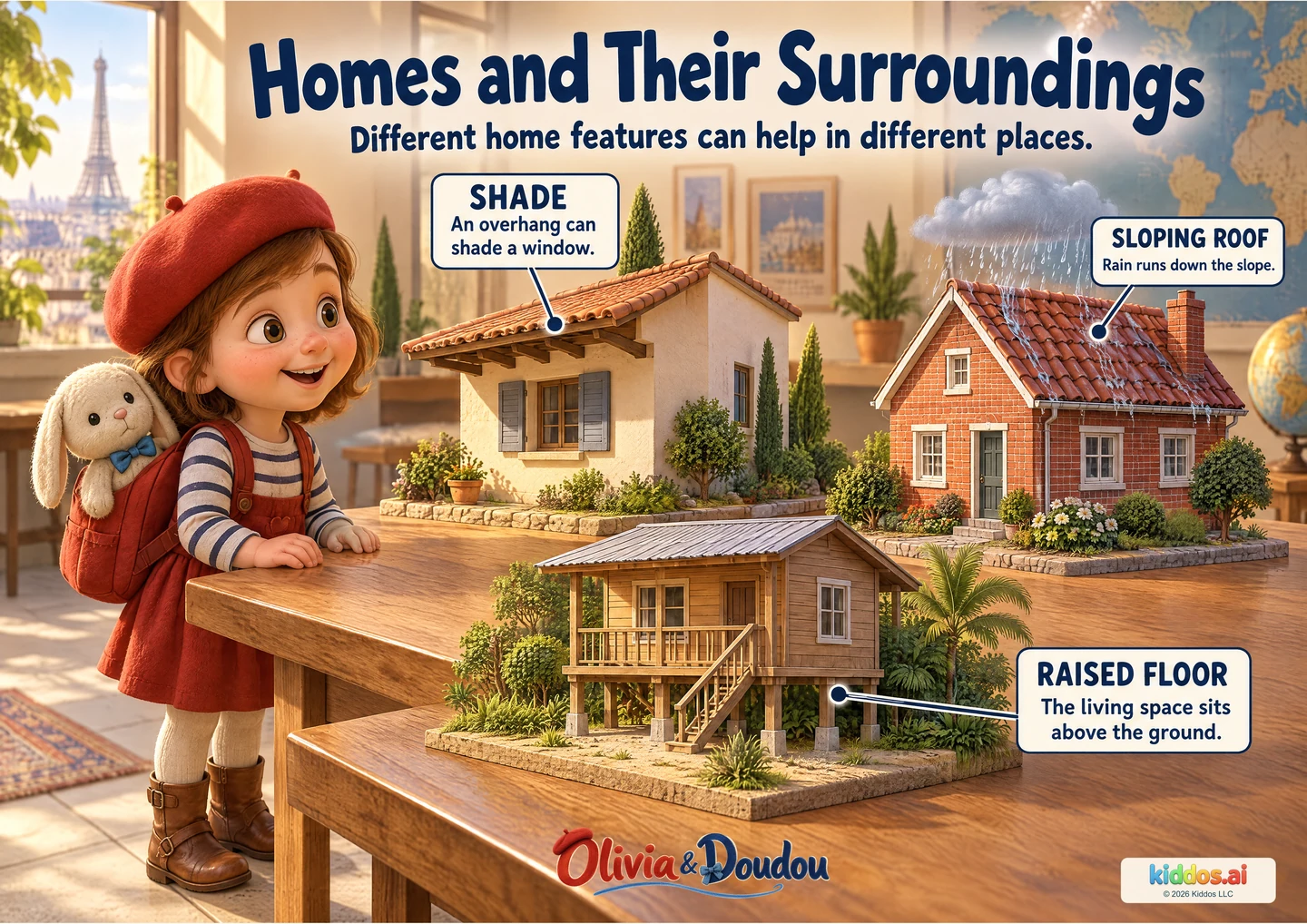
Look closely at one model house. Follow the sunlight or rain with your finger and talk about what the building feature does. The poster compares useful features, rather than sorting people or countries into house types.
What is making shade over this window?
Start here
Match one feature with its visible effect: overhang and shade, or roof and downward water.
Explore further
Explain two features in one home and name a limit, such as changing sun position.
Three questions to share
1What is making shade over this window?
Answer cue: The overhang projects out above it and blocks some sunlight. Whether it shades the window depends on where the sun is.
2Which way does the rainwater go on the sloping roof?
Answer cue: Down the roof toward the edges. A roof also needs suitable materials and drainage; a slope alone is not a promise that a home stays dry.
3What makes the third home’s floor raised?
Answer cue: Its living floor is above the ground on supports. Point to the space beneath it and the stairs leading up.
If your child is unsure: Match one feature with its visible effect: overhang and shade, or roof and downward water.
Something to try together
Give a pretend home one useful feature
You’ll need: Paper and crayons.
- Draw a pretend home beside something in its surroundings, such as sunshine or a tree.
- Add one feature from the poster and point to it.
- Explain what that feature can do. Add a second feature if your child wants to continue.
What this can show
The child identifies one feature and explains its visible function without making a country-wide or safety guarantee. Keep this a drawing activity. Do not climb, enter building sites, test real roofs or construct raised structures. There is no need to draw or identify the family home.
Return to it: Look again: could one of the houses have both an overhang and a sloping roof?
Get the guide and discovery recordFor teachers · About 15 minutes
A small lesson with room to explore.
Learning aim: Explain one visible relationship between a home feature and its surroundings, without assigning one house type to an entire country.
Prepare: Paper and crayons. Read the answer cues before sharing.
- 3 min
Notice
Look together and invite one observation before introducing the vocabulary.
- 4 min
Compare
Use the three discussion prompts, following the picture rather than expecting memorized definitions.
- 5 min
Try together
Draw a pretend home beside something in its surroundings, such as sunshine or a tree. Add one feature from the poster and point to it. Explain what that feature can do. Add a second feature if your child wants to continue.
- 3 min
Explain
The child identifies one feature and explains its visible function without making a country-wide or safety guarantee.
Check the idea together
The child identifies one feature and explains its visible function without making a country-wide or safety guarantee.
What to listen for
The overhang projects out above it and blocks some sunlight. Whether it shades the window depends on where the sun is. Down the roof toward the edges. A roof also needs suitable materials and drainage; a slope alone is not a promise that a home stays dry. Its living floor is above the ground on supports. Point to the space beneath it and the stairs leading up.
Describe the shadows and supports aloud; let children point, choose between two features or direct an adult’s drawing. Avoid asking children to discuss their own housing.