Five minutes together
Look. Wonder. Talk.
Our discovery: Identify three destination features and compare their shapes and uses.
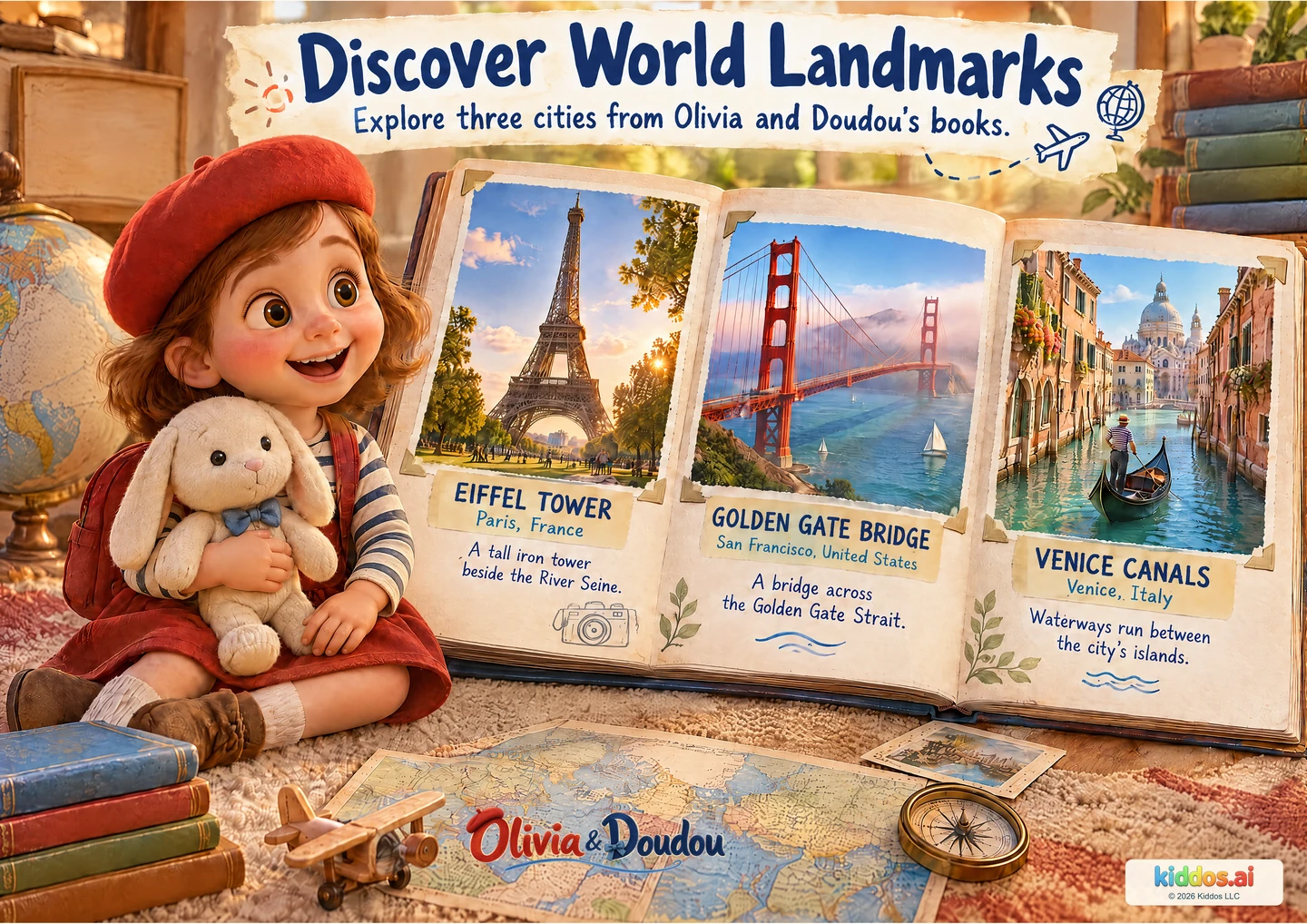
Open this illustrated travel album with Olivia. These are three separate places from her book destinations, and you can explore them from home.
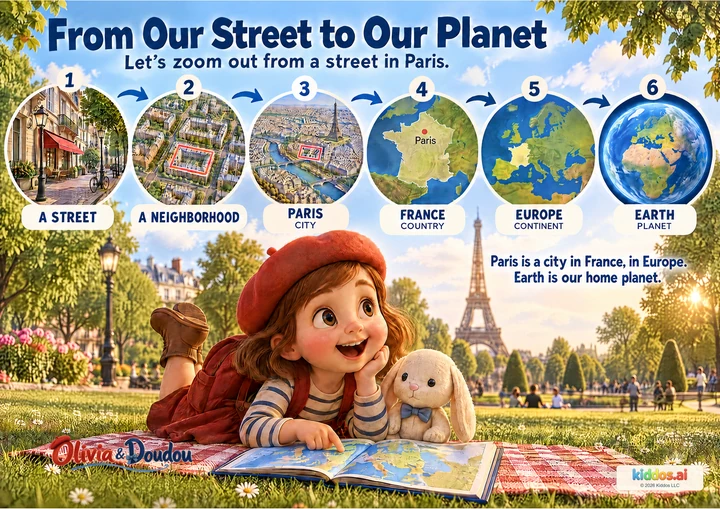
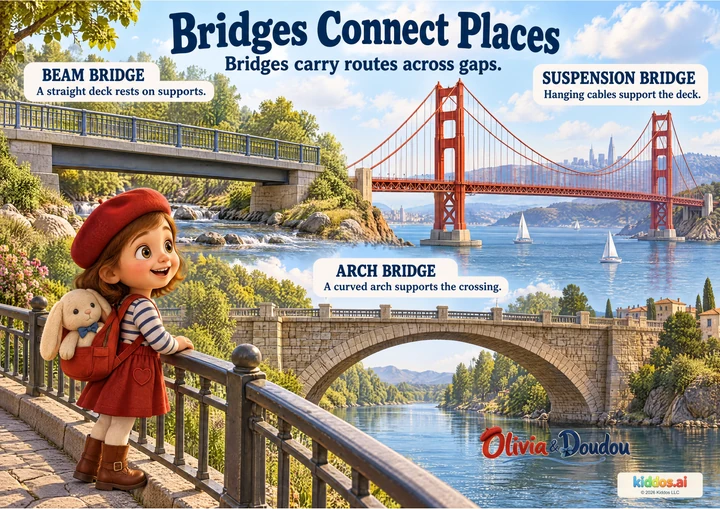
Can you find a tower, a bridge and a waterway?
Start here
Offer a tower-versus-bridge choice and read place names aloud.
Explore further
Discuss bridge function and distinguish a strait from a river or canal.
Three questions to share
1Can you find a tower, a bridge and a waterway?
Answer cue: The Eiffel Tower is in Paris, the Golden Gate Bridge is at San Francisco, and the canals are in Venice.
2What does the bridge cross? What could move along the canals?
Answer cue: The Golden Gate Bridge crosses a sea strait. Boats can travel along Venice's canals.
3What is alike or different about these places?
Answer cue: Accept pictured evidence: tall tower versus long bridge, iron structure versus buildings beside water, or different ways of moving around. There is no single required comparison.
If your child is unsure: Offer a tower-versus-bridge choice and read place names aloud.
Something to try together
Design a pretend landmark
You’ll need: Paper and a pencil, or an oral description.
- Choose a purpose: a tower for looking out, a bridge for crossing, or a waterway for boats.
- Draw or describe your invented place.
- Explain how someone could use it. Call it pretend, and keep it separate from the real landmark names.
What this can show
Can the child pair one feature with its city and support a comparison with visible evidence? This is a drawing or storytelling activity, not an instruction to build or climb a structure.
Return to it: Invite a partner to follow your map. Can they recognize your landmark from your description?
Get the guide and discovery recordFor teachers · About 20 minutes
A small lesson with room to explore.
Learning aim: Identify three destination features and compare their shapes and uses.
Prepare: Read the picture and answer cues. Have the optional explorer’s notebook available. Paper and a pencil, or an oral description.
- 3 min
Notice
Locate: name the city and country below each destination view.
- 4 min
Compare
Compare: children find one difference and one similarity.
- 8 min
Try together
Choose a purpose: a tower for looking out, a bridge for crossing, or a waterway for boats. Draw or describe your invented place. Explain how someone could use it. Call it pretend, and keep it separate from the real landmark names.
- 5 min
Explain
Connect: recall how a bridge can appear as a symbol on a map.
Check the idea together
Can the child pair one feature with its city and support a comparison with visible evidence?
What to listen for
The Eiffel Tower is in Paris, the Golden Gate Bridge is at San Francisco, and the canals are in Venice. The Golden Gate Bridge crosses a sea strait. Boats can travel along Venice's canals. Accept pictured evidence: tall tower versus long bridge, iron structure versus buildings beside water, or different ways of moving around. There is no single required comparison.
Read destination labels, describe the structure, and accept a spoken or pointed comparison without relying on travel experience.