Five minutes together
Look. Wonder. Talk.
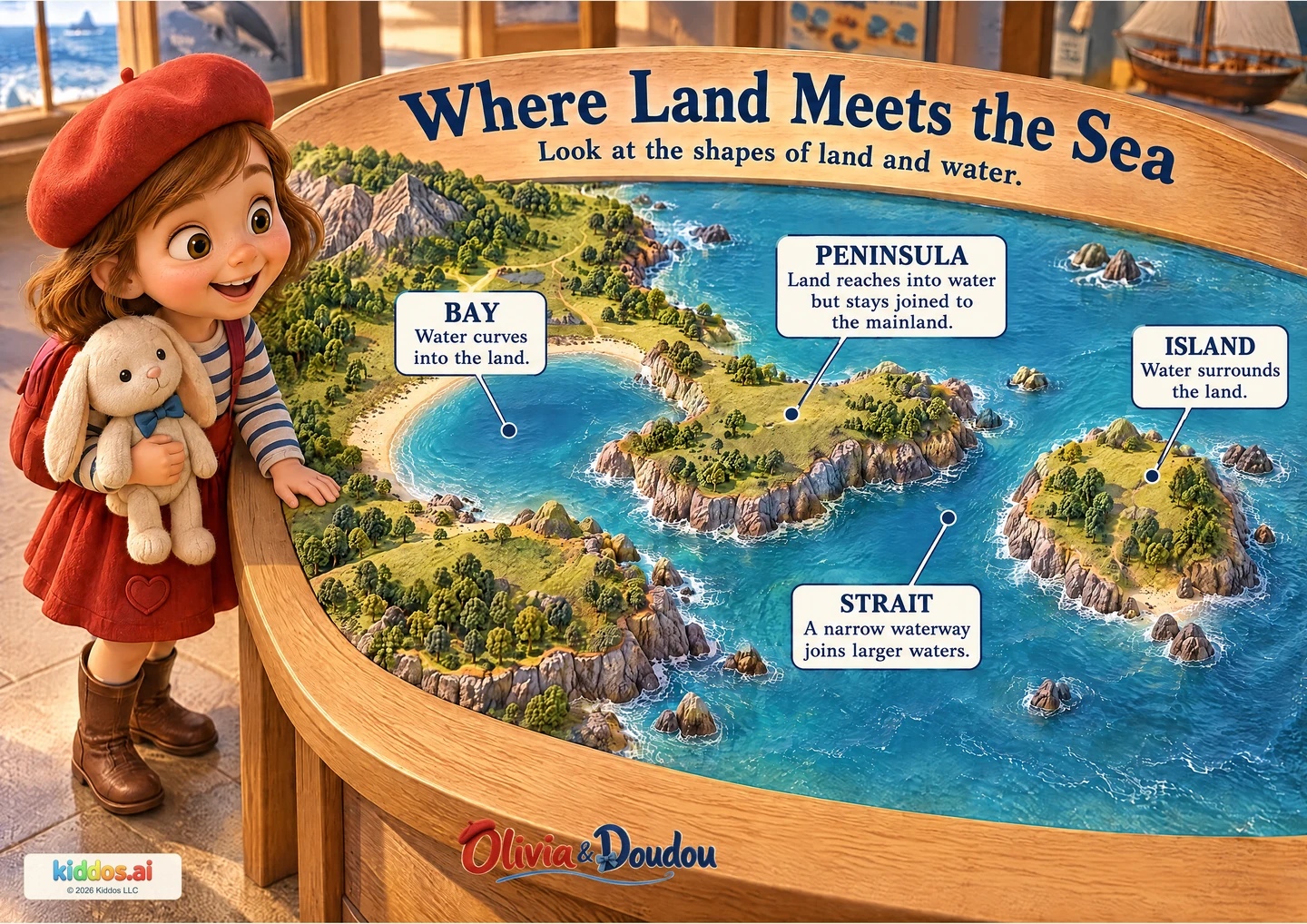
Our discovery: Distinguish an island and peninsula, and identify a bay and a strait from land-water relationships.
Trace one coastline slowly. Notice when water surrounds land and when land remains connected.
Which land has water all the way around it?
Start here
Begin with island versus connected land; add bay and strait later.
Explore further
Explain how a strait connects larger waters while a peninsula connects to land.
Three questions to share
1Which land has water all the way around it?
Answer cue: The island. Follow its complete shore without finding a land connection.
2How is the peninsula different from the island?
Answer cue: It is still joined to the mainland, while water reaches around most of it.
3Which label names narrow water, rather than land?
Answer cue: Strait. The narrow passage connects the larger water areas on its two sides. The bay is water curving into the land.
If your child is unsure: Begin with island versus connected land; add bay and strait later.
Something to try together
Draw two different shores
You’ll need: Paper and a pencil or crayon, or use pointing and spoken descriptions.
- Draw an island with a complete ring of water around it.
- Draw a second land shape still joined to a larger area of land.
- Explain why the second one can be a peninsula and the first cannot.
What this can show
Can the child follow the island shore and identify the peninsula’s land connection? Stay together and use the picture or an indoor drawing. No trip, purchase, cutting, water access or real address is needed.
Return to it: Cover the labels. Can you still explain which shape is an island and which is a peninsula?
Get the guide and discovery recordFor teachers · About 20 minutes
A small lesson with room to explore.
Learning aim: Distinguish an island and peninsula, and identify a bay and a strait from land-water relationships.
Prepare: Read the picture and answer cues. Have the optional explorer’s notebook available. Paper and a pencil or crayon, or use pointing and spoken descriptions.
- 3 min
Notice
Look together: Trace one coastline slowly. Notice when water surrounds land and when land remains connected.
- 4 min
Compare
Discuss: read one question and invite children to point to the evidence.
- 8 min
Try together
Draw an island with a complete ring of water around it. Draw a second land shape still joined to a larger area of land. Explain why the second one can be a peninsula and the first cannot.
- 5 min
Explain
Try and explain: Draw an island with a complete ring of water around it. Draw a second land shape still joined to a larger area of land. Explain why the second one can be a peninsula and the first cannot.
Check the idea together
Can the child follow the island shore and identify the peninsula’s land connection?
What to listen for
The island. Follow its complete shore without finding a land connection. It is still joined to the mainland, while water reaches around most of it. Strait. The narrow passage connects the larger water areas on its two sides. The bay is water curving into the land.
Read labels aloud and describe shape and position. Accept speech, signing, pointing or eye gaze; do not rely only on color.