Five minutes together
Look. Wonder. Talk.
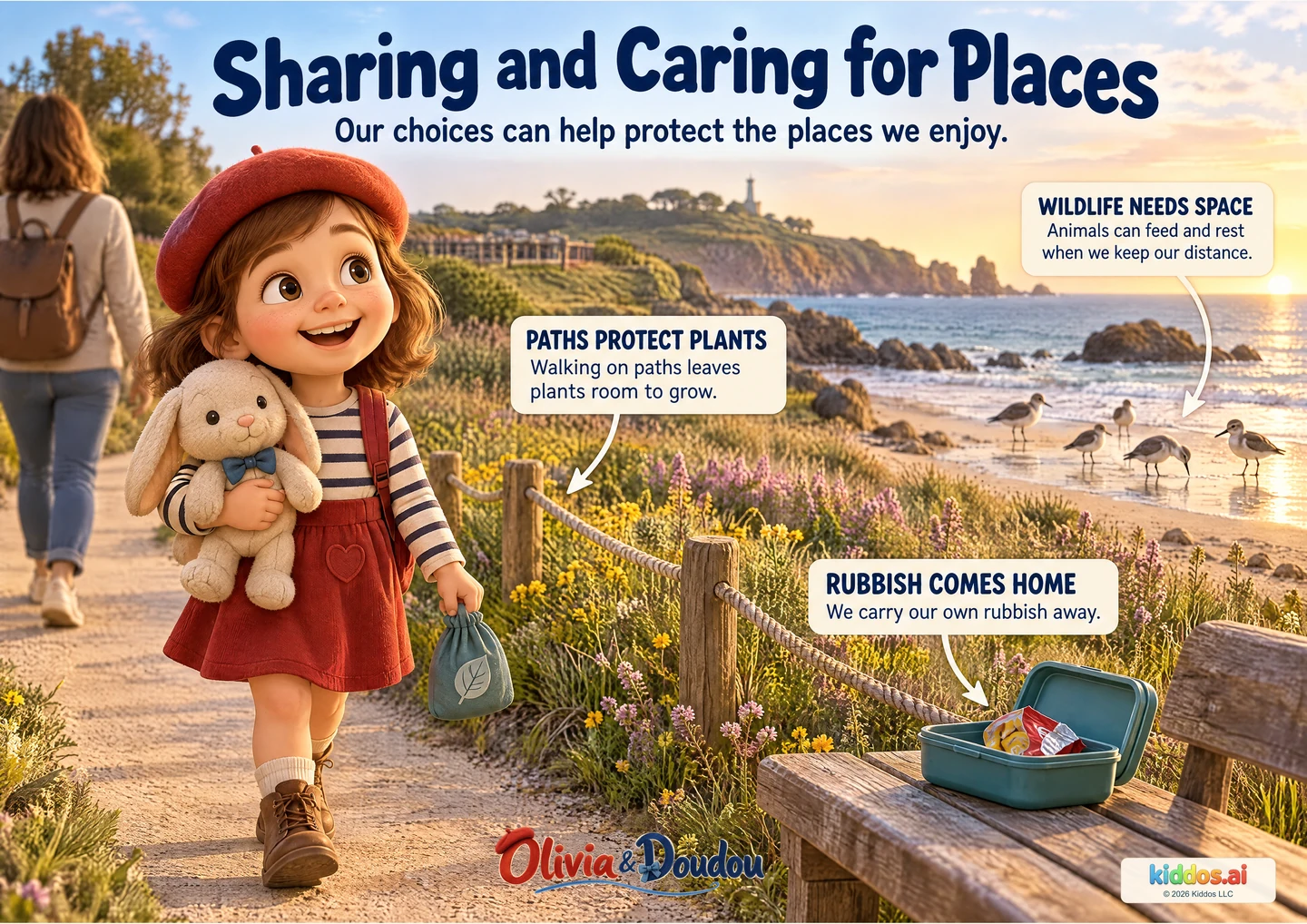
Our discovery: Explain how one visible visitor choice helps plants, wildlife or a shared place.
Notice the space between people, plants and birds. Talk about one small choice an adult and child can make together when visiting a place, without making the child responsible for everyone else’s behavior.
How does the path help the plants?
Start here
Point to the path or distant birds and describe one helpful choice.
Explore further
Explain the link between a choice and its effect, then apply it to a different place.
Three questions to share
1How does the path help the plants?
Answer cue: People can walk on it without stepping on the plants beside it, leaving room for them to grow.
2Why are the visitors staying away from the birds?
Answer cue: Space lets the birds feed and rest without people approaching or disturbing them. We watch rather than feed or touch wildlife.
3What happens to our own snack wrapper after a picnic?
Answer cue: We keep it in our bag or container and take it to an appropriate bin or home with the grown-up. Children do not need to pick up unfamiliar rubbish.
If your child is unsure: Point to the path or distant birds and describe one helpful choice.
Something to try together
Add one care choice to your map
You’ll need: Your pretend-place map, or a fresh sheet of paper and crayons.
- Choose a place that visitors and wildlife might share.
- Add a path or viewing place with space around plants or animals.
- Draw a bag for taking your own rubbish away and explain one choice that helps the place.
What this can show
The child connects one practical choice with plants, animals or keeping a shared place pleasant. The drawing can stay indoors. For a real visit, an adult chooses the route, stays nearby and handles waste. Avoid nests, feeding wildlife or collecting found litter.
Return to it: Before another outing, choose one shared care habit. Afterwards, talk about what you noticed without scoring or blaming.
Get the guide and discovery recordFor teachers · About 15 minutes
A small lesson with room to explore.
Learning aim: Explain how one visible visitor choice helps plants, wildlife or a shared place.
Prepare: Your pretend-place map, or a fresh sheet of paper and crayons. Read the answer cues before sharing.
- 3 min
Notice
Look together and invite one observation before introducing the vocabulary.
- 4 min
Compare
Use the three discussion prompts, following the picture rather than expecting memorized definitions.
- 5 min
Try together
Choose a place that visitors and wildlife might share. Add a path or viewing place with space around plants or animals. Draw a bag for taking your own rubbish away and explain one choice that helps the place.
- 3 min
Explain
The child connects one practical choice with plants, animals or keeping a shared place pleasant.
Check the idea together
The child connects one practical choice with plants, animals or keeping a shared place pleasant.
What to listen for
People can walk on it without stepping on the plants beside it, leaving room for them to grow. Space lets the birds feed and rest without people approaching or disturbing them. We watch rather than feed or touch wildlife. We keep it in our bag or container and take it to an appropriate bin or home with the grown-up. Children do not need to pick up unfamiliar rubbish.
Use a familiar accessible park or an imagined place. Pointing, drawing and spoken plans all count; a physical outing is optional.