Five minutes together
Look. Wonder. Talk.
Our discovery: Make a prediction, record a floating or sinking result, and compare the two.
Remember: Choose one comfortable way to notice or describe a detail. What do you already wonder about this picture?
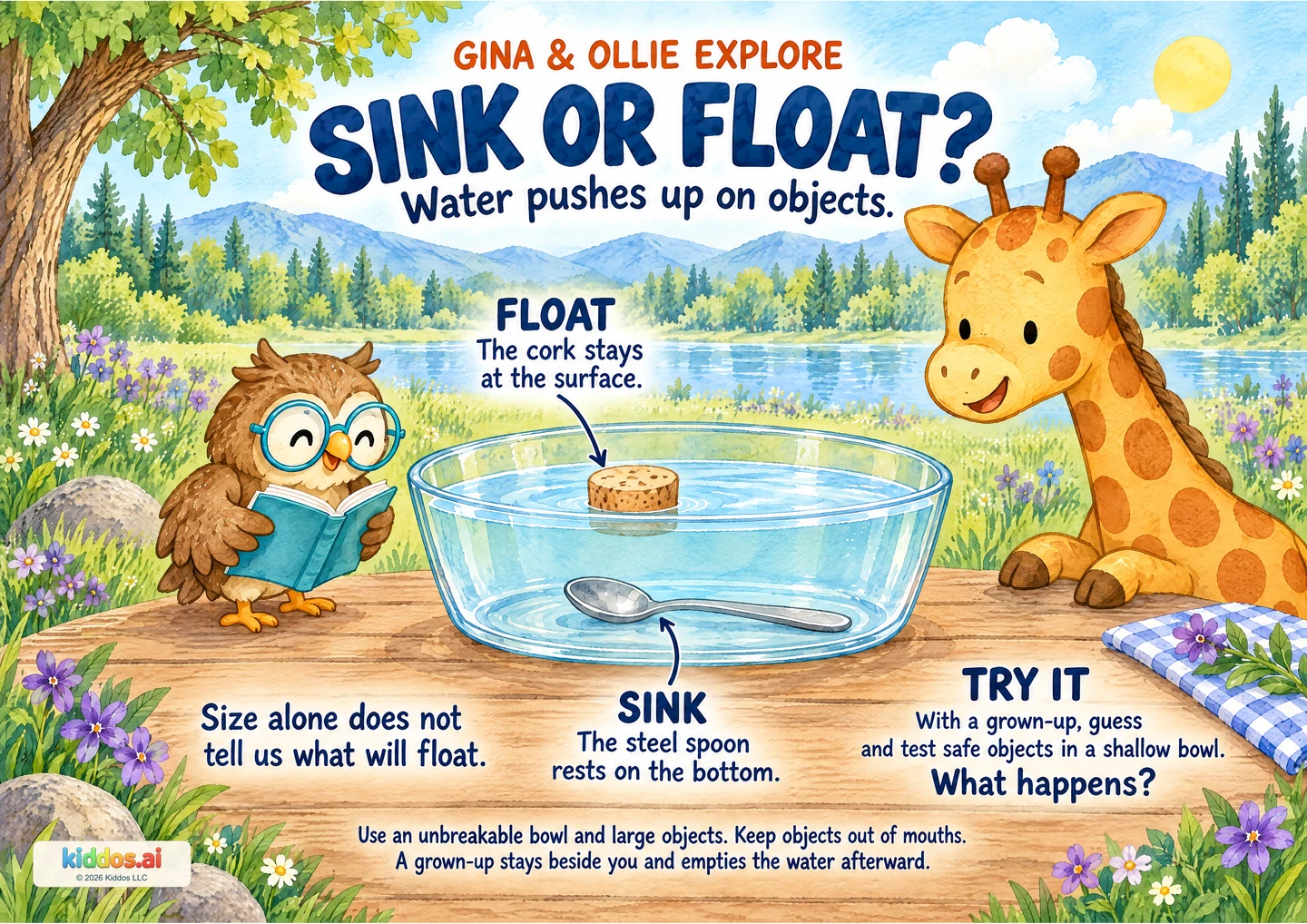
Revisit that discoveryBegin with the cork and spoon as results already shown. Name the surface and bottom, then explain that water pushes upward. For a real prediction, an adult chooses a new safe object not shown on the poster and follows the activity below. Welcome an uncertain guess, record the actual result and revisit the idea. Size alone does not tell us what will float.
Look at the cork and the spoon. What is different about where they are?
Start here
Find the cork at the surface and the spoon at the bottom.
Explore further
Explain why one large object’s result cannot tell us what all large objects will do.
Three questions to share
1Which object stays at the surface?
Answer cue: The cork.
2Where is the steel spoon?
Answer cue: On the bottom; it sank.
3Can size alone tell us what will float?
Answer cue: No. Size alone is not enough.
If your child is unsure: Let’s use one clue together. Find the cork at the surface and the spoon at the bottom.
Something to try together
Predict, test, revisit
You’ll need: An adult, a shallow unbreakable bowl, a little water and one large safe-to-wet object.
- An adult chooses one large, clean, nonbreakable object not shown on the poster, such as a suitable plastic toy without batteries or detachable parts, and checks it is safe to wet.
- Before placing it in a shallow unbreakable bowl, say or draw a prediction: surface or bottom. An adult stays beside the child throughout.
- Gently test it, record what actually happens and compare with the prediction. Keep objects out of mouths; the adult empties the bowl afterward.
What this can show
Predictions can differ from results. Record what this particular object does, including anything unexpected, without making a rule based on size alone.
Return to it: Describe one thing you would check before predicting what a different object will do.
Get the guide and discovery recordFor teachers · About 20 minutes
A small lesson with room to explore.
Learning aim: Make a prediction, record a floating or sinking result, and compare the two.
Prepare: Read the poster, answer cues and misconception note. Prepare only the materials named in the activity; keep a picture-only or described option available.
- 3 min
Reconnect and wonder
Can we predict a new object’s result before testing it? Invite an initial idea; record it without marking it right or wrong.
- 4 min
Look together
Find the cork at the surface and the spoon at the bottom. Introduce float using the poster.
- 8 min
Investigate or represent
Use “Predict, test, revisit.” Let pairs take turns noticing and recording, with adult help and the activity’s stated boundaries.
- 5 min
Explain and return
Ask the core check: Can we predict a new object’s result before testing it? Accept pointing, words, signing or a drawing. If the learner is ready, offer this optional extension: Explain why one large object’s result cannot tell us what all large objects will do.
Check the idea together
Can we predict a new object’s result before testing it?
What to listen for
A child can make an idea before the test, describe where the object actually ends up and compare the two. A changed idea after observing is a useful outcome. Predictions can differ from results. Record what this particular object does, including anything unexpected, without making a rule based on size alone.
Accept pointing, speech, signing, a drawing or adult dictation. Describe the illustration and use labels/position as well as color. Offer one contrast first, and use the extension when the learner is ready.