From story to discovery
Try it together.
Peel on. Peel off. Will it float with its peel? What about without?
Gather
One ordinary fresh orange, a clear unbreakable bowl, room-temperature water and a tray.
Adult setup — read before trying
An adult pours enough water to cover the peeled fruit while leaving room below the rim, lowers/releases the fruit and peels it by hand without a knife. Keep segments together. Skip for citrus allergy. Do not taste the experiment fruit/water; keep peel from mouths, supervise water and empty it afterward.
- Predict; adult lowers whole orange in deep water and releases it.
- Observe where it settles. Adult removes and peels the same orange by hand.
- Lower and release the peeled fruit; observe, compare, and describe the actual result.
- Keep the same
- The same fruit, bowl and water.
- What changes
- Removing peel changes both mass and volume.
- Look for
- Observe where the released fruit settles relative to the water surface and bottom.
Make sense of what happened
Tiny air spaces in the rind help reduce the whole fruit’s average density. Without that layer, the remaining fruit may be denser than water.
Whole oranges usually float and peeled ones often sink, but variety, pith and trapped air matter. Never force the fruit under to match the picture.
Full grown-up notes, setup details & honest limits
Use a smooth, transparent, unbreakable plastic bowl on a stable tray, one ordinary fresh orange, and room-temperature tap water. Add enough water for the peeled fruit to fit fully below the surface while resting on the bottom, leaving plenty of room below the bowl rim to avoid overflow. The adult pours and gently lowers the whole orange, then lets go. Ask the child to predict before either test and point to where fruit meets water. The adult lifts the same fruit out, peels it by hand without a knife, keeps the segments together, and gently lowers and releases it again. Observe after it settles. Keep the bowl, water and fruit the same; peel removal changes both mass and volume, so this is not a test of mass alone. The waterline may move slightly because the displaced volume changes. Whole oranges usually float; peeled oranges often sink. Variety, ripeness, peel thickness, remaining pith and trapped air can change the outcome. If yours differs, describe or draw the actual result; do not hold it under, change the water, or promise a guaranteed result. The tiny air spaces in the rind help lower the average density of the whole fruit. Removing this relatively low-density layer may leave fruit denser than water. Gravity still acts on floating objects; water pushes upward. Weight alone does not decide flotation. Page 5 is a simplified enlarged peel diagram, not a microscopic image; it does not show a hollow orange or literal air bubbles leaving the fruit. Let the child point, describe, draw, or direct the adult. Ask “What changed? What stayed the same?” Compare your two observations and welcome a changed prediction. For a small group, collect guesses, then draw the waterline on pictures of the two fruit states. Adults handle fruit and water; choose another activity for citrus allergy. Keep peel and fruit away from mouths and younger siblings, do not taste experiment water or fruit, wipe spills, and empty the bowl when finished. This brief activity needs no salt, hot water, knife or special equipment. Gina and the Great Gravity Hug is related reading about Earth’s pull; its shipping story does not contain the orange experiment. No live family trial or measured learning outcome is claimed.
A conversation, not a quiz
Leave room for their idea.
Welcome a new prediction before testing the peeled version.
Peel on. Peel off. Will it float with its peel? What about without?
A cue for the grown-up
Welcome a guess before reading the result. No correct prediction is required.
Where did each version settle after you let go?
A cue for the grown-up
Describe the actual positions; the illustrated whole fruit floats and peeled fruit sinks.
Does a lighter object always float more easily?
A cue for the grown-up
No. Removing peel changes volume too; weight alone does not decide floating.
A simple way in
An adult handles the fruit while the child points to the waterline.
Another thing to notice
Draw both observations, showing the waterline and the same bowl.
Come back to it
Use “usually” and “in our test” when telling someone what happened.
For teachers
A small-group discovery.
Flexible 20-minute small-group session; pause or shorten as needed.
Prepare the named materials and adult setup above. One adult-led demonstration is a useful option.
- 3 min
Wonder
Read pages 1–2. Invite a prediction with words, pointing or a sketch; keep the result hidden.
- 4 min
Notice the story
Read pages 3–5. Where did each version settle after you let go? Separate the observation from the explanation.
- 9 min
Try together
Use the materials and adult setup on this guide, then follow the activity steps in this guide. Observe where the released fruit settles relative to the water surface and bottom.
- 4 min
Make meaning
Does a lighter object always float more easily? Invite a drawing, a description or an adult-written note. Welcome a new prediction before testing the peeled version.
What to listen for
Does a lighter object always float more easily?
Answer guidance
No. Removing peel changes volume too; weight alone does not decide floating.
Ways to take part
An adult handles the fruit while the child points to the waterline. Accept pointing, words, a drawing or adult-directed action. Use the story alone if the activity is unsuitable.
Record an observation with a drawing, a gesture described by an adult or a sentence. No timed performance or winning prediction is needed.
All the story words.
Read aloud, enlarge the browser text, or use this text alongside the pictures.
Page 1 · Will it float without its peel?
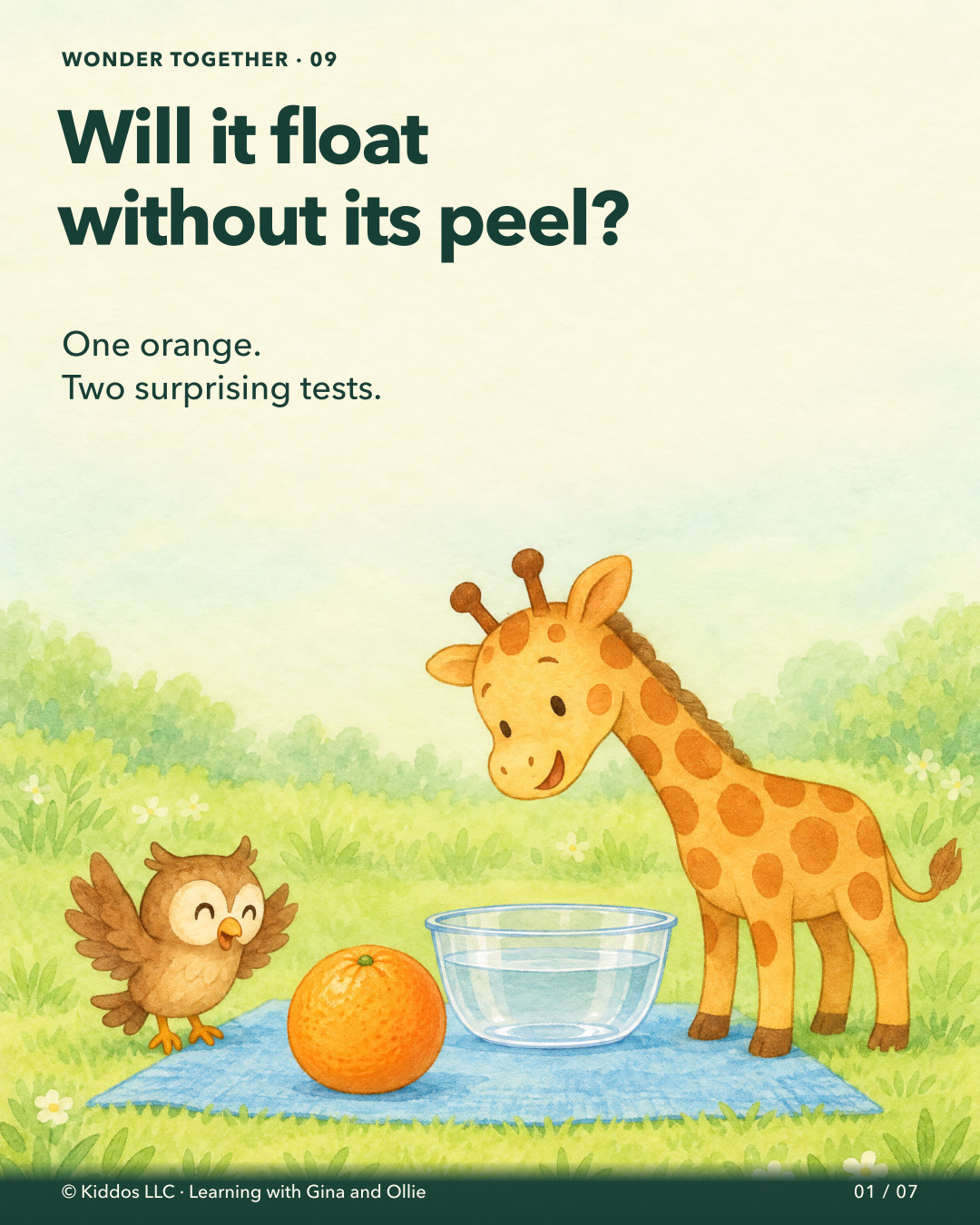
WONDER TOGETHER · 09 Will it float without its peel? One orange. Two surprising tests. © Kiddos LLC · Learning with Gina and Ollie 01 / 07
Picture description: Gina the yellow giraffe and her small brown owl friend Ollie look at a whole orange beside a clear bowl of water on a blue ground mat. The title asks whether it will float without its peel; the result is not yet shown.
Page 2 · Peel on. Peel off.
GUESS BEFORE YOU SWIPE Peel on. Peel off. Will it float with its peel? What about without? Tell each other your guess. © Kiddos LLC · Learning with Gina and Ollie 02 / 07
Picture description: A whole orange waits outside a deep clear plastic bowl filled with water. Ollie sits to the left and Gina stands to the right. The family predicts whether it will float with its peel, then predicts what will happen without it.
Page 3 · It floats!
FIRST, KEEP THE PEEL It floats! Gina watches the whole orange bob. Part stays above the water. Look closely at the waterline. © Kiddos LLC · Learning with Gina and Ollie 03 / 07
Picture description: The orange with its peel is floating in the bowl, partly above the waterline and mostly submerged. Gina and Ollie watch from the same positions. The bowl, camera and light match the prediction scene.
Page 4 · It sinks!
NOW, TAKE THE PEEL OFF It sinks! They peel that same orange. This time, it sinks to the bottom. Lighter… but it sinks? © Kiddos LLC · Learning with Gina and Ollie 04 / 07
Picture description: The same orange, now peeled with its segments still together, rests fully underwater on the bottom of the same deep bowl. The removed peel lies beside the bowl. Gina and Ollie observe the result in the matched scene.
Page 5 · Air makes a difference.
PEEL FRUIT INSIDE TINY AIR SPACES Peel close-up · simplified THE PART TO REMEMBER Air makes a difference. The peel has tiny air spaces. They help the whole orange float. Lighter can still sink. © Kiddos LLC · Learning with Gina and Ollie 05 / 07
Picture description: An editable cutaway diagram shows solid orange flesh surrounded by peel. A magnified piece of peel shows many small air spaces, with a leader connecting it to the rind. It is a simplified close-up, not a hollow orange. The key message is that lighter objects can still sink.
Page 6 · Guess. Peel. Try again.
1 PREDICT 2 TEST WITH THE PEEL 3 PEEL THE SAME ORANGE TEST AGAIN Water deep enough to cover the fruit. TRY IT TOGETHER Guess. Peel. Try again. With an adult: an orange, water and a deep, clear plastic bowl. Oranges vary. What does yours do? Adult pours and peels. No tasting. Use a stable tray. Wipe up spills. © Kiddos LLC · Learning with Gina and Ollie 06 / 07
Picture description: Three illustrated steps show a whole orange waiting beside a water-filled bowl for a prediction, the whole orange floating, then the same orange peeled and submerged. An adult pours and peels; the child guesses, observes and compares. Use a stable tray, do not taste experiment fruit or water, and wipe spills. Oranges can vary.
Page 7 · A little orange. A bigger question.
KEEP ASKING TOGETHER A little orange. A bigger question. Next, explore Earth’s pull in Gina and the Great Gravity Hug. Parents: read together in Kiddos Books. Kiddos Books · Read with confidence. © Kiddos LLC · Learning with Gina and Ollie 07 / 07
Picture description: Gina and Ollie settle beside an open blue picture book in the mint-green garden. Parents are invited to explore Earth’s pull in Gina and the Great Gravity Hug in Kiddos Books. The orange lesson is complete; the book is related reading, not the source of this experiment.
Where the explanation comes from.
Related storybooks invite further reading. The factual sources below support the investigation; illustration diagrams simplify what happens.