From story to discovery
Try it together.
Wet? Or dry? Paper is tucked inside. The opening goes down first.
Gather
A small stable clear plastic tub, a short rigid hole-free clear plastic cup, paper towel, water and a towel under the tub.
Adult setup — read before trying
Adult stays within arm’s reach throughout. Use only water deep enough to cover the small inverted cup; no glass or large bucket. Keep faces, younger children and pets away. Wedge dry paper firmly at the dry cup’s closed bottom, leaving air space. Wipe spills and empty the tub immediately afterward.
- Tuck dry paper firmly at closed bottom of dry plastic cup.
- Turn mouth down; lower and lift straight without tilting. Dry the rim, then check the paper.
- Repeat and tilt underwater to observe escaping air and entering water. Adult stays beside the activity and empties tub afterward.
- Keep the same
- Cup, paper placement, water tub and careful handling.
- What changes
- Cup orientation: straight down, then deliberately tilted underwater.
- Look for
- Dry the rim before checking the paper. On the tilted test, look for bubbles leaving and water entering.
Make sense of what happened
Air already inside the inverted cup takes up space. Tilting lets some air escape so more water can enter.
Air is compressible, not a solid lid or vacuum. Leaks, splashes, loose paper or drips may wet it; a tiny tilt may not immediately wet the whole towel.
Full grown-up notes, setup details & honest limits
Use a small, stable clear plastic food tub and a short, rigid clear plastic cup with an intact closed base and no holes. Do not use glass or a large bucket. An adult prepares room-temperature water only deep enough to cover the small inverted cup, places the tub on a stable waterproof surface at comfortable reach, and stays within arm’s reach throughout. Keep younger children and pets away; never leave standing water unattended. Use a towel beneath the tub, keep faces above and away from the water, wipe spills promptly and empty the tub immediately after the activity. Children can point, predict or direct instead of handling water. Begin with a dry cup and dry paper towel. Crumple enough paper to wedge firmly at the closed bottom so it stays put when turned over; leave most of the cup’s space open. Turn the opening straight down. Lower it slowly until submerged without tilting, then lift it vertically out again. Dry the outside and rim before touching the paper so drips do not spoil the check. The paper should remain dry if air is retained and the paper is well above the rim. If it gets wet, notice that result without blame: check for a tilt, a leaky cup, loose or low-hanging paper, splashes or drips. Reset with a dry cup and dry paper. For the second test use the same cup, paper placement and tub; lower it again, then tip it sideways under water until bubbles escape. Water enters as the air leaves and may wet the paper as the cup fills. Do not promise that a tiny tilt immediately wets the whole towel. Pause before the tilt to welcome another prediction. Compare the orientation and resulting air/water movement; do not call an accidental splash evidence about trapped air. The small amount of water that can rise inside a straight cup compresses the trapped air slightly; air is not an impenetrable solid lid and is not the same as a vacuum. The simplified diagram shows air and water regions, not literal air color or scale-perfect compression. No live family trial or measured learning gain is claimed. In a small group, an adult holds the tub while children take turns directing straight/tilted tests and drawing what the bubbles reveal, with no ranking of guesses. The invitation to Where Did My Water Go? is related reading about another water question; its shipping story teaches the water cycle and does not include this trapped-air experiment.
A conversation, not a quiz
Leave room for their idea.
Pause before tilting for a second prediction; reset if a splash confuses the observation.
Wet? Or dry? Paper is tucked inside. The opening goes down first.
A cue for the grown-up
Welcome a guess before reading the result. No correct prediction is required.
What left the cup when it tilted?
A cue for the grown-up
Air escaped as bubbles while water entered.
Was an apparently empty cup really empty?
A cue for the grown-up
It held air, even though we could not see the air directly.
A simple way in
The adult performs both immersions while the child chooses straight or tilted.
Another thing to notice
Repeat carefully with dry equipment and explain what the bubbles show.
Come back to it
Recall this cup when talking about another place air takes up space.
For teachers
A small-group discovery.
Flexible 20-minute small-group session; pause or shorten as needed.
Prepare the named materials and adult setup above. One adult-led demonstration is a useful option.
- 3 min
Wonder
Read pages 1–2. Invite a prediction with words, pointing or a sketch; keep the result hidden.
- 4 min
Notice the story
Read pages 3–5. What left the cup when it tilted? Separate the observation from the explanation.
- 9 min
Try together
Use the materials and adult setup on this guide, then follow the activity steps in this guide. Dry the rim before checking the paper. On the tilted test, look for bubbles leaving and water entering.
- 4 min
Make meaning
Was an apparently empty cup really empty? Invite a drawing, a description or an adult-written note. Pause before tilting for a second prediction; reset if a splash confuses the observation.
What to listen for
Was an apparently empty cup really empty?
Answer guidance
It held air, even though we could not see the air directly.
Ways to take part
The adult performs both immersions while the child chooses straight or tilted. Accept pointing, words, a drawing or adult-directed action. Use the story alone if the activity is unsuitable.
Record an observation with a drawing, a gesture described by an adult or a sentence. No timed performance or winning prediction is needed.
All the story words.
Read aloud, enlarge the browser text, or use this text alongside the pictures.
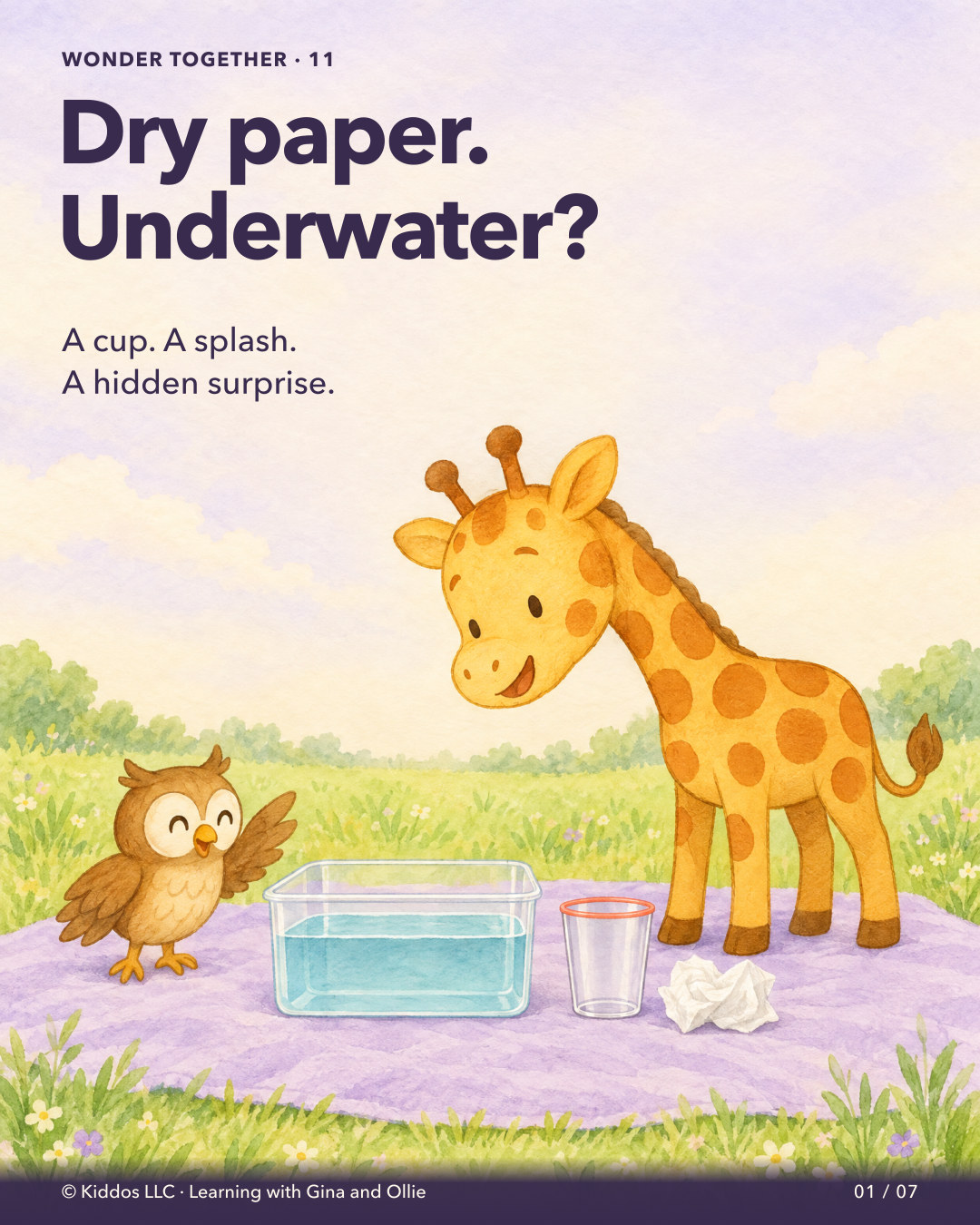
Page 1 · Dry paper. Underwater?
WONDER TOGETHER · 11 Dry paper. Underwater? A cup. A splash. A hidden surprise. © Kiddos LLC · Learning with Gina and Ollie 01 / 07
Picture description: Gina the yellow giraffe and her much smaller brown owl friend Ollie investigate a clear plastic cup, a white paper towel and a small clear tub of water on a lavender picnic mat. Nothing has been dunked yet.
Page 2 · Wet? Or dry?
GUESS BEFORE YOU SWIPE Wet? Or dry? Paper is tucked inside. The opening goes down first. What do you think will happen? © Kiddos LLC · Learning with Gina and Ollie 02 / 07
Picture description: The cup waits upside down beside the water tub. A crumpled white paper towel is wedged at its closed end, now at the top. Gina and Ollie pause before lowering it into the water. The result is not yet shown.
Page 3 · Still dry!
FIRST, STRAIGHT DOWN Still dry! Gina lowers the cup without tilting. Air keeps water from the paper. Lift it straight up to check. © Kiddos LLC · Learning with Gina and Ollie 03 / 07
Picture description: Gina holds the inverted cup straight down under water with one front hoof on its closed base. The paper stays high inside the cup above the small amount of water entering at its open rim. The rest of the cup contains trapped air. Ollie watches from outside the tub.
Page 4 · Hello, bubbles!
NOW, TRY A TILT Hello, bubbles! Gina tilts the cup underwater. Air bubbles out. Water moves in. What changed when the cup tilted? © Kiddos LLC · Learning with Gina and Ollie 04 / 07
Picture description: The same cup is now tilted sideways underwater. Air bubbles rise outside the open mouth as Gina tilts the cup and water enters. Gina holds the closed base and Ollie watches. The tub, paper, camera and setting match the straight-down test.
Page 5 · Air takes up space.
STRAIGHT TILTED AIR WATER PAPER BUBBLES OUT WATER IN THE PART TO REMEMBER Air takes up space. The cup was never empty. Invisible air was inside. Invisible does not mean empty. © Kiddos LLC · Learning with Gina and Ollie 05 / 07
Picture description: A side-view diagram compares the same inverted cup straight down and tilted in water. The first has a large air pocket below the dry paper. The tilted cup lets bubbles leave through its opening and water enter. Labels identify paper, air, water and escaping bubbles.
Page 6 · Catch some air.
1 Crumple dry paper. Wedge it firmly at a dry cup’s closed end. 2 Turn over. Down and up. Keep straight. Dry the rim. Check the paper. 3 Try again. Tilt underwater. Watch for bubbles. TRY IT TOGETHER Catch some air. With an adult: a clear plastic cup, paper towel and a small tub of water. Predict. Try. Tell what you noticed. Adult stays beside you. No glass. Wipe spills. Empty the tub afterward. © Kiddos LLC · Learning with Gina and Ollie 06 / 07
Picture description: Three apparatus diagrams show packing dry crumpled paper firmly at the closed end of a dry cup, turning the cup mouth down to lower and lift straight, drying the rim before checking the paper, then repeating with an underwater tilt to watch bubbles. Written instructions require an adult beside the activity, plastic materials, spill cleanup and emptying the tub afterward.
Page 7 · One mystery. Another adventure.
KEEP EXPLORING TOGETHER One mystery. Another adventure. Follow Gina’s next water question in Where Did My Water Go? Parents: read together in Kiddos Books. Kiddos Books · Read with confidence. © Kiddos LLC · Learning with Gina and Ollie 07 / 07
Picture description: Gina and Ollie share an open picture book on their dry lavender picnic mat after tidying the experiment away. Parents are invited to read Where Did My Water Go?, a separate story about the water cycle.
Where the explanation comes from.
Related storybooks invite further reading. The factual sources below support the investigation; illustration diagrams simplify what happens.