Five minutes together
Look. Wonder. Talk.
Our discovery: Describe one detail and identify a comfortable way of noticing it.
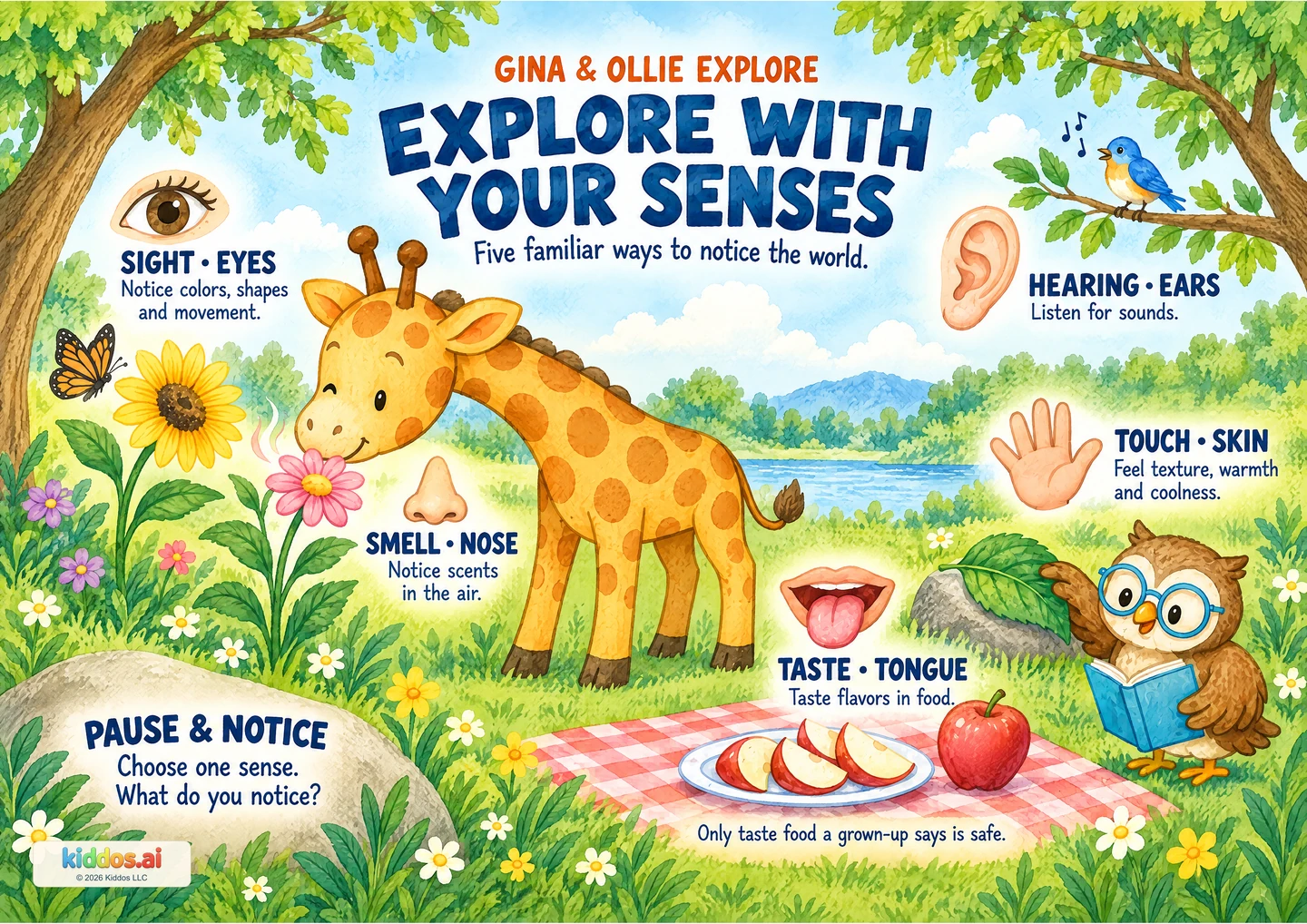
Use the poster as an invitation to notice, not a test of what a child can do. Read a label and connect it to the pictured example. Offer a description whenever a visual or sound detail is not accessible. Children can point, speak, sign or simply listen; skip any sensory experience they do not want.
Which pictured detail would you like to explore, or have me describe?
Start here
Choose one detail you can notice, or ask your adult to describe it.
Explore further
Describe the same object in two different ways. What information does each way give you?
Three questions to share
1Which sense helps us notice a sound?
Answer cue: Hearing.
2What part of our body helps us feel texture?
Answer cue: Our skin; touch is not limited to our hands.
3Which pictured detail would you like to explore or have described?
Answer cue: Any comfortable choice is welcome; there is no single right answer.
If your child is unsure: Let’s use one clue together. Choose one detail you can notice, or ask your adult to describe it.
Something to try together
A closer look at one familiar thing
You’ll need: The poster and an adult; optional paper and drawing materials. Describing or pointing is enough.
- Choose a familiar book, cup or toy. Looking or hearing a description is enough; tasting is not part of this activity.
- Name or point to one detail. Ask an adult to write your words or draw what you noticed.
- Return to the same object and add one different detail.
What this can show
A description such as smooth, round or blue is an observation. A preference such as my favorite is a different kind of statement.
Return to it: Which detail did you notice the second time that you missed the first time?
Get the guide and discovery recordFor teachers · About 20 minutes
A small lesson with room to explore.
Learning aim: Describe one detail and identify a comfortable way of noticing it.
Prepare: Read the poster, answer cues and misconception note. Prepare only the materials named in the activity; keep a picture-only or described option available.
- 3 min
Reconnect and wonder
How can we notice and describe something together? Invite an initial idea; record it without marking it right or wrong.
- 4 min
Look together
Choose one detail you can notice, or ask your adult to describe it. Introduce observe using the poster.
- 8 min
Investigate or represent
Use “A closer look at one familiar thing.” Let pairs take turns noticing and recording, with adult help and the activity’s stated boundaries.
- 5 min
Explain and return
Ask the core check: How can we notice and describe something together? Accept pointing, words, signing or a drawing. If the learner is ready, offer this optional extension: Describe the same object in two different ways. What information does each way give you?
Check the idea together
How can we notice and describe something together?
What to listen for
A child can describe a detail such as shape or texture and say, point to or have an adult describe how it was noticed. Different comfortable ways of participating are valid. A description such as smooth, round or blue is an observation. A preference such as my favorite is a different kind of statement.
Accept pointing, speech, signing, a drawing or adult dictation. Describe the illustration and use labels/position as well as color. Offer one contrast first, and use the extension when the learner is ready.