Five minutes together
Look. Wonder. Talk.
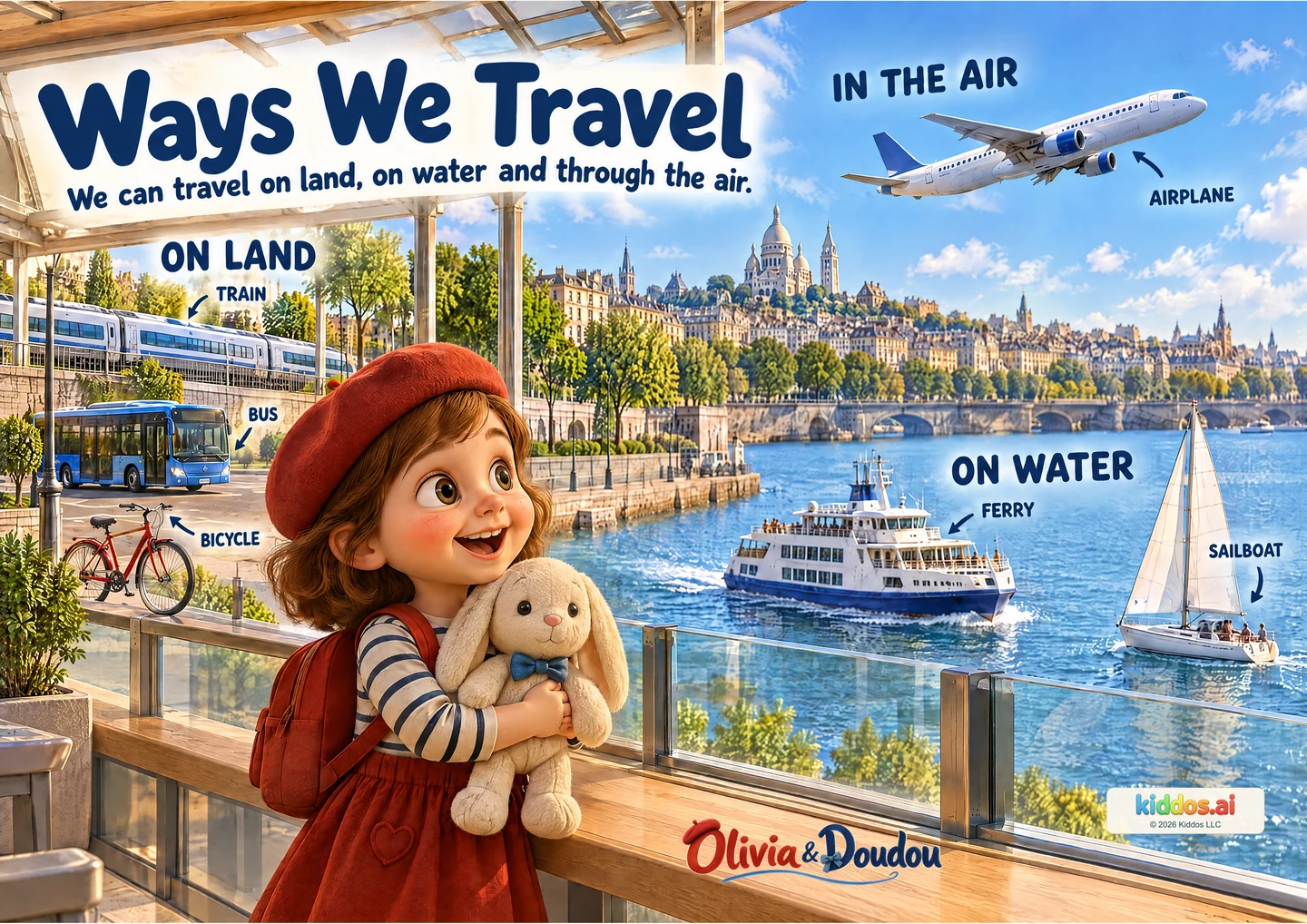
Our discovery: Sort six familiar vehicles by the environment in which they travel and explain a choice.
Choose one pictured vehicle and ask where it travels. Let the scene supply the answer.
Which vehicles travel on water?
Start here
Choose between two pictured vehicles.
Explore further
Describe a journey using two different transport environments.
Three questions to share
1Which vehicles travel on water?
Answer cue: The ferry and sailboat.
2Which three vehicles travel on land?
Answer cue: The train, bus and bicycle. Trains use rails; buses and bicycles use suitable land routes.
3What could carry people across this harbor without a bridge?
Answer cue: The ferry. A sailboat can also travel across water. Invite an explanation using the pictured water route.
If your child is unsure: Choose between two pictured vehicles.
Something to try together
Plan an imaginary two-part journey
You’ll need: Paper and a pencil or crayon, or use pointing and spoken descriptions.
- Draw a simple home-to-harbor route and water to an island; do not use a real address.
- Choose a land vehicle for the first part and a water vehicle for the crossing.
- Explain why a land vehicle alone cannot complete this water crossing when there is no bridge.
What this can show
Can the child sort a land vehicle and a water vehicle and explain a reasonable water crossing? Stay together and use the picture or an indoor drawing. No trip, purchase, cutting, water access or real address is needed.
Return to it: If your route crosses water without a bridge, which part needs a different way to travel?
Get the guide and discovery recordFor teachers · About 20 minutes
A small lesson with room to explore.
Learning aim: Sort six familiar vehicles by the environment in which they travel and explain a choice.
Prepare: Read the picture and answer cues. Have the optional explorer’s notebook available. Paper and a pencil or crayon, or use pointing and spoken descriptions.
- 3 min
Notice
Look together: Choose one pictured vehicle and ask where it travels. Let the scene supply the answer.
- 4 min
Compare
Discuss: read one question and invite children to point to the evidence.
- 8 min
Try together
Draw a simple home-to-harbor route and water to an island; do not use a real address. Choose a land vehicle for the first part and a water vehicle for the crossing. Explain why a land vehicle alone cannot complete this water crossing when there is no bridge.
- 5 min
Explain
Try and explain: Draw a simple home-to-harbor route and water to an island; do not use a real address. Choose a land vehicle for the first part and a water vehicle for the crossing. Explain why a land vehicle alone cannot complete this water crossing when there is no bridge.
Check the idea together
Can the child sort a land vehicle and a water vehicle and explain a reasonable water crossing?
What to listen for
The ferry and sailboat. The train, bus and bicycle. Trains use rails; buses and bicycles use suitable land routes. The ferry. A sailboat can also travel across water. Invite an explanation using the pictured water route.
Read labels aloud and describe shape and position. Accept speech, signing, pointing or eye gaze; do not rely only on color.