Five minutes together
Look. Wonder. Talk.
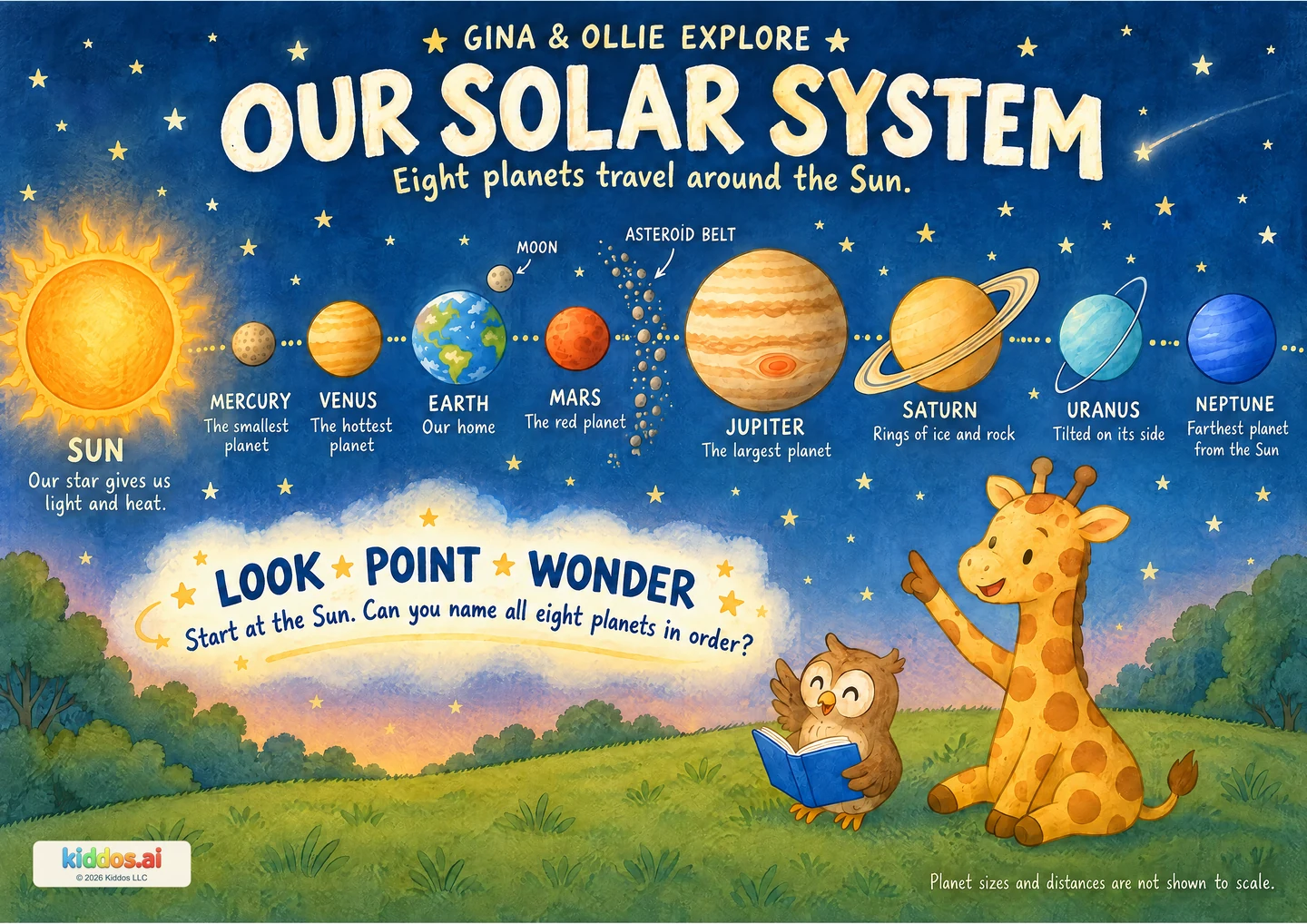
Our discovery: Use two labeled facts to compare planets while recognizing the diagram is not to scale.
Remember: The Moon travels around Earth and reflects sunlight. Where is Earth among the planets that travel around the Sun?
Revisit that discoveryFind the Sun first and explain that it is a star. Follow the planets in order, pausing wherever your child is curious. Compare two poster facts, such as the smallest and largest planet. Remind your child that the picture fits everything onto one page, so the sizes and gaps are not shown to scale.
Choose a planet that catches your eye. What would you like to find out about it?
Start here
Find Earth, then choose one other planet to name.
Explore further
Compare Mercury and Jupiter using their facts, then explain why measuring the drawing would not give their true sizes.
Three questions to share
1Which planet is our home?
Answer cue: Earth.
2Which planet is largest, and which is smallest?
Answer cue: Jupiter is largest; Mercury is smallest.
3What comes after Earth as we move away from the Sun?
Answer cue: Mars, then Jupiter, Saturn, Uranus and Neptune.
If your child is unsure: Let’s use one clue together. Find Earth, then choose one other planet to name.
Something to try together
Make a two-planet comparison
You’ll need: The poster and an adult; optional paper and drawing materials. Describing or pointing is enough.
- Choose two planets from the poster.
- An adult reads their labels. Draw, dictate or point to one fact for each.
- Explain a similarity or difference using those facts; distinguish our Sun and Moon from the eight planets.
What this can show
Accept a comparison grounded in the text, such as smallest and largest. Colors, drawn gaps and measured picture sizes are not a scale model.
Return to it: When you return, choose a different pair. What new question would you like an adult to help investigate?
Get the guide and discovery recordFor teachers · About 20 minutes
A small lesson with room to explore.
Learning aim: Use two labeled facts to compare planets while recognizing the diagram is not to scale.
Prepare: Read the poster, answer cues and misconception note. Prepare only the materials named in the activity; keep a picture-only or described option available.
- 3 min
Reconnect and wonder
How can we compare planets using reliable clues? Invite an initial idea; record it without marking it right or wrong.
- 4 min
Look together
Find Earth, then choose one other planet to name. Introduce planet using the poster.
- 8 min
Investigate or represent
Use “Make a two-planet comparison.” Let pairs take turns noticing and recording, with adult help and the activity’s stated boundaries.
- 5 min
Explain and return
Ask the core check: How can we compare planets using reliable clues? Accept pointing, words, signing or a drawing. If the learner is ready, offer this optional extension: Compare Mercury and Jupiter using their facts, then explain why measuring the drawing would not give their true sizes.
Check the idea together
How can we compare planets using reliable clues?
What to listen for
A child can compare two labeled facts, such as Mercury being the smallest planet and Jupiter the largest. The drawn sizes and gaps cannot be measured as their true sizes and distances. Accept a comparison grounded in the text, such as smallest and largest. Colors, drawn gaps and measured picture sizes are not a scale model.
Accept pointing, speech, signing, a drawing or adult dictation. Describe the illustration and use labels/position as well as color. Offer one contrast first, and use the extension when the learner is ready.