Five minutes together
Look. Wonder. Talk.
Our discovery: Describe the changing view of the Moon’s sunlit half without saying pieces disappear.
Remember: Earth’s turning explains day and night. Our next light question has a different explanation: why does the Moon’s bright shape seem to change?
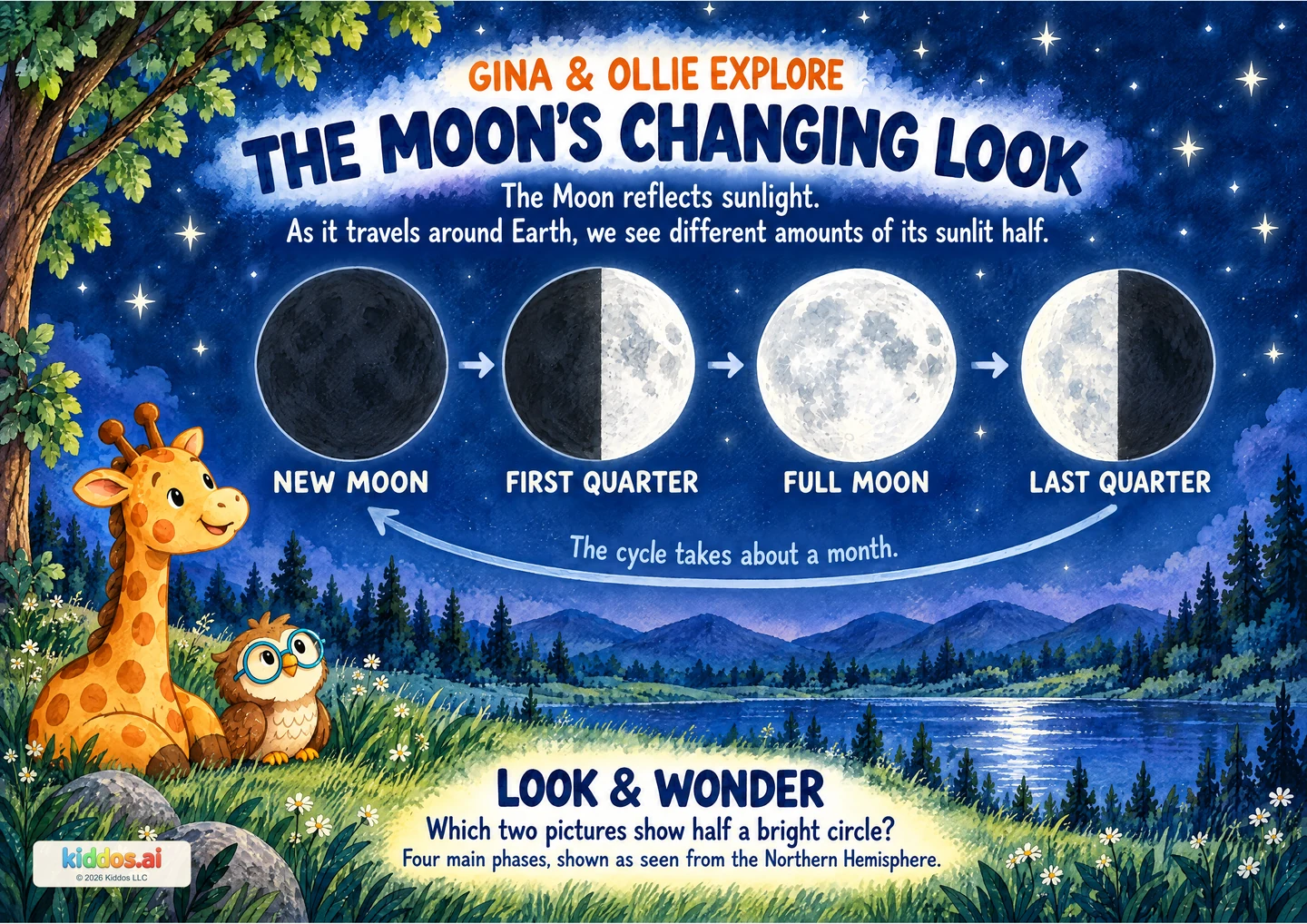
Revisit that discoveryCompare the four illustrated phases before introducing their names. Explain that the Moon reflects sunlight and that our view of its sunlit half changes as it orbits Earth. A quarter Moon looks like a half-lit circle in the sky. The poster shows a Northern Hemisphere view; the bright side can look different elsewhere.
Which Moon shape catches your eye? How would you describe it?
Start here
Find the full bright circle and a half-bright circle.
Explore further
Explain why the ordinary phase change is different from Earth casting a shadow on the Moon.
Three questions to share
1Which phase looks like a full bright circle?
Answer cue: The full Moon.
2Does the Moon make its own sunlight?
Answer cue: No. It reflects sunlight.
3Is part of the Moon disappearing during a phase?
Answer cue: No. We are seeing a different amount of its sunlit half.
If your child is unsure: Let’s use one clue together. Find the full bright circle and a half-bright circle.
Something to try together
Keep a Moon-looking record
You’ll need: The poster and an adult; optional paper and drawing materials. Describing or pointing is enough.
- With an adult, look for the Moon from a safe familiar place at a convenient time. Never look directly at the Sun.
- If it is visible, record the date, time and bright shape by drawing or dictation; if not, simply record not seen.
- Compare observations made on later days. Use the poster to discuss patterns without expecting a new visible shape every day.
What this can show
A missing sighting does not prove a new Moon; weather, buildings and timing affect visibility. The shown orientation is a Northern Hemisphere example.
Return to it: Compare two dated drawings. What changed in the bright part, and what remains uncertain?
Get the guide and discovery recordFor teachers · About 20 minutes
A small lesson with room to explore.
Learning aim: Describe the changing view of the Moon’s sunlit half without saying pieces disappear.
Prepare: Read the poster, answer cues and misconception note. Prepare only the materials named in the activity; keep a picture-only or described option available.
- 3 min
Reconnect and wonder
Why does the Moon seem to have different shapes? Invite an initial idea; record it without marking it right or wrong.
- 4 min
Look together
Find the full bright circle and a half-bright circle. Introduce phase using the poster.
- 8 min
Investigate or represent
Use “Keep a Moon-looking record.” Let pairs take turns noticing and recording, with adult help and the activity’s stated boundaries.
- 5 min
Explain and return
Ask the core check: Why does the Moon seem to have different shapes? Accept pointing, words, signing or a drawing. If the learner is ready, offer this optional extension: Explain why the ordinary phase change is different from Earth casting a shadow on the Moon.
Check the idea together
Why does the Moon seem to have different shapes?
What to listen for
The Moon reflects sunlight. As it travels around Earth, we see different amounts of its sunlit half; the Moon is not losing pieces. A missing sighting does not prove a new Moon; weather, buildings and timing affect visibility. The shown orientation is a Northern Hemisphere example.
Accept pointing, speech, signing, a drawing or adult dictation. Describe the illustration and use labels/position as well as color. Offer one contrast first, and use the extension when the learner is ready.