Five minutes together
Look. Wonder. Talk.
Our discovery: Compare route lengths to the same height and describe the ramp’s force-distance trade.
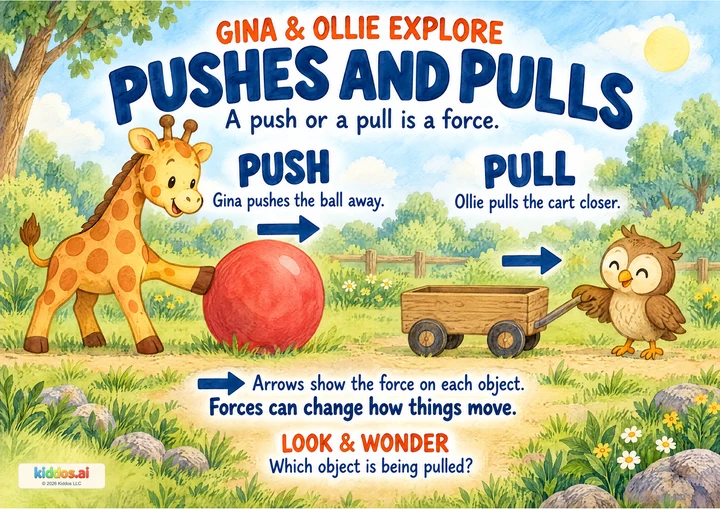
Remember: We described a push or pull as a force. What is Gina pushing, and how could a ramp help the load reach a higher place?
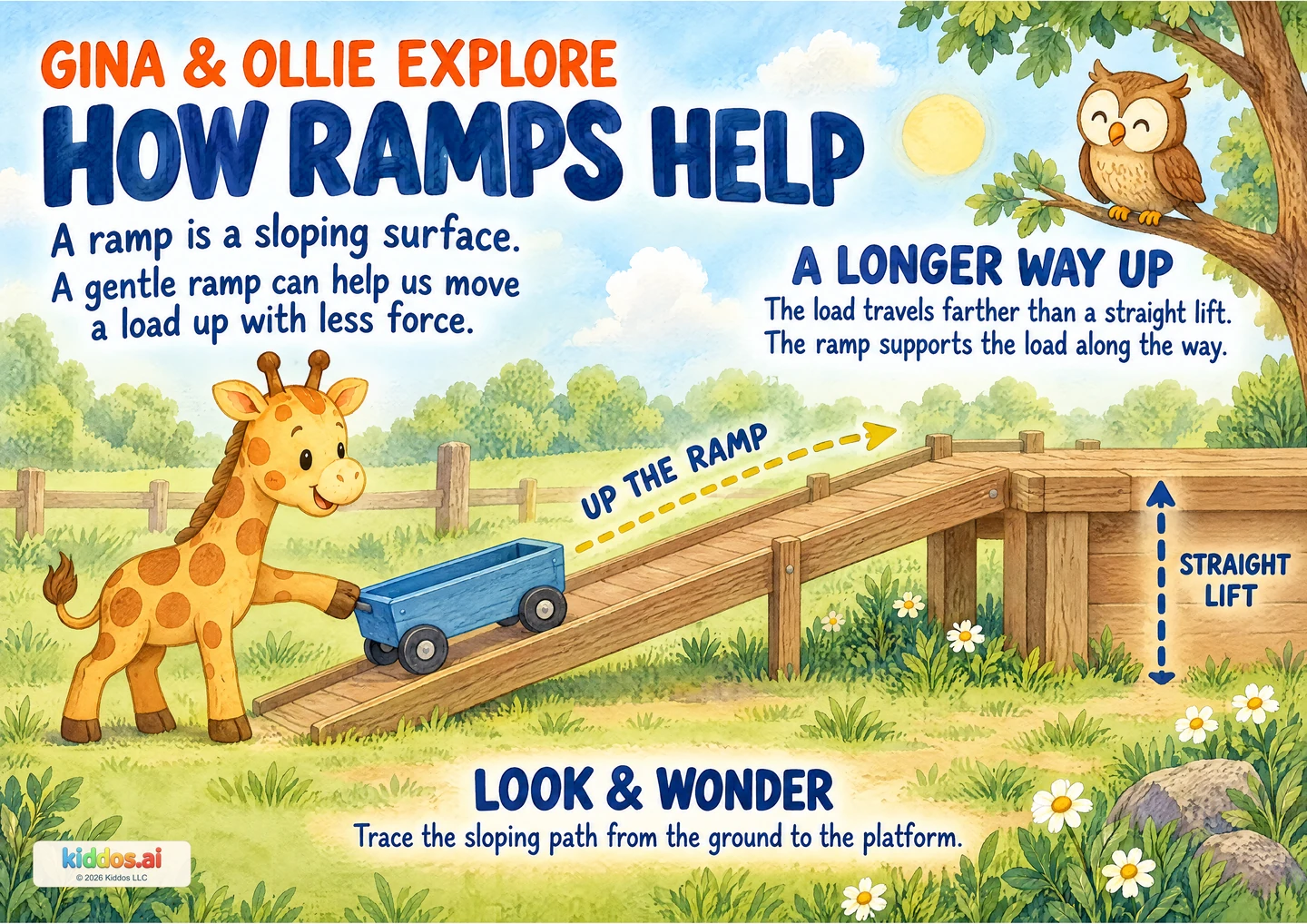
Revisit that discoveryBegin with Gina and the cart. Let your child notice where the ramp starts and ends before reading the labels. A ramp is a sloping surface. It supports a load as the load moves upward. Trace the ramp route and compare it with the straight-lift route to the same platform height. A gentle ramp can reduce the force needed, but the load travels farther. Invite a guess, then return to the picture together. There is no need to build a ramp or lift anything.
Gina wants the cart to reach the platform. What do you notice about the path?
Start here
Trace both routes to the platform.
Explore further
Explain which feature is visible in the picture and which claim about force comes from the explanation.
Three questions to share
1Where does the ramp start, and where does it lead?
Answer cue: It begins on the ground and slopes up to the low platform. Follow the cart’s route with a finger, words or a gesture.
2Which route to the platform is longer: up the slope or straight up?
Answer cue: The sloping route is longer. Both routes reach the same platform height.
3Why might a longer route be helpful?
Answer cue: A gentle ramp supports the load and can reduce how much force is needed to move it upward. The trade is moving it over a longer distance.
If your child is unsure: Let’s use one clue together. Trace both routes to the platform.
Something to try together
Compare two routes on paper
You’ll need: The poster and an adult; optional paper and drawing materials. Describing or pointing is enough.
- An adult draws a low platform, a straight route up and a sloping route to the same top.
- Trace or describe each route and compare their lengths.
- Explain how a ramp supports a load and can reduce the force needed. No lifting, riding or building a ramp is required.
What this can show
The drawing lets us compare routes. It does not measure force or prove less total work; friction and steepness matter.
Return to it: Find a ramp in a familiar picture or recall one you have seen. What two levels does it connect?
Get the guide and discovery recordFor teachers · About 20 minutes
A small lesson with room to explore.
Learning aim: Compare route lengths to the same height and describe the ramp’s force-distance trade.
Prepare: Read the poster, answer cues and misconception note. Prepare only the materials named in the activity; keep a picture-only or described option available.
- 3 min
Reconnect and wonder
Why might a longer route upward be useful? Invite an initial idea; record it without marking it right or wrong.
- 4 min
Look together
Trace both routes to the platform. Introduce ramp using the poster.
- 8 min
Investigate or represent
Use “Compare two routes on paper.” Let pairs take turns noticing and recording, with adult help and the activity’s stated boundaries.
- 5 min
Explain and return
Ask the core check: Why might a longer route upward be useful? Accept pointing, words, signing or a drawing. If the learner is ready, offer this optional extension: Explain which feature is visible in the picture and which claim about force comes from the explanation.
Check the idea together
Why might a longer route upward be useful?
What to listen for
A gentle ramp supports a load and can reduce the force needed to move it up, in exchange for moving it along a longer route to the same height. The drawing lets us compare routes. It does not measure force or prove less total work; friction and steepness matter.
Accept pointing, speech, signing, a drawing or adult dictation. Describe the illustration and use labels/position as well as color. Offer one contrast first, and use the extension when the learner is ready.