From story to discovery
Try it together.
Bare ramp. Or towel? Will the block slide on the bare ramp? What if we cover it with a towel?
Gather
Stiff smooth cardboard without sharp edges, a low stable book, a large lightweight flat-faced wooden block without detachable parts and a dry hand towel.
Adult setup — read before trying
An adult secures a low ramp on the floor with clear runout away from stairs, faces, feet and pets. No heavy objects, small balls, high stacks or climbing. Privately find a gentle bare-card setup that slides, then fix its height. Secure one flat towel layer so it cannot bunch or become a wall.
- Adult builds and steadies a low ramp on the floor.
- Predict; release one large block from the top without a push.
- Secure a flat towel; predict and release from the same place with the same block and ramp height. Compare.
- Keep the same
- Block, bottom face, starting place, ramp height and release without a push.
- What changes
- The surface pair: block on cardboard, then block on towel.
- Look for
- Notice whether the block slides, moves more slowly or stays put.
Make sense of what happened
Friction opposes sliding or the tendency to slide between touching surfaces. It can keep a block still even while gravity acts.
A bare ramp has friction too. Rougher does not always mean more friction for every material pair. If you change height, repeat both surface tests.
Full grown-up notes, setup details & honest limits
Choose a large, lightweight wooden block with flat faces and no detachable pieces, stiff smooth cardboard without sharp edges, a low stable book, a dry hand towel and adult-applied tape if needed. Build a short low ramp on the floor with a clear runout, away from stairs, pets, faces and feet. Do not use glass, heavy objects, small balls, high stacks or a ramp for children to climb. The adult secures and steadies the cardboard and book. Before inviting predictions, choose a gentle setup on which the block can slide down the bare surface when released; use a smooth card surface or a modest height adjustment, then keep this height fixed for the comparison. Mark or remember a starting place near the upper end. Use the same block, same bottom face, same release point and no push in both trials. First test bare cardboard. Then lay one layer of towel flat over the whole ramp and secure it so it cannot slide, bunch up or make a physical wall. Repeat with the same block, same orientation and starting place. Lift a holding finger or hand away rather than pushing; the child may release the block while the adult steadies the setup, or point/direct if preferred. Keep toes clear and watch from beside the path. In the illustrated example the bare ramp lets the block slide and the towel keeps it still. In real life the block may slide more slowly on the towel, stay put, or behave similarly on both. Report the actual observation. If revising the setup, repeat both tests at the new fixed height; do not compare different ramp angles and blame only the surface. Repeat each surface a few times, predict before testing, and ask “What changed? What stayed the same?” For a small group, draw where the block ended and collect several guesses without ranking children. Friction is a contact force opposing relative sliding or the tendency to slide. Here static friction can balance the downhill component of weight and keep the block at rest; if it slides, kinetic friction acts uphill. Gravity still acts on a block that remains still. Surface pairs, pressure and materials matter; do not teach that every rougher surface always has more friction, that the bare ramp has none, or that friction always prevents all movement. Page 5 isolates friction’s direction on this ramp, not a complete force diagram or a measured force scale; the supporting force and weight are omitted. Gina and the Great Gravity Hug is related reading about Earth’s pull; its shipping story does not contain this ramp experiment. No live family trial or measured learning outcome is claimed.
A conversation, not a quiz
Leave room for their idea.
Ask the child to choose where to release, then keep that place for both trials.
Bare ramp. Or towel? Will the block slide on the bare ramp? What if we cover it with a towel?
A cue for the grown-up
Welcome a guess before reading the result. No correct prediction is required.
What changed in the block’s journey?
A cue for the grown-up
In the story it slides on card and stays on the towel; actual results may vary.
Did gravity switch off when the block stayed still?
A cue for the grown-up
No. Other forces can balance its tendency to slide.
A simple way in
Watch from beside the path and direct the adult’s release.
Another thing to notice
Repeat each surface a few times before deciding what you noticed.
Come back to it
Notice another everyday situation where sliding is slowed by contact.
For teachers
A small-group discovery.
Flexible 20-minute small-group session; pause or shorten as needed.
Prepare the named materials and adult setup above. One adult-led demonstration is a useful option.
- 3 min
Wonder
Read pages 1–2. Invite a prediction with words, pointing or a sketch; keep the result hidden.
- 4 min
Notice the story
Read pages 3–5. What changed in the block’s journey? Separate the observation from the explanation.
- 9 min
Try together
Use the materials and adult setup on this guide, then follow the activity steps in this guide. Notice whether the block slides, moves more slowly or stays put.
- 4 min
Make meaning
Did gravity switch off when the block stayed still? Invite a drawing, a description or an adult-written note. Ask the child to choose where to release, then keep that place for both trials.
What to listen for
Did gravity switch off when the block stayed still?
Answer guidance
No. Other forces can balance its tendency to slide.
Ways to take part
Watch from beside the path and direct the adult’s release. Accept pointing, words, a drawing or adult-directed action. Use the story alone if the activity is unsuitable.
Record an observation with a drawing, a gesture described by an adult or a sentence. No timed performance or winning prediction is needed.
All the story words.
Read aloud, enlarge the browser text, or use this text alongside the pictures.
Page 1 · What slows the slide?
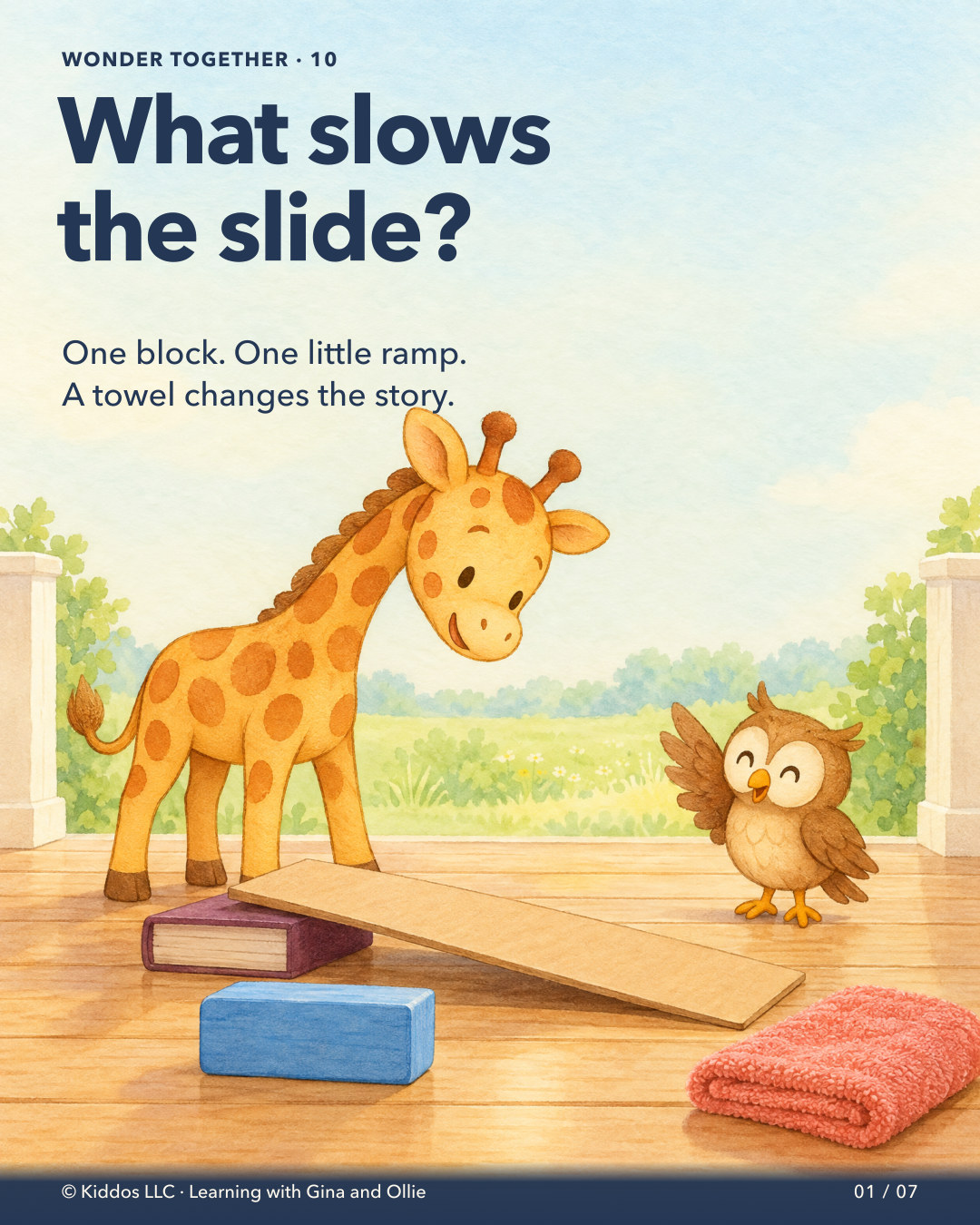
WONDER TOGETHER · 10 What slows the slide? One block. One little ramp. A towel changes the story. © Kiddos LLC · Learning with Gina and Ollie 01 / 07
Picture description: Gina the yellow giraffe and her small brown owl friend Ollie look at a blue wooden block, a low cardboard ramp propped on one thick book, and a folded coral towel on a shaded porch floor. The block waits beside the ramp; neither test result is shown.
Page 2 · Bare ramp. Or towel?
START HERE GUESS BEFORE YOU SWIPE Bare ramp. Or towel? Will the block slide on the bare ramp? What if we cover it with a towel? Share a guess before each test. © Kiddos LLC · Learning with Gina and Ollie 02 / 07
Picture description: The blue block waits beside the bare ramp before testing. A coral towel lies folded nearby. Gina is on the left and Ollie on the right, both clear of the ramp. The family predicts the result for each surface. An editable Start here label marks the upper release location.
Page 3 · Down it goes!
START HERE FIRST, THE BARE RAMP Down it goes! Gina lets go without a push. The block slides to the bottom. Remember where it started. © Kiddos LLC · Learning with Gina and Ollie 03 / 07
Picture description: After release from the top of the bare cardboard ramp, the same blue block has reached the floor at its lower end. Gina watches from the left and Ollie from the right. The ramp slopes down from left to right and is supported by the same book. An editable Start here label marks the upper release location.
Page 4 · This time, it stays.
START HERE NOW, ADD THE TOWEL This time, it stays. Same block. Same starting place. They add a towel and let go again. What changed? What stayed the same? © Kiddos LLC · Learning with Gina and Ollie 04 / 07
Picture description: The same ramp is covered by one coral towel laid flat along it. The same blue block stays at the upper starting place after release. Ramp height, book, camera and characters match the previous test; nobody holds the block. An editable Start here label marks the upper release location.
Page 5 · Friction resists sliding.
FRICTION Acts up this ramp Where block and towel touch THE PART TO REMEMBER Friction resists sliding. Where surfaces touch, friction can slow a slide—or stop it from starting. More grip. Less slip. © Kiddos LLC · Learning with Gina and Ollie 05 / 07
Picture description: An editable diagram shows a blue block resting on the coral-covered ramp. One arrow points up along the ramp and is labeled friction. It shows the direction in which friction resists this block’s downhill slide, not all forces acting on it.
Page 6 · Same ramp. New surface.
1 BUILD A LOW RAMP 2 RELEASE · NO PUSH 3 ADD A FLAT TOWEL TRY AGAIN Same height. Same block. Same start. TRY IT TOGETHER Same ramp. New surface. With an adult: stiff cardboard, a book, a large wooden block and a towel. What does your block do? Keep the ramp low, on the floor. Adult steadies it. Keep toes clear. © Kiddos LLC · Learning with Gina and Ollie 06 / 07
Picture description: Three illustrated steps show building a low bare ramp, releasing the same block without a push, then adding a flat towel and releasing from the same place. Keep the ramp low on the floor; an adult steadies it and everyone keeps toes out of the block’s path. Observe the actual result.
Page 7 · A little slide. A bigger question.
KEEP EXPLORING TOGETHER A little slide. A bigger question. Explore Earth’s pull in Gina and the Great Gravity Hug. Parents: read together in Kiddos Books. Kiddos Books · Read with confidence. © Kiddos LLC · Learning with Gina and Ollie 07 / 07
Picture description: Gina and Ollie settle beside an open blue picture book on the warm porch floor. Parents are invited to read Gina and the Great Gravity Hug together in Kiddos Books. This is related reading about Earth’s pull; the friction lesson is complete.
Where the explanation comes from.
Related storybooks invite further reading. The factual sources below support the investigation; illustration diagrams simplify what happens.