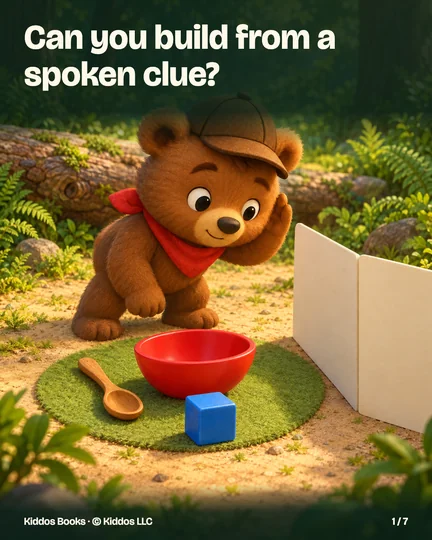
From story to discovery
Try it together.
How can we make the two models match?
Gather
Two matching sets of three large blocks; Cloth.
Adult setup — read before trying
Provide two identical sets of three large age-appropriate blocks on a stable reachable surface and an opaque cloth. Leave room between model and copy. Begin with a row and use one shared viewing side.
- Grown-up makes a simple arrangement with one set of three large blocks. Keep the second matching set separate.
- Look together from the same side. Child may point to the order or describe the shapes.
- Cover the model with an opaque cloth. Child uses the second set to build a copy; peeking is welcome.
- Uncover both arrangements and compare from the same direction.
- Move any blocks needed to make them match. In Benny’s example, one end block moves to the other end.
- Swap: child makes a model, grown-up copies, and both check it.
- Keep the same
- Both sets contain one red cube, one yellow triangular prism and one blue cylinder. The first model stays red, yellow, blue from the shared viewing side.
- What changes
- The model is covered and uncovered. Benny first copies yellow, blue, red, then moves the red cube from the right end to the left. Page 7 deliberately begins a new model.
- Look for
- The model is red cube, yellow triangular prism, blue cylinder. The copy starts yellow triangular prism, blue cylinder, red cube. Moving the red cube from the right end to the left makes the rows match.
Make sense of what happened
The model is red cube, yellow triangular prism, blue cylinder. The copy starts yellow triangular prism, blue cylinder, red cube. Moving the red cube from the right end to the left makes the rows match.
Covering is optional and peeking is welcome. This is a build-and-check game, not an unaided memory test. Compare from the same side; a different viewpoint can reverse how an order appears. The one-block move solves Benny’s pictured copy, not every possible copy.
Full grown-up notes, setup details & honest limits
Build a simple model and look together from one side before covering it. Offer another look whenever wanted. After uncovering, ask what differs and let the child move a block or direct your hands. Swap maker and copier.
Covering is optional and peeking is welcome. This is a build-and-check game, not an unaided memory test. Compare from the same side; a different viewpoint can reverse how an order appears. The one-block move solves Benny’s pictured copy, not every possible copy.
These are authored shared-play examples. Suggested ages and times are starting points, not an assessment or evidence of measured learning outcomes.
A conversation, not a quiz
Leave room for their idea.
Build a simple model and look together from one side before covering it. Offer another look whenever wanted. After uncovering, ask what differs and let the child move a block or direct your hands. Swap maker and copier.
What order do you see in Benny’s first model?
A cue for the grown-up
From the shared viewing side: red cube, yellow triangular prism, blue cylinder. Shapes or pointing work as well as color names.
Which part of the first copy is in a different place?
A cue for the grown-up
The red cube is at the right end. The yellow and blue blocks come before it.
What move makes the two rows match?
A cue for the grown-up
Move the red cube from the right end to the left, then compare both rows again from the same side.
A simple way in
Leave the model uncovered and use two blocks first. The child can direct the grown-up’s hands.
Another thing to notice
Let the child make a new two- or three-block model for the grown-up. A low stable stack is optional; check shape and position together from the same side.
Come back to it
Use the same blocks in a fresh simple arrangement. Ask whether keeping the model visible or taking another look helps today.
For teachers
A small-group discovery.
Flexible 15-minute small-group sequence; prepare materials first, and shorten or pause as needed.
Prepare the named materials and adult setup above. One adult-led demonstration is a useful option.
- 2 min
Meet the matching sets
Pair the matching blocks and choose one side from which to view both arrangements.
- 3 min
Watch a copy change
Read pages 1–5 and pause to compare the uncovered rows. Read page 6 after children suggest or show a possible move.
- 7 min
Build, cover and check
Adult models once. Pairs take maker and copier roles, leave the model visible or peek as needed, uncover both, revise and swap.
- 3 min
Describe a helpful check
Ask children to show how they checked the two arrangements rather than how much they remembered.
What to listen for
The child can compare a part of the model with the copy and move a block or direct an adult to make the chosen arrangement match.
Answer guidance
The model is red cube, yellow triangular prism, blue cylinder. The copy starts yellow triangular prism, blue cylinder, red cube. Moving the red cube from the right end to the left makes the rows match.
Ways to take part
Accept pointing, showing, home-language words or directing an adult. Keep the materials within comfortable reach; no spoken answer is required. Leave the model uncovered and use two blocks first. The child can direct the grown-up’s hands.
Record an observation with a drawing, a gesture described by an adult or a sentence. No timed performance or winning prediction is needed.
All the story words.
Read aloud, enlarge the browser text, or use this text alongside the pictures.
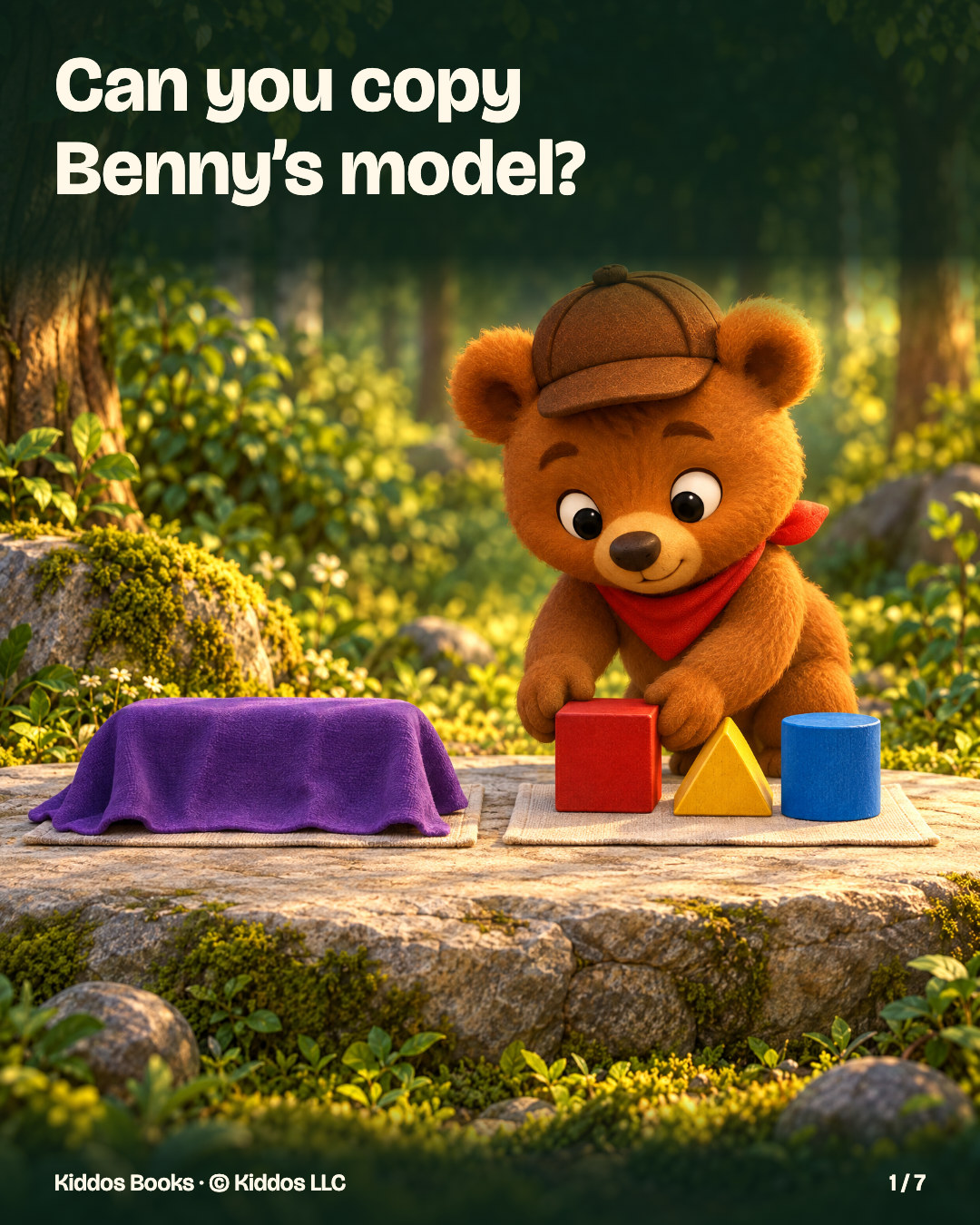
Page 1 · Can you copy Benny’s model?
Can you copy Benny’s model? Kiddos Books · © Kiddos LLC 1 / 7
Picture description: Page 1 of 7. Can you copy Benny’s model? Benny stands beside two mats on a woodland stone. A purple cloth covers the far set; red, yellow and blue blocks are visible on the near mat.
Page 2 · Grown-up, build. Child, look closely.
Grown-up, build. Child, look closely. Kiddos Books · © Kiddos LLC 2 / 7
Picture description: Page 2 of 7. Grown-up, build. Child, look closely. Benny gestures toward the uncovered far model: a red cube, yellow triangle and blue cylinder. The matching three pieces are loose on the near mat; the purple cloth rests aside.
Page 3 · Cover the model. Child, build a copy.
Cover the model. Child, build a copy. Kiddos Books · © Kiddos LLC 3 / 7
Picture description: Page 3 of 7. Cover the model. Child, build a copy. Benny lowers the purple cloth over the far model. The near set remains loose, with its blue cylinder on its side.
Page 4 · Place your three blocks.
Place your three blocks. Kiddos Books · © Kiddos LLC 4 / 7
Picture description: Page 4 of 7. Place your three blocks. With the far model covered, Benny places a red cube to the right of a yellow triangle and blue cylinder on the near mat.
Page 5 · Uncover. Do they match?
Uncover. Do they match? Kiddos Books · © Kiddos LLC 5 / 7
Picture description: Page 5 of 7. Uncover. Do they match? Benny lifts the cloth, revealing red cube, yellow triangle, blue cylinder on the far mat. His near row is yellow triangle, blue cylinder, red cube.
Page 6 · Move one block. Check again.
Move one block. Check again. Kiddos Books · © Kiddos LLC 6 / 7
Picture description: Page 6 of 7. Move one block. Check again. Benny moves the red cube to the left of his near row. Both uncovered rows now read red cube, yellow triangle, blue cylinder. The cloth lies beside the mats.
Page 7 · Now make a model for your grown-up.
Now make a model for your grown-up. Kiddos Books · © Kiddos LLC 7 / 7
Picture description: Page 7 of 7. Now make a model for your grown-up. From above, Benny makes a new model by stacking the blue cylinder on the red cube, with the yellow triangle beside them. The second set remains on the far mat.
Where the explanation comes from.
Related storybooks invite further reading. The factual sources below support the investigation; illustration diagrams simplify what happens.