From story to discovery
Try it together.
Which picture lines and torn edges fit together?
Gather
One sheet of ordinary paper; A thick crayon; A flat clear place to play.
Adult setup — read before trying
Grown-up draws one large simple acorn across a sheet, shows it, then tears it into three large pieces. Child mixes and turns the pieces.
- Together, draw and look at one large simple picture.
- Grown-up tears the sheet into three large pieces; child mixes them.
- Child turns and slides pieces, looking for picture lines and torn edges that meet.
- Put all three together and check the whole picture. Looking at the original drawing before tearing is allowed.
- Swap: child draws and directs the tearing; grown-up solves.
- Keep the same
- The three large pieces all come from one acorn drawing. Every piece is used once.
- What changes
- Turn and slide the paper pieces until both the drawing and torn edges meet. Make a new fish drawing for the next turn.
- Look for
- The three pieces form the same acorn picture when the brown cap line and body join, and the torn edges meet. A piece can need turning before it fits.
Make sense of what happened
The three pieces form the same acorn picture when the brown cap line and body join, and the torn edges meet. A piece can need turning before it fits.
Color alone may not identify a fit. Check the continuing picture lines and torn edges together. Looking at the original drawing and asking for help are welcome.
Full grown-up notes, setup details & honest limits
Ask “Which lines could meet?” and let the child turn a piece. Offer to hold a piece steady rather than placing it for them.
Color alone may not identify a fit. Check the continuing picture lines and torn edges together. Looking at the original drawing and asking for help are welcome.
These are authored shared-play examples. Suggested ages and times are starting points, not an assessment or evidence of measured learning outcomes.
A conversation, not a quiz
Leave room for their idea.
Ask “Which lines could meet?” and let the child turn a piece. Offer to hold a piece steady rather than placing it for them.
What helped these two pieces meet?
A cue for the grown-up
Accept a matching torn edge, the cap line, a color or a part of the drawing; ask the child to point.
What could you try when a piece does not fit?
A cue for the grown-up
Turn it or try a different neighbor. Looking again or asking for help is welcome.
How can we check that we made one whole picture?
A cue for the grown-up
The picture lines continue across the joins and all three pieces are used; there is no gap in the sheet.
A simple way in
Use two large pieces and keep the picture upright. The child can point while an adult moves the pieces.
Another thing to notice
Make a new three-piece puzzle with a different picture. Try one piece turned sideways; do not add tiny pieces.
Come back to it
Another day, draw a new simple picture and take turns making a puzzle.
For teachers
A small-group discovery.
Flexible 15-minute small-group sequence; prepare materials first and shorten or pause as needed.
Prepare the named materials and adult setup above. One adult-led demonstration is a useful option.
- 3 min
Meet the picture
Show one large drawing and let children name or point to a useful line. An adult tears it into three large pieces.
- 4 min
Try the fit
Invite a child to turn and slide the pieces while a partner points to a line or edge that could meet. Use two pieces if helpful.
- 5 min
Check and swap
Check all the joins together. Children draw a new simple picture and direct an adult to tear it; the adult solves with their clues.
- 3 min
Show a helpful clue
Invite each pair to point to one joined line or torn edge. A child may direct an adult without moving the pieces.
What to listen for
Ask the child to show one line or edge that helped them join two pieces.
Answer guidance
The three pieces form the same acorn picture when the brown cap line and body join, and the torn edges meet. A piece can need turning before it fits.
Ways to take part
Accept pointing, gestures, home-language words or directing an adult. Use two large pieces and keep the picture upright. The child can point while an adult moves the pieces.
Record an observation with a drawing, a gesture described by an adult or a sentence. No timed performance or winning prediction is needed.
All the story words.
Read aloud, enlarge the browser text, or use this text alongside the pictures.
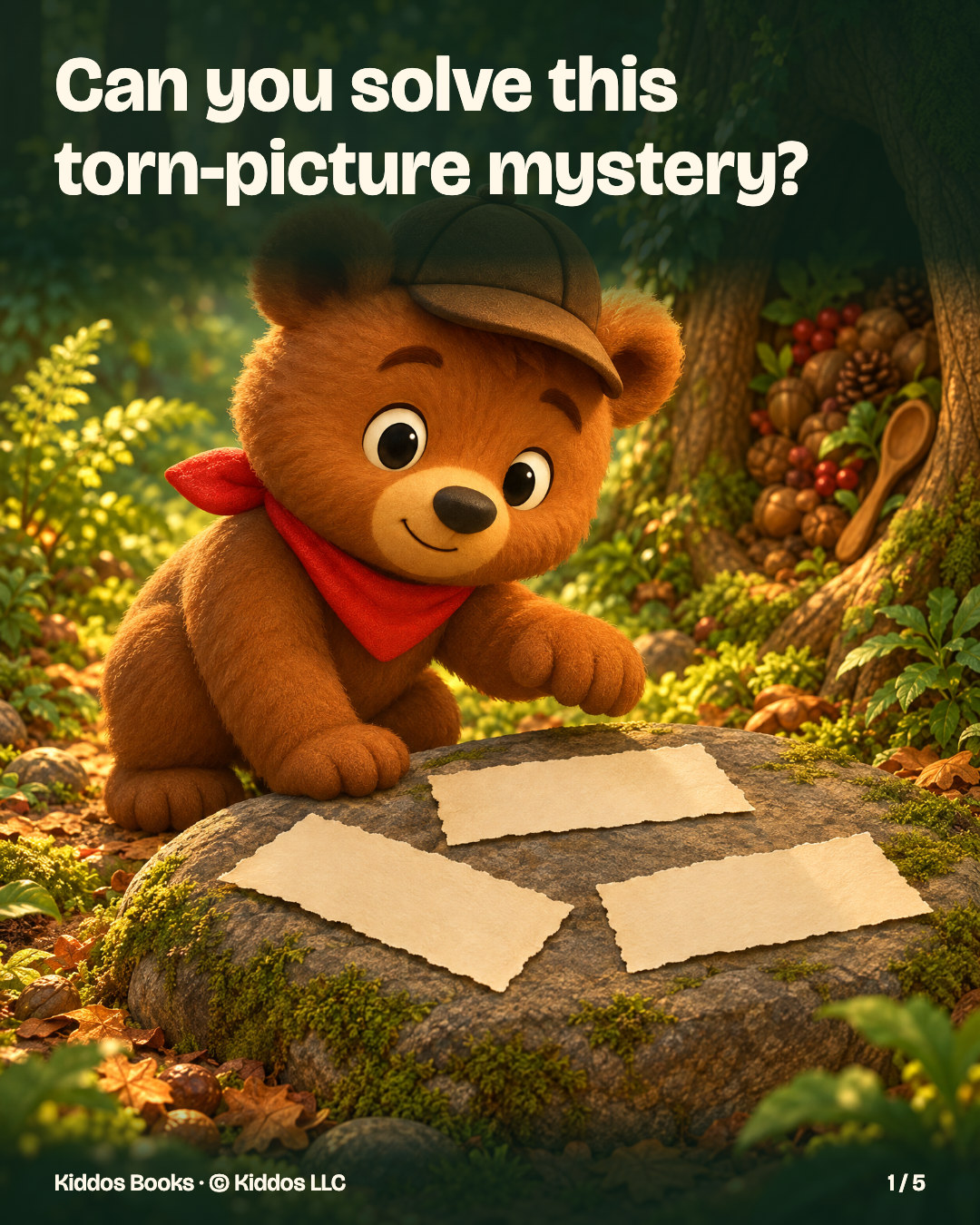
Page 1 · Can you solve this torn-picture mystery?
Can you solve this torn-picture mystery? Kiddos Books · © Kiddos LLC 1 / 5
Picture description: Page 1 of 5. Can you solve this torn-picture mystery? Benny crouches beside three large torn paper strips, all with their blank backs facing up on the low stone. He raises one paw above them and looks invitingly toward the viewer.
Page 2 · Grown-up, draw a picture. Tear three big pieces.
Grown-up, draw a picture. Tear three big pieces. Kiddos Books · © Kiddos LLC 2 / 5
Picture description: Page 2 of 5. Grown-up, draw a picture. Tear three big pieces. Benny holds an intact cream sheet showing one large crayon acorn with a brown body, darker cap and green stem. A thick brown crayon rests in his other paw.
Page 3 · Which edges meet? Slide them together.
Which edges meet? Slide them together. Kiddos Books · © Kiddos LLC 3 / 5
Picture description: Page 3 of 5. Which edges meet? Slide them together. Benny crouches beside the low stone and nudges the lowest paper band toward the two already joined bands. A narrow gap remains above the acorn tip; the drawing and torn edges show where it belongs.
Page 4 · One whole picture. You found the fit!
One whole picture. You found the fit! Kiddos Books · © Kiddos LLC 4 / 5
Picture description: Page 4 of 5. One whole picture. You found the fit! All three paper bands now lie joined flat on the stone, making the original complete acorn. Two fine horizontal torn seams cross the picture. Benny rests his paws outside the paper and looks pleased.
Page 5 · Now draw a puzzle for your grown-up.
Now draw a puzzle for your grown-up. Kiddos Books · © Kiddos LLC 5 / 5
Picture description: Page 5 of 5. Now draw a puzzle for your grown-up. Benny draws a large blue fish on a fresh sheet with a thick blue crayon. The completed three-piece acorn puzzle rests on the stone behind him, ready while he makes the next puzzle.
Where the explanation comes from.
Related storybooks invite further reading. The factual sources below support the investigation; illustration diagrams simplify what happens.