From story to discovery
Try it together.
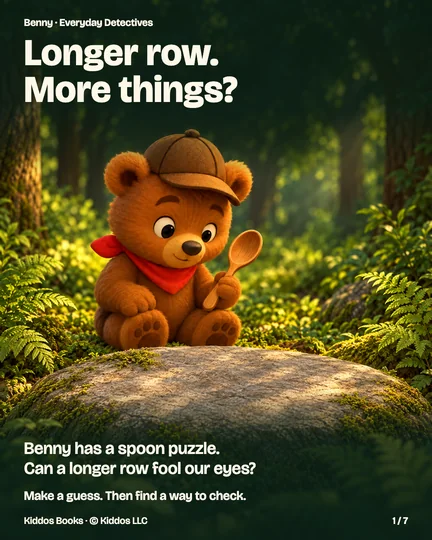
Which end goes farther?
Gather
Two large straight paper strips, one clearly longer than the other. An adult prepares them before the game. A flat stable surface.
Adult setup — read before trying
Adult prepares two wide strips of different lengths, such as about 25 cm and 18 cm. Put cutting tools away. Adult selects large safe materials and a stable reachable surface. An adult prepares the paper and puts cutting tools away. No glass, sharp objects, small loose parts, blindfolds or climbing. Pointing, showing and directing an adult are welcome; no speed test or required spoken response.
- Adult prepares two wide strips of different lengths, such as about 25 cm and 18 cm. Put cutting tools away.
- Lay them straight and parallel. Shift the shorter strip so its far end reaches beyond the longer strip’s end.
- Invite a first idea, then ask whether the strips start at the same place.
- Slide one strip until the near ends line up. Keep both flat and straight; do not stretch, fold or trim them.
- Compare the other ends. The farther end belongs to the longer strip.
- Swap roles arranging and checking. Try another pair, including equal lengths if wanted.
- Keep the same
- length, width and color of both strips; flat surface; camera and light.
- What changes
- Only the yellow strip’s horizontal position.
- Look for
- The blue strip is longer. The yellow strip initially reaches farther right only because it starts farther right. When their left ends line up, the blue strip extends farther.
Make sense of what happened
Line up one end of two straight paper strips to compare their lengths. The blue strip is longer. The yellow strip initially reaches farther right only because it starts farther right. When their left ends line up, the blue strip extends farther.
Compare straight, flat strips from one aligned end. Moving a strip changes its position, not its length. The pictures are not a ruler or a calibrated scale.
Full grown-up notes, setup details & honest limits
Welcome the first guess. Ask what would make the comparison easier to check.
Compare straight, flat strips from one aligned end. Moving a strip changes its position, not its length. The pictures are not a ruler or a calibrated scale.
These are shared activities inspired by Benny’s story world. Suggested ages and times are editorial starting points; they are not standardized assessments or measured learning outcomes.
A conversation, not a quiz
Leave room for their idea.
Welcome the first guess. Ask what would make the comparison easier to check.
Why did the yellow strip reach farther at first?
A cue for the grown-up
It started farther along the surface.
What stayed the same when we slid it?
A cue for the grown-up
Both strips kept their lengths.
How can we compare more clearly?
A cue for the grown-up
Line up one end and look at the other ends.
A simple way in
Start with the ends already aligned and a very clear length difference. Let the child point to the farther end.
Another thing to notice
Try two equal strips with offset starts. Align the ends and discover that neither is longer.
Come back to it
Return to the game another day with one adult-approved change. Ask which clue or checking method helped this time.
For teachers
A small-group discovery.
Flexible 15-minute small-group sequence; prepare materials first, and shorten or pause as needed.
Prepare the named materials and adult setup above. One adult-led demonstration is a useful option.
- 2 min
Notice
Introduce the question and invite a first idea.
- 4 min
Read and compare
Read the clues and pause before the reveal; compare together.
- 6 min
Try together
Model the household game, then let pairs take turns with adult-selected objects.
- 3 min
Show your thinking
Show aligned starting ends before identifying the longer strip; distinguish moving a strip from changing its length. Accept pointing, showing or directing an adult; an informal observation, not a score.
What to listen for
Show aligned starting ends before identifying the longer strip; distinguish moving a strip from changing its length.
Answer guidance
The blue strip is longer. The yellow strip initially reaches farther right only because it starts farther right. When their left ends line up, the blue strip extends farther.
Ways to take part
Accept pointing, showing, words in a home language or directing an adult. Start with the ends already aligned and a very clear length difference. Let the child point to the farther end.
Record an observation with a drawing, a gesture described by an adult or a sentence. No timed performance or winning prediction is needed.
All the story words.
Read aloud, enlarge the browser text, or use this text alongside the pictures.
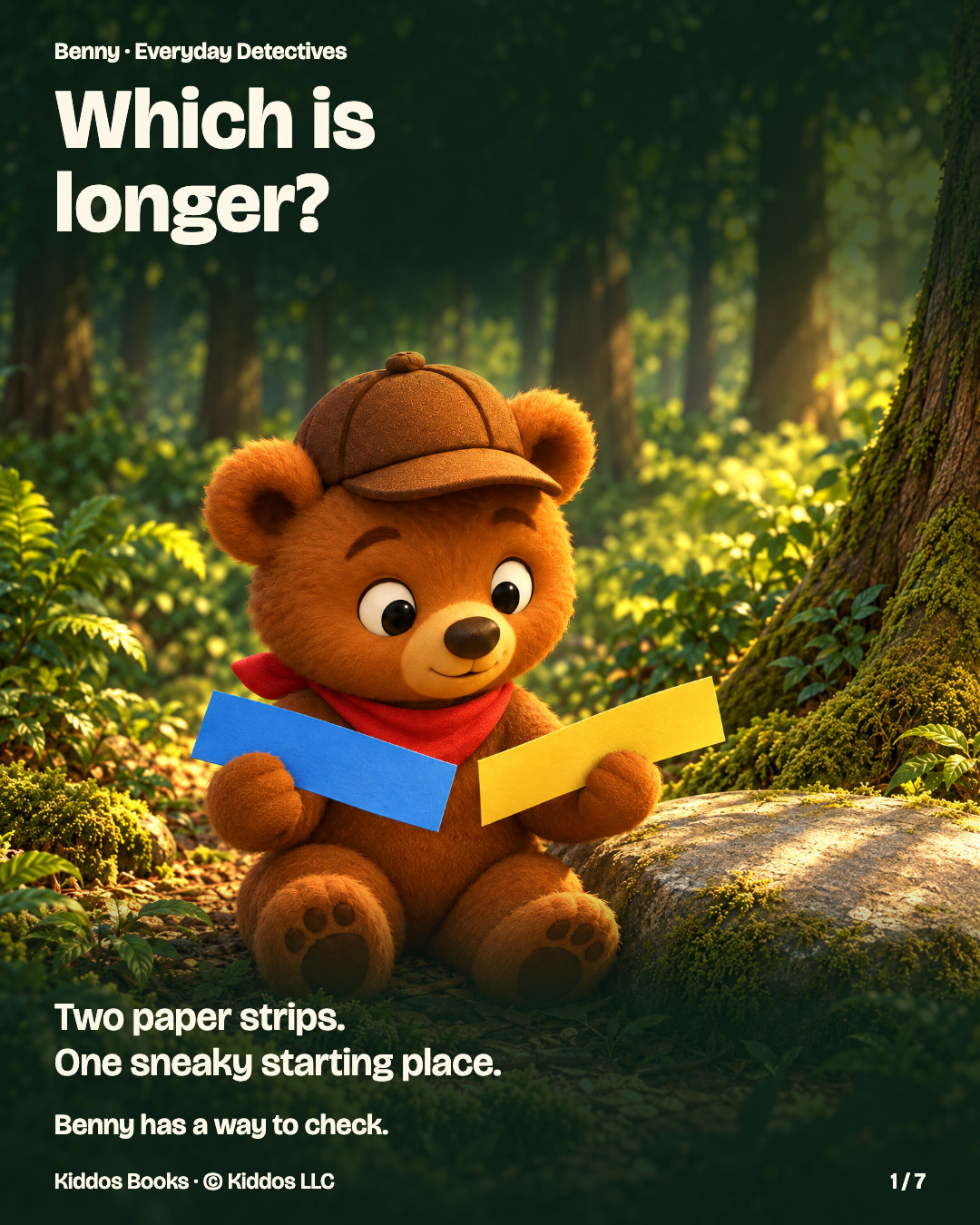
Page 1 · Which is longer?
Benny · Everyday Detectives Which is longer? Two paper strips. One sneaky starting place. Benny has a way to check. Kiddos Books · © Kiddos LLC 1 / 7
Picture description: Page 1 of 7. Benny, a small brown bear in a brown cap and red neckerchief, holds a blue paper strip and a yellow paper strip beside a mossy stone in a sunlit forest. Text: Which is longer? Two paper strips. One sneaky starting place. Benny has a way to check.
Page 2 · Which end goes farther?
01 / TAKE A LOOK Which end goes farther? The yellow end reaches farther. Does that make its strip longer? Notice where each strip starts. Kiddos Books · © Kiddos LLC 2 / 7
Picture description: Page 2 of 7. Two straight strips lie on the stone. The blue strip starts farther left; the yellow strip starts farther right and its far end reaches beyond the blue end. Benny watches. Text: Which end goes farther? The yellow end reaches farther. Does that make its strip longer? Notice where each strip starts.
Page 3 · Line up one end.
02 / MAKE IT FAIR Line up one end. Slide the yellow strip to the left. Keep both strips straight and flat. Do not cut, fold, or stretch them. Kiddos Books · © Kiddos LLC 3 / 7
Picture description: Page 3 of 7. The same strips now have aligned starting ends. The blue strip extends farther than the yellow strip. Benny sits behind the stone with paws on his knees. Text: Line up one end. Slide the yellow strip to the left. Keep both strips straight and flat. Do not cut, fold, or stretch them.
Page 4 · Blue reaches farther now.
03 / CHECK THE RESULT Blue reaches farther now. The blue strip is longer. Sliding did not change either length. We changed the starting place. Kiddos Books · © Kiddos LLC 4 / 7
Picture description: Page 4 of 7. The aligned strips remain unchanged, with the blue strip visibly longer. This page reads the result of the comparison. Text: Blue reaches farther now. The blue strip is longer. Sliding did not change either length. We changed the starting place.
Page 5 · Same start. Then compare.
BEFORE ALIGNED 04 / REMEMBER Same start. Then compare. Line up one end of each strip. Look at the other two ends. Moving is not making it longer. Kiddos Books · © Kiddos LLC 5 / 7
Picture description: Page 5 of 7. Two exact detail views compare the offset strips, labeled Before, with their aligned starts, labeled Aligned. Both strips keep their original lengths. Text: Same start. Then compare. Line up one end of each strip. Look at the other two ends. Moving is not making it longer.
Page 6 · Try two strips at home.
05 / TRY IT TOGETHER Try two strips at home. Adult: prepare two wide paper strips. Make one longer than the other. Child, line up one end of each. Compare the other ends together. Adult prepares the strips. Keep them flat. Kiddos Books · © Kiddos LLC 6 / 7
Picture description: Page 6 of 7. Benny sits beside two straight, flat strips with aligned starts on the stone. The blue strip is longer. All ends remain visible. Text: Try two strips at home. Adult: prepare two wide paper strips. Make one longer than the other. Child, line up one end of each. Compare the other ends together. Adult prepares the strips. Keep them flat.
Page 7 · You arrange. We compare.
06 / YOUR TURN TO LEAD You arrange. We compare. Child, change the starting places. Grown-up, line up the ends. Swap roles and check again. Same start. Compare the other ends. Kiddos Books · © Kiddos LLC 7 / 7
Picture description: Page 7 of 7. Benny holds the two paper strips again beside the stone as the child is invited to arrange a new comparison. Text: You arrange. We compare. Child, change the starting places. Grown-up, line up the ends. Swap roles and check again. Same start. Compare the other ends.
Where the explanation comes from.
Related storybooks invite further reading. The factual sources below support the investigation; illustration diagrams simplify what happens.