From story to discovery
Try it together.
Can you make the same relationships from spoken clues?
Gather
Two empty plastic bowls; Two large wooden spoons; Two large blocks; An opaque freestanding book or folded card as a low screen.
Adult setup — read before trying
Give each player the same three objects: bowl, spoon and block. Use an upright low book or card between the players to hide the grown-up’s model while the child builds. Both sides face their own identical arrangement; directions use in and beside, never ambiguous left/right.
- Grown-up and child each take a bowl, spoon and block. Place a low stable screen between the two play spaces.
- Grown-up secretly puts the spoon in the bowl and the block beside it.
- Grown-up says “Put your spoon in the bowl.” Child can ask for the clue again.
- Grown-up says “Put the block beside the bowl.” Either side is accepted; no left/right match is required.
- Remove the screen and check the two relationships: spoon in bowl, block beside bowl. Adjust together if helpful.
- Swap roles: child arranges their objects and gives two simple position clues to the adult.
- Keep the same
- Each player has a matching empty plastic bowl, large spoon and large block. In the first model, the spoon is in the bowl and the block beside it.
- What changes
- Benny follows one spoken clue at a time, then lifts the screen to compare. For the new turn, he puts the block in the bowl and spoon beside it.
- Look for
- A match here means the same two relationships: spoon IN the bowl and block BESIDE the bowl. The block may be on either side, and the spoon angle may differ. Comparing checks whether the clues were clear, not who performed better.
Make sense of what happened
A match here means the same two relationships: spoon IN the bowl and block BESIDE the bowl. The block may be on either side, and the spoon angle may differ. Comparing checks whether the clues were clear, not who performed better.
Beside accepts either side: the two blocks can be on opposite sides of their bowls. Match the stated relationships, not every angle or left/right position. The camera sometimes shows the model while Benny’s view is screened.
Full grown-up notes, setup details & honest limits
Give one short clue at a time, welcome questions and check shared understanding. Accept either side for beside.
Beside accepts either side: the two blocks can be on opposite sides of their bowls. Match the stated relationships, not every angle or left/right position. The camera sometimes shows the model while Benny’s view is screened.
These are authored shared-play examples. Suggested ages and times are starting points, not an assessment or evidence of measured learning outcomes.
A conversation, not a quiz
Leave room for their idea.
Give one short clue at a time, welcome questions and check shared understanding. Accept either side for beside.
What did the word in ask us to do?
A cue for the grown-up
Put the spoon inside the empty bowl; point to where it rests.
Can the block be beside the bowl on either side?
A cue for the grown-up
Yes. Beside means next to; neither left nor right was specified.
What could we do if our arrangements do not match?
A cue for the grown-up
Ask for the clue again, explain or point, then adjust together. A mismatch can show that a clue needed clarification.
A simple way in
Use two objects and one clue with the model visible. Point or gesture, or ask an adult to place an object.
Another thing to notice
Swap roles and change the arrangement, such as putting the block in the bowl with the spoon beside it. Keep objects large enough to handle safely.
Come back to it
Another day, try a new familiar pair of objects and one clear position clue.
For teachers
A small-group discovery.
Flexible 15-minute small-group sequence; prepare materials first and shorten or pause as needed.
Prepare the named materials and adult setup above. One adult-led demonstration is a useful option.
- 3 min
Share the matching objects
Give each player a bowl, spoon and block. Place a low stable screen between the play spaces; show in and beside with a visible practice model if useful.
- 4 min
Give one clue at a time
Hide the model. Say spoon in the bowl, then block beside the bowl, allowing a repeat, pointing or a question after each clue.
- 5 min
Reveal, compare and swap
Lift the screen and check the two relationships. Accept either side for beside. Help the child build a new model and give the adult clear clues.
- 3 min
Show the relationships
Ask which object is in the bowl and which is beside it. Discuss a mismatch as a reason to clarify a clue, without comparing children.
What to listen for
Ask the child to show what is in the bowl and what is beside it.
Answer guidance
A match here means the same two relationships: spoon IN the bowl and block BESIDE the bowl. The block may be on either side, and the spoon angle may differ. Comparing checks whether the clues were clear, not who performed better.
Ways to take part
Accept pointing, gestures, home-language words or directing an adult. Use two objects and one clue with the model visible. Point or gesture, or ask an adult to place an object.
Record an observation with a drawing, a gesture described by an adult or a sentence. No timed performance or winning prediction is needed.
All the story words.
Read aloud, enlarge the browser text, or use this text alongside the pictures.
Page 1 · Can you build from a spoken clue?
Can you build from a spoken clue? Kiddos Books · © Kiddos LLC 1 / 7
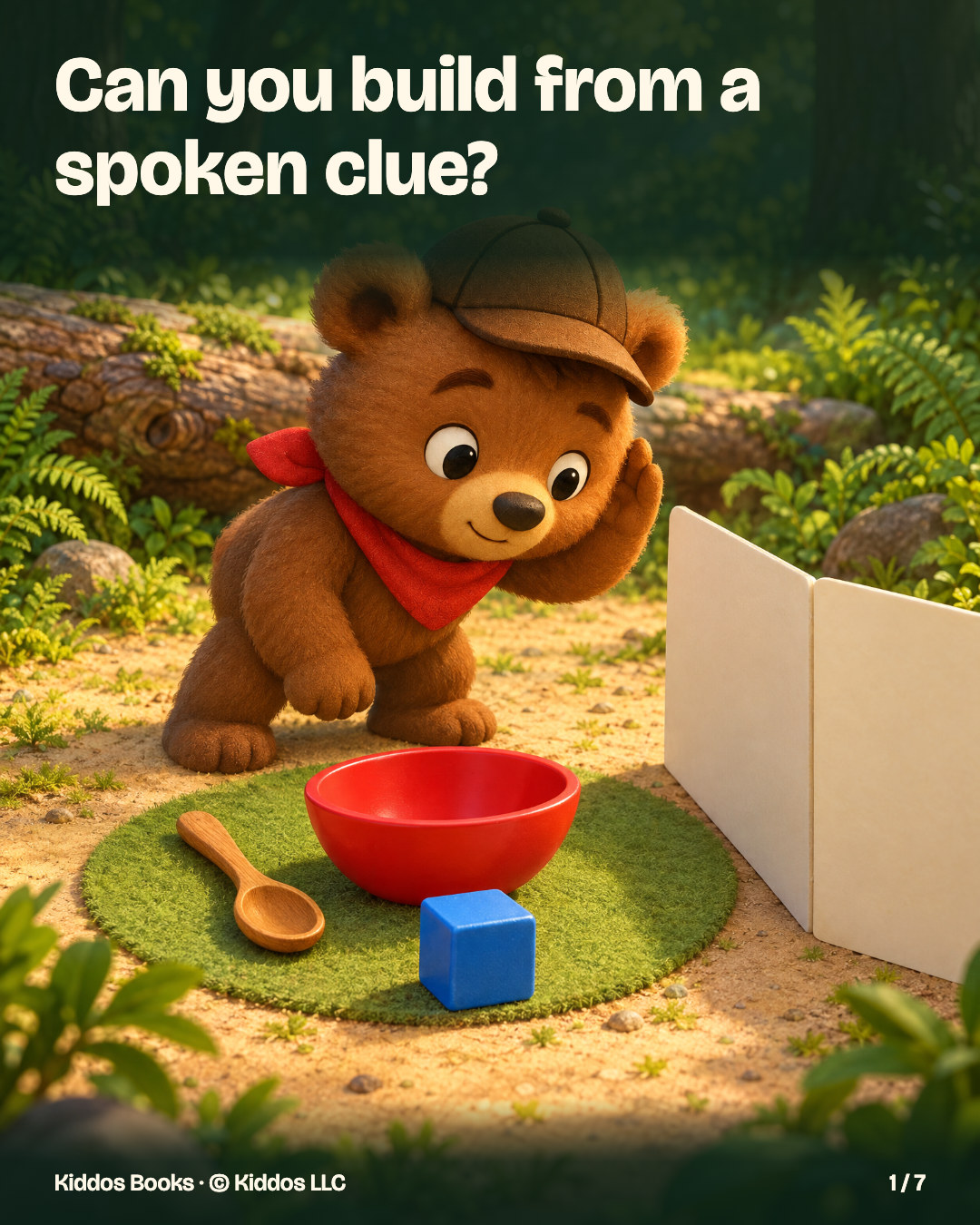
Picture description: Page 1 of 7. Can you build from a spoken clue? Benny leans toward a freestanding cream card screen with one paw beside his ear. An empty red bowl, wooden spoon and blue cube lie separately on his green mat. The other side is out of view.
Page 2 · Grown-up, hide your model. Child, take matching things.
Grown-up, hide your model. Child, take matching things. Kiddos Books · © Kiddos LLC 2 / 7
Picture description: Page 2 of 7. Grown-up, hide your model. Child, take matching things. Two matching sets sit on opposite sides of the cream screen. The far set has its spoon in the red bowl and blue cube beside it. Benny’s near set is still loose: spoon left, empty bowl centered, cube in front.
Page 3 · First clue: put the spoon in the bowl.
First clue: put the spoon in the bowl. Kiddos Books · © Kiddos LLC 3 / 7
Picture description: Page 3 of 7. First clue: put the spoon in the bowl. Benny lowers the wooden spoon into his red bowl while steadying its rim. The blue cube stays in front of the bowl. From our higher side view we can also see the model on the far mat, separated from Benny by the screen.
Page 4 · Next clue: put the block beside the bowl.
Next clue: put the block beside the bowl. Kiddos Books · © Kiddos LLC 4 / 7
Picture description: Page 4 of 7. Next clue: put the block beside the bowl. Benny places his blue cube beside the red bowl, on its right. The wooden spoon is already in the bowl. Across the screen, the model has the same two relationships, with its cube on the other side of its bowl.
Page 5 · Ready? Lift the screen and check.
Ready? Lift the screen and check. Kiddos Books · © Kiddos LLC 5 / 7
Picture description: Page 5 of 7. Ready? Lift the screen and check. Benny lifts the cream screen slightly with both paws. The near mat has a spoon in its red bowl and the blue cube beside it. The other arrangement is still concealed behind the screen.
Page 6 · In the bowl. Beside the bowl. Both match!
In the bowl. Beside the bowl. Both match! Kiddos Books · © Kiddos LLC 6 / 7
Picture description: Page 6 of 7. In the bowl. Beside the bowl. Both match! Benny points to the spoon in his bowl. Both sets are now open to view, with the cream screen flat on the ground to one side. Each bowl contains a wooden spoon, and each blue cube sits beside its bowl, on opposite sides.
Page 7 · Your turn to give the clues.
Your turn to give the clues. Kiddos Books · © Kiddos LLC 7 / 7
Picture description: Page 7 of 7. Your turn to give the clues. Benny presents a new arrangement: a blue cube inside the red bowl and a wooden spoon beside it. He opens one paw invitingly toward the viewer. Across the cream screen, the second set is still loose.
Where the explanation comes from.
Related storybooks invite further reading. The factual sources below support the investigation; illustration diagrams simplify what happens.