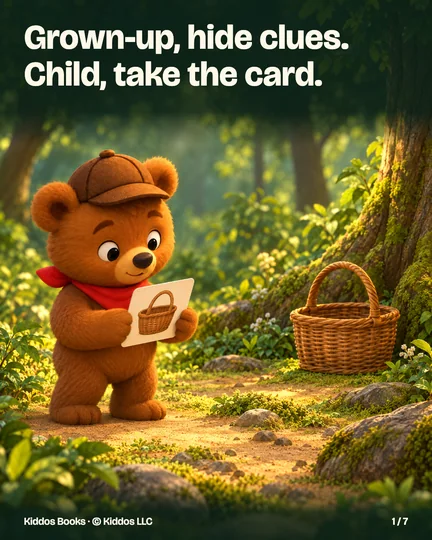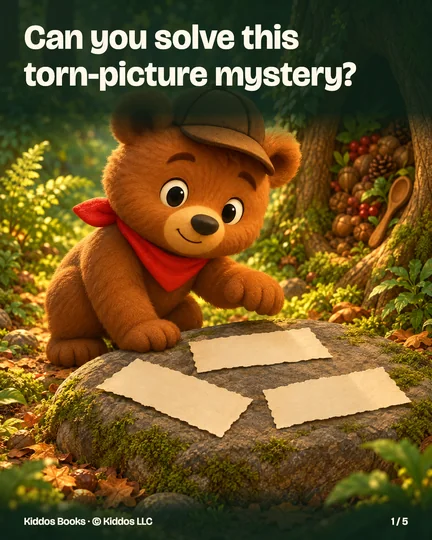
From story to discovery
Try it together.
Which whole object matches this tiny detail?
Gather
One close-up object picture; Three safe familiar objects.
Adult setup — read before trying
Prepare an object-only close-up photo for local viewing or draw a clear pattern. Place its whole object among two or three large safe choices. Check that only one choice matches; keep all choices reachable. Nothing needs to be uploaded.
- Grown-up makes a close-up picture of one distinctive part of a familiar object. Take an object-only photo for local viewing, or draw the pattern.
- Put the object among two or three reachable choices. Make sure only one matches the pictured detail.
- Child looks at the clue, then searches for its whole object.
- Compare the detail with each possible match. Ask “What is the same?” rather than naming the answer.
- Place the clue beside the object and check the shape or pattern.
- Swap: child chooses a detail for the grown-up to find.
- Keep the same
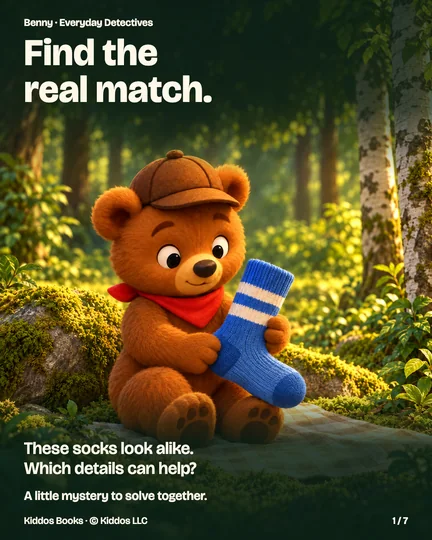
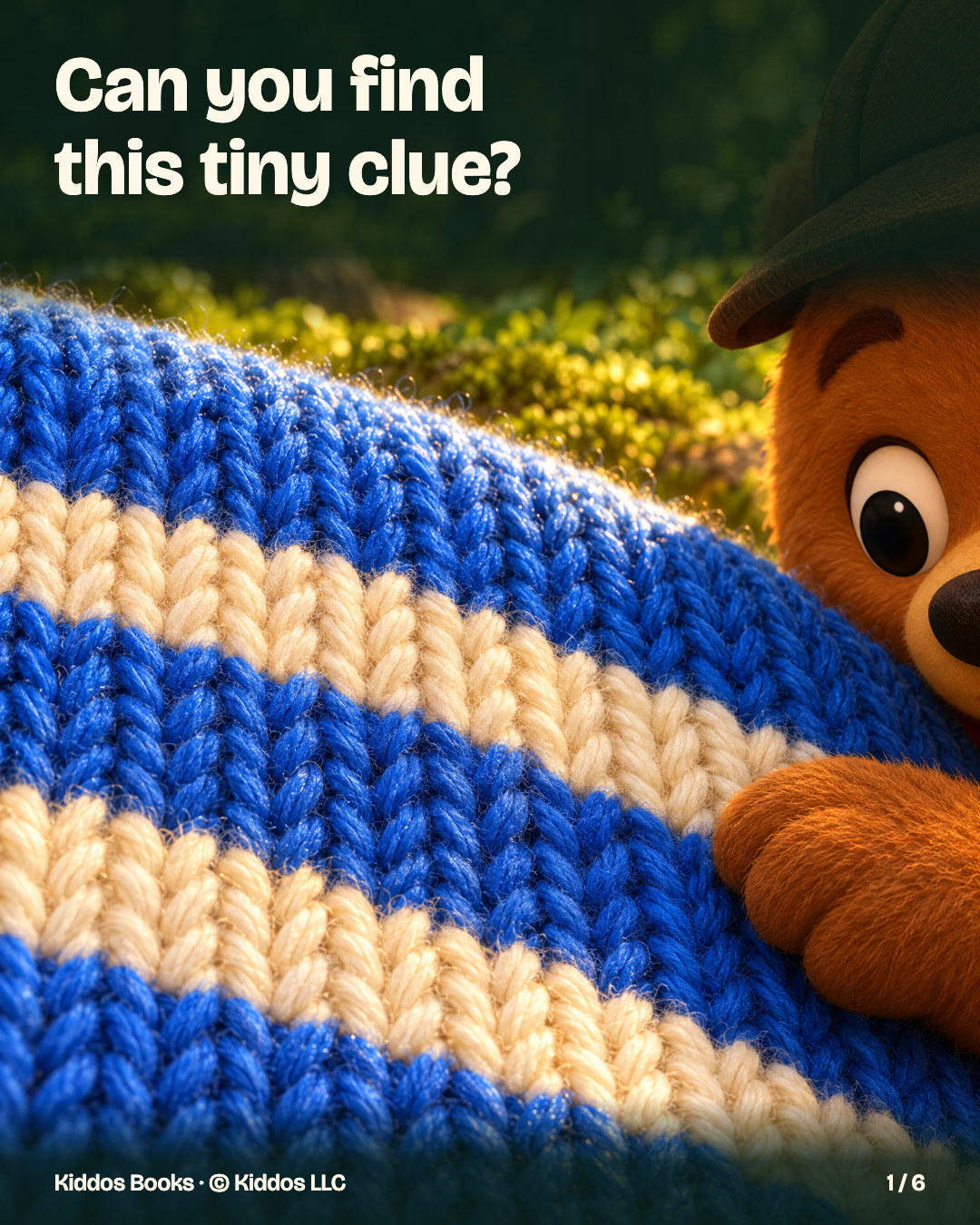
- The clue shows two broad cream stripes on blue knit. The sock, plain blue cup and yellow napkin keep their own patterns during this round.
- What changes
- Benny compares different possible objects, then brings the sock and clue together. The last page begins a new round with the striped yellow napkin.
- Look for
- The pictured clue matches the sock’s two broad cream stripes on blue knit. The blue cup has no stripes; the yellow napkin has three thin green stripes. Color alone does not settle the match.
Make sense of what happened
The pictured clue matches the sock’s two broad cream stripes on blue knit. The blue cup has no stripes; the yellow napkin has three thin green stripes. Color alone does not settle the match.
A close-up must show a distinctive detail, and exactly one of the choices should fit it. If two real objects match, both are reasonable answers: change the choices or add a detail. The six-page story demonstrates comparison, not a timed visual test.
Full grown-up notes, setup details & honest limits
Make a close-up picture of one familiar object and put the real object among two or three reachable choices. Ask what is the same rather than naming the answer. Let the child choose a detail for your turn.
A close-up must show a distinctive detail, and exactly one of the choices should fit it. If two real objects match, both are reasonable answers: change the choices or add a detail. The six-page story demonstrates comparison, not a timed visual test.
These are authored shared-play examples. Suggested ages and times are starting points, not an assessment or evidence of measured learning outcomes.
A conversation, not a quiz
Leave room for their idea.
Make a close-up picture of one familiar object and put the real object among two or three reachable choices. Ask what is the same rather than naming the answer. Let the child choose a detail for your turn.
The cup is blue. Does that make it a match?
A cue for the grown-up
No. The clue also has two cream stripes and knitted texture; the plain blue cup does not.
What matches when Benny puts the card beside the sock?
A cue for the grown-up
Two broad cream stripes on blue knitted fabric. Point to the same pattern on both.
What could make a useful clue for the next turn?
A cue for the grown-up
The three thin green stripes on the yellow napkin, or a similarly distinctive detail on a safe familiar object. Check that only one choice fits.
A simple way in
Offer two objects beside the clue first. The child can point to the matching pattern; no search is required.
Another thing to notice
Let the child choose a safe object and point to the detail the grown-up should draw or photograph. Check the possible choices together before the grown-up searches.
Come back to it
Return with one new object and a different distinctive detail. Keep the clue next to the objects if comparison is more useful than searching.
For teachers
A small-group discovery.
Flexible 15-minute small-group sequence; prepare materials first, and shorten or pause as needed.
Prepare the named materials and adult setup above. One adult-led demonstration is a useful option.
- 2 min
Meet a small clue
Show a close-up and invite children to point to its color, marks or texture without naming the whole object yet.
- 3 min
Compare, then check
Read the six-page story. Pause at page 2 to compare the plain cup with the striped clue, then inspect the card and sock together on page 5.
- 7 min
Find a whole-object match
Use prepared picture clues and two or three real choices. In pairs, point to a match and place clue beside object to check. Swap chooser and finder with adult help.
- 3 min
Show the matching detail
Invite each child to show one feature shared by clue and object. If two choices fit, acknowledge both and refine the clue together.
What to listen for
The child can show a shared pattern, shape or texture between clue and object, with the picture kept alongside it.
Answer guidance
The pictured clue matches the sock’s two broad cream stripes on blue knit. The blue cup has no stripes; the yellow napkin has three thin green stripes. Color alone does not settle the match.
Ways to take part
Accept pointing, showing, home-language words or directing an adult. Keep the materials within comfortable reach; no spoken answer is required. Offer two objects beside the clue first. The child can point to the matching pattern; no search is required.
Record an observation with a drawing, a gesture described by an adult or a sentence. No timed performance or winning prediction is needed.
All the story words.
Read aloud, enlarge the browser text, or use this text alongside the pictures.
Page 1 · Can you find this tiny clue?
Can you find this tiny clue? Kiddos Books · © Kiddos LLC 1 / 6
Picture description: Page 1 of 6. Can you find this tiny clue? An extreme close-up shows blue knitted fabric crossed by two cream stripes. Only part of Benny’s curious eye, cap and paw appears at the edge; the whole object is not shown.
Page 2 · Same blue. Same stripes?
Same blue. Same stripes? Kiddos Books · © Kiddos LLC 2 / 6
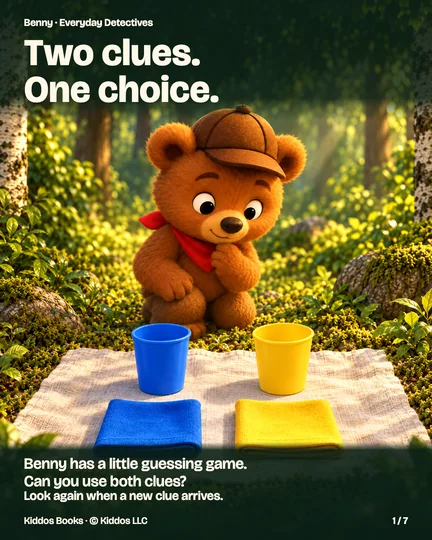
Picture description: Page 2 of 6. Same blue. Same stripes? Benny compares the blue knitted picture clue with a plain blue cup, which has no stripes. The striped sock and yellow napkin rest in the basket below.
Page 3 · Look through your choices.
Look through your choices. Kiddos Books · © Kiddos LLC 3 / 6
Picture description: Page 3 of 6. Look through your choices. Benny looks through a basket, holding his picture clue and reaching toward the blue sock among the blue cup and yellow napkin.
Page 4 · Look closer at this one.
Look closer at this one. Kiddos Books · © Kiddos LLC 4 / 6
Picture description: Page 4 of 6. Look closer at this one. Benny lifts the whole blue sock from the basket and looks between it and his separate clue card. Both show two cream stripes.
Page 5 · A match! Show your clue.
A match! Show your clue. Kiddos Books · © Kiddos LLC 5 / 6
Picture description: Page 5 of 6. A match! Show your clue. In a tight close-up, Benny places the picture card beside the sock cuff. The two cream stripes on blue knit match.
Page 6 · Your turn to choose a tiny clue.
Your turn to choose a tiny clue. Kiddos Books · © Kiddos LLC 6 / 6
Picture description: Page 6 of 6. Your turn to choose a tiny clue. Benny selects a yellow napkin with three green stripes for the next clue. The blue sock is set aside, and he holds a blank card ready for a new picture.
Where the explanation comes from.
Related storybooks invite further reading. The factual sources below support the investigation; illustration diagrams simplify what happens.