Five minutes together
Look. Wonder. Talk.
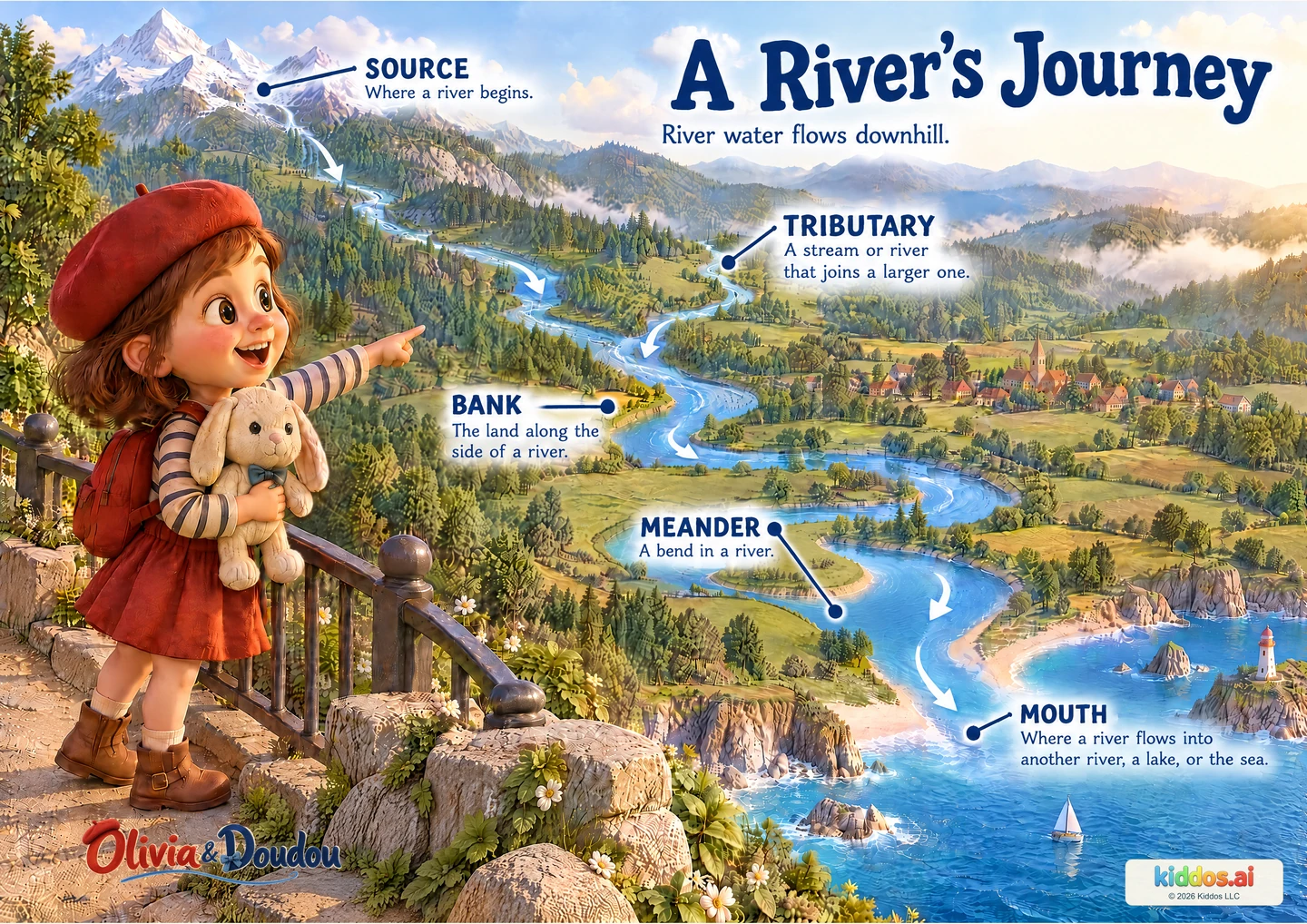
Our discovery: Trace downstream flow and distinguish source, tributary, bank, meander and mouth.
Begin where the river starts. Move a finger or your gaze slowly along the water, letting your child choose where to pause.
Which way does the water go? What helps you tell?
Start here
Use 'begins,' 'joins' and 'bend' before introducing the formal words.
Explore further
Ask where a river mouth could be besides the sea, and why downhill does not mean south.
Three questions to share
1Which way does the water go? What helps you tell?
Answer cue: It travels downhill from the source toward the mouth. Follow the downstream arrows and the descending landscape.
2What happens where the smaller stream meets the river?
Answer cue: The tributary joins the main river. Their water continues downstream together.
3Can you find a bend and the land beside the water?
Answer cue: A bend is a meander. The land along a river's side is its bank, not the water itself.
If your child is unsure: Use 'begins,' 'joins' and 'bend' before introducing the formal words.
Something to try together
Draw a joining river
You’ll need: Paper and a pencil or crayon.
- Draw one winding river from high land to a lake or sea.
- Add a smaller stream joining its side.
- Add arrows showing the two streams joining and continuing downstream.
What this can show
Can the child show a joining tributary without tracing away from the main river? Use a drawing indoors; this activity does not require visiting water. If your family later visits water, an adult chooses a safe viewpoint and stays with the child.
Return to it: Point to the bank, then the water. Which one is land?
Get the guide and discovery recordFor teachers · About 20 minutes
A small lesson with room to explore.
Learning aim: Trace downstream flow and distinguish source, tributary, bank, meander and mouth.
Prepare: Read the picture and answer cues. Have the optional explorer’s notebook available. Paper and a pencil or crayon.
- 3 min
Notice
Trace: follow the main river from its source to the sea.
- 4 min
Compare
Join: trace the tributary to its meeting point, then continue along the main river.
- 8 min
Try together
Draw one winding river from high land to a lake or sea. Add a smaller stream joining its side. Add arrows showing the two streams joining and continuing downstream.
- 5 min
Explain
Explain: invite children to describe one bend or one bank.
Check the idea together
Can the child show a joining tributary without tracing away from the main river?
What to listen for
It travels downhill from the source toward the mouth. Follow the downstream arrows and the descending landscape. The tributary joins the main river. Their water continues downstream together. A bend is a meander. The land along a river's side is its bank, not the water itself.
Use verbal path descriptions and a shared large print; tracing with gaze is as valid as moving a hand.