Five minutes together
Look. Wonder. Talk.
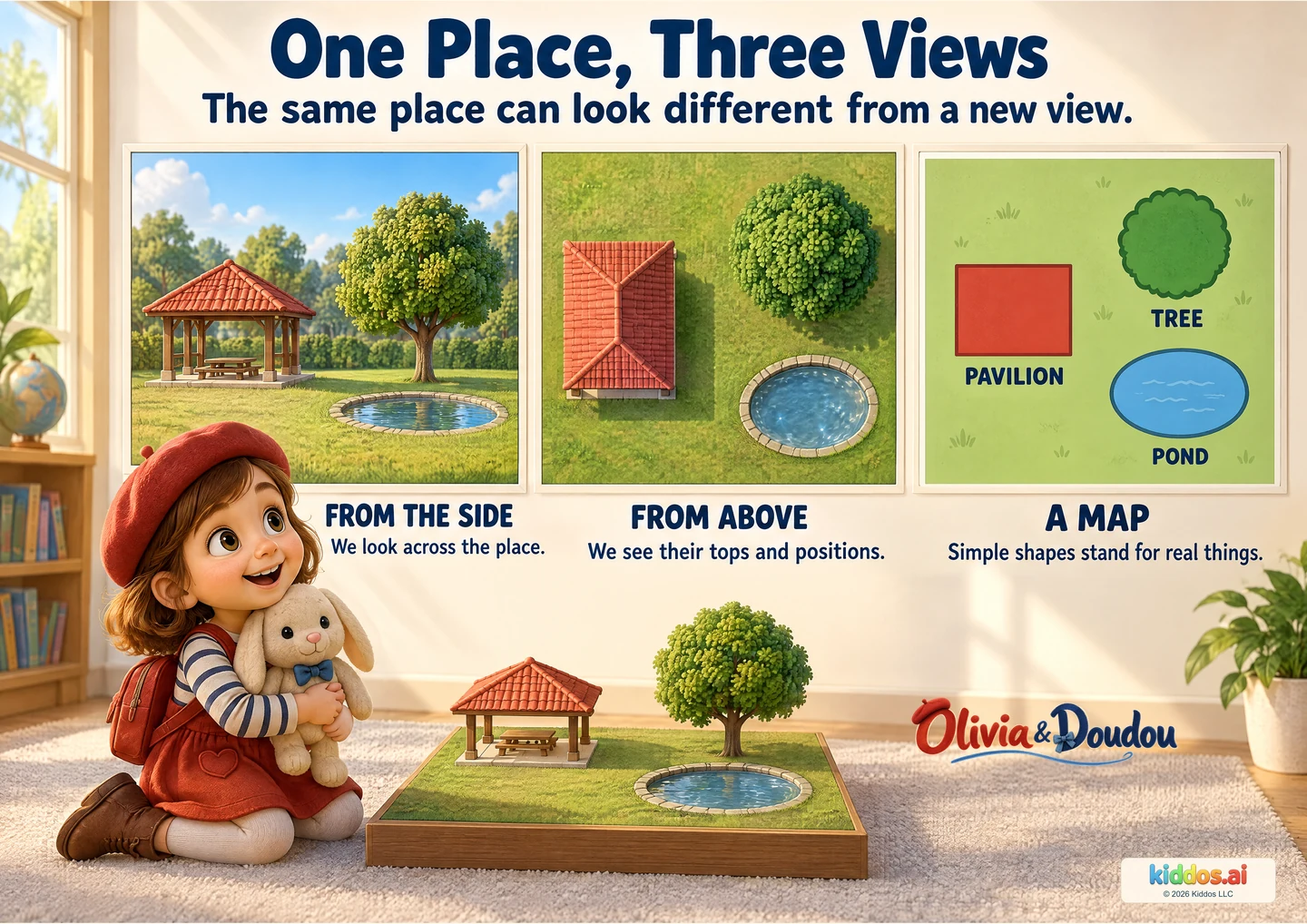
Our discovery: Match three features across a side view, a directly overhead view and a simple map of the same place.
Look at the pavilion, tree and pond with your child. Follow one feature through the three pictures before naming all the viewpoints. Olivia and Doudou are looking at a model of the same place.
What stays the same in the three pictures?
Start here
Match the pond across two pictures; accept pointing or eye gaze.
Explore further
Explain what changes and what stays fixed, then add a three-symbol key to a new map.
Three questions to share
1What stays the same in the three pictures?
Answer cue: The pavilion is on the left, the tree is at the back/right, and the pond is at the front/right. Their appearance changes with the view; they still represent the same features.
2What can you see more clearly from above?
Answer cue: The roof, the top of the tree and where the pond sits in relation to them. An answer based on a visible detail is enough.
3How does the map show the pond?
Answer cue: With a simple blue oval. A symbol stands for a feature; it need not show every detail.
If your child is unsure: Match the pond across two pictures; accept pointing or eye gaze.
Something to try together
Make a place, then map it
You’ll need: Paper, crayons and three large household objects, such as a tissue box, cushion and folded towel.
- With an adult, arrange the three objects on the floor with space between them. Choose what each one represents.
- Look across them while seated. Then stand on the floor and look down; leave the objects in place.
- Draw three simple shapes in matching positions. Explain which object each shape represents.
What this can show
The child matches at least two features across the pictures and explains one map symbol using speech, pointing or drawing. Keep everything on the floor; no climbing onto furniture. An adult can draw while the child points or directs. Use objects too large to swallow.
Return to it: Change one object’s position. Which part of your map needs to change?
Get the guide and discovery recordFor teachers · About 15 minutes
A small lesson with room to explore.
Learning aim: Match three features across a side view, a directly overhead view and a simple map of the same place.
Prepare: Paper, crayons and three large household objects, such as a tissue box, cushion and folded towel. Read the answer cues before sharing.
- 3 min
Notice
Look together and invite one observation before introducing the vocabulary.
- 4 min
Compare
Use the three discussion prompts, following the picture rather than expecting memorized definitions.
- 5 min
Try together
With an adult, arrange the three objects on the floor with space between them. Choose what each one represents. Look across them while seated. Then stand on the floor and look down; leave the objects in place. Draw three simple shapes in matching positions. Explain which object each shape represents.
- 3 min
Explain
The child matches at least two features across the pictures and explains one map symbol using speech, pointing or drawing.
Check the idea together
The child matches at least two features across the pictures and explains one map symbol using speech, pointing or drawing.
What to listen for
The pavilion is on the left, the tree is at the back/right, and the pond is at the front/right. Their appearance changes with the view; they still represent the same features. The roof, the top of the tree and where the pond sits in relation to them. An answer based on a visible detail is enough. With a simple blue oval. A symbol stands for a feature; it need not show every detail.
Bring separate enlarged views close to the child. Describe left/right and back/front aloud; offer tactile household shapes without requiring a raised viewpoint.