From story to discovery
Try it together.
More or fewer? If we use bigger measuring pieces, will we need more or fewer?
Gather
A closed book and two sets of large safe matching blocks, one set longer in the measuring direction.
Adult setup — read before trying
Use age-appropriate blocks without loose parts. Adult helps align along one straight book edge. Each set has identical pieces in the same orientation. If needed, an adult prepares large paper rectangles instead.
- Lay a closed book flat. Guess the count along one edge.
- Use equal pieces, end to end. Same side. No gaps or overlaps.
- Try longer units on that edge. Say “about” if the fit is not exact.
- Keep the same
- The same book edge, starting point and end-to-end placement without gaps or overlaps.
- What changes
- The length of each measuring unit.
- Look for
- Say the count together with the unit, and compare shared endpoints.
Make sense of what happened
The same length takes fewer larger units. The number changes because the unit changes; the object does not shrink.
The story’s six-small/three-double-length example is exact. Household objects may need “about five” or “five and a little more.” Use the same unit when comparing two objects.
Full grown-up notes, setup details & honest limits
Use a closed book and two sets of large toy blocks, with the second set longer in the measuring direction. Each set must have identical blocks that are safe for the child’s age and have no loose parts. An adult helps line them along one straight edge, all in the same orientation. Repeat along the same book edge with the second set. Start at the edge, keep units touching and do not overlap them. A book that does not fit whole blocks can be described as “about five blocks” or “five blocks and a little more.” This is informal length measurement, not a ruler calibration. If suitable blocks are unavailable, an adult can prepare two sets of large paper rectangles: identical within each set, with the second set longer. Use the same orientation for every piece.
The illustrated leaf is a deliberately exact model: six small units and three units twice as long cover identical endpoints. Real leaves and household blocks need not match those counts. Say the number and the unit together. For the same object and measured direction, larger units require fewer repetitions; the object has not changed length. When comparing two objects, use the same unit on both.
Parent move: let the child notice an accidental gap and ask “Are we measuring the leaf or the spaces?” Help close the gap without calling the first attempt wrong. The child may place blocks, point to a boundary, count aloud or direct the adult. A group can compare two block rows laid beside one demonstration book. If counting six is difficult, begin with a shorter edge and three or four blocks.
A gentle later check: point to the three-big-unit row and ask whether the leaf shrank. Invite the child to show the shared endpoints. An older child can predict what happens with a third, larger unit. Avoid speed races, scores or claims that a child must master conversion formulas.
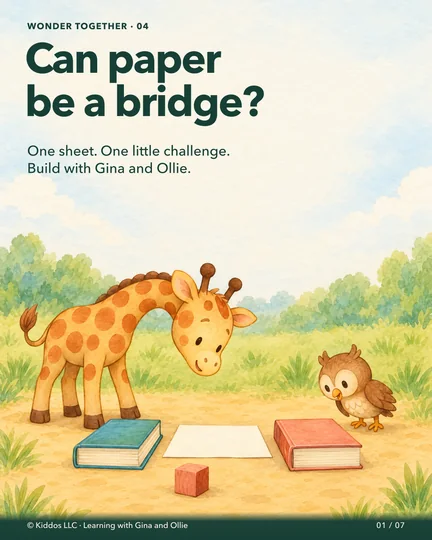
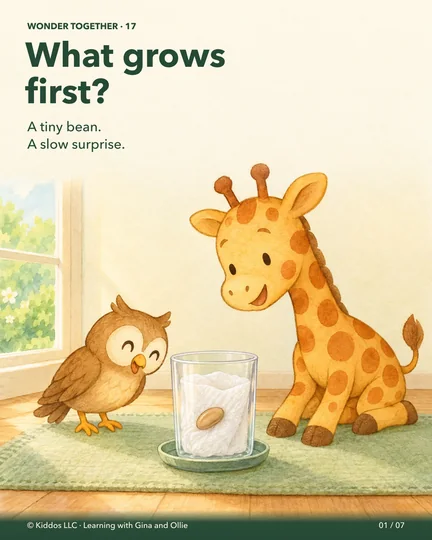
Discovery connection: carousel 04, Can paper be a bridge?, changes a structure; this activity adds a way to compare its span fairly. Carousel 17 adds observing a real plant over time. Ollie Teaches Time is related reading about measuring time, a different quantity from length. The leaf-measurement example is editorial and is not in that story. No family learning trial was performed.
A conversation, not a quiz
Leave room for their idea.
Treat a gap as something to investigate: “Are we measuring the book or the spaces?”
More or fewer? If we use bigger measuring pieces, will we need more or fewer?
A cue for the grown-up
Welcome a guess before reading the result. No correct prediction is required.
Which units did you need fewer of?
A cue for the grown-up
Larger units cover the same length with fewer repetitions.
Did the book get shorter when the count was smaller?
A cue for the grown-up
No. The endpoints stayed the same; the measuring units became larger.
A simple way in
Choose a short edge that takes three or four units; pointing or directing is enough.
Another thing to notice
Predict the count for a third, larger unit, then check without a speed race.
Come back to it
Ask for both a number and its unit when describing an informal measurement.
For teachers
A small-group discovery.
Flexible 20-minute small-group session; pause or shorten as needed.
Prepare the named materials and adult setup above. One adult-led demonstration is a useful option.
- 3 min
Wonder
Read pages 1–2. Invite a prediction with words, pointing or a sketch; keep the result hidden.
- 4 min
Notice the story
Read pages 3–5. Which units did you need fewer of? Separate the observation from the explanation.
- 9 min
Try together
Use the materials and adult setup on this guide, then follow the activity steps in this guide. Say the count together with the unit, and compare shared endpoints.
- 4 min
Make meaning
Did the book get shorter when the count was smaller? Invite a drawing, a description or an adult-written note. Treat a gap as something to investigate: “Are we measuring the book or the spaces?”
What to listen for
Did the book get shorter when the count was smaller?
Answer guidance
No. The endpoints stayed the same; the measuring units became larger.
Ways to take part
Choose a short edge that takes three or four units; pointing or directing is enough. Accept pointing, words, a drawing or adult-directed action. Use the story alone if the activity is unsuitable.
Record an observation with a drawing, a gesture described by an adult or a sentence. No timed performance or winning prediction is needed.
All the story words.
Read aloud, enlarge the browser text, or use this text alongside the pictures.
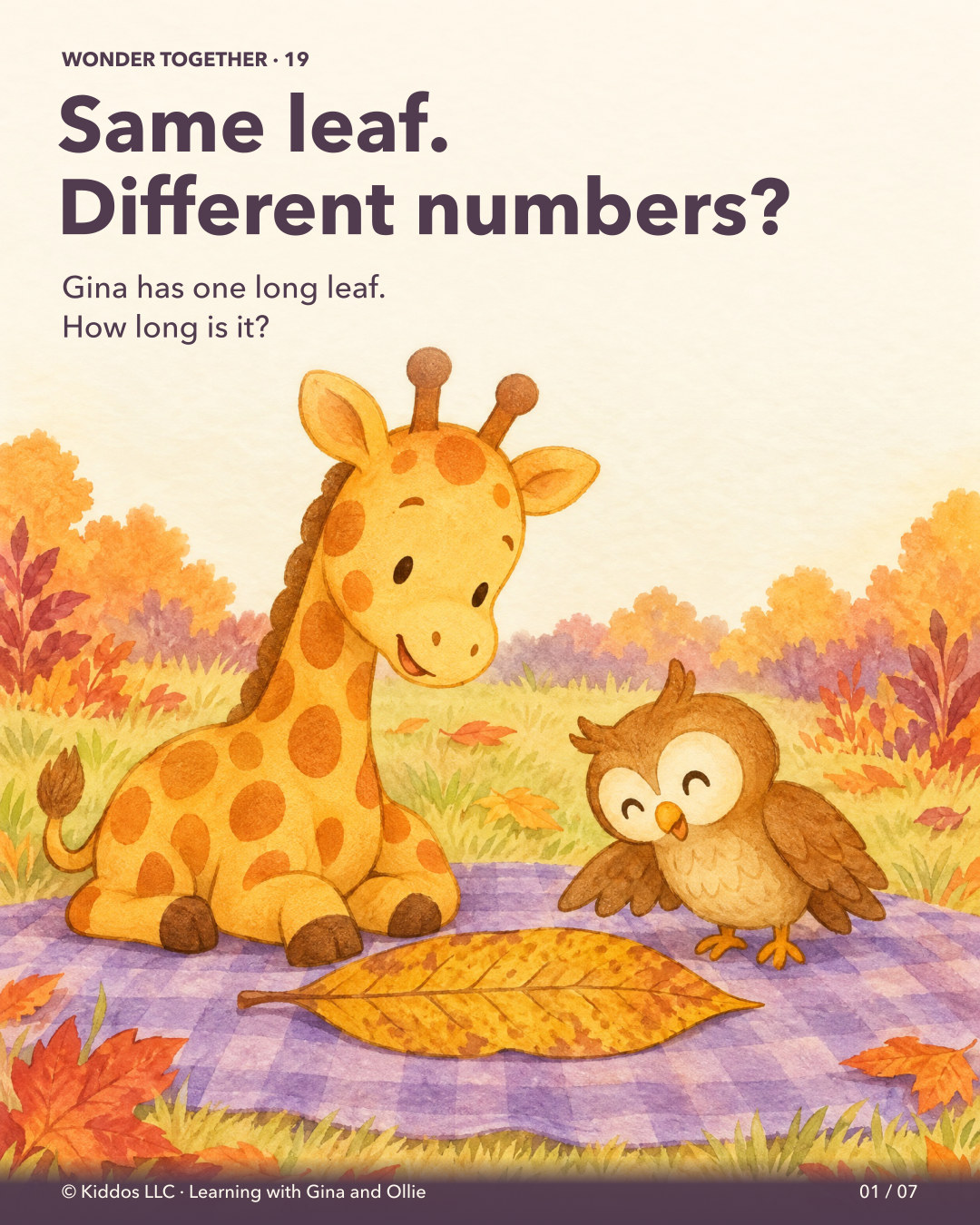
Page 1 · Same leaf. Different numbers?
WONDER TOGETHER · 19 Same leaf. Different numbers? Gina has one long leaf. How long is it? © Kiddos LLC · Learning with Gina and Ollie 01 / 07
Picture description: In an autumn-tinted clearing, Gina and Ollie study a long golden leaf on a violet picnic cloth. The leaf is the focus of a length question; there are no measurement results on the cover.
Page 2 · More or fewer?
GUESS BEFORE YOU SWIPE More or fewer? If we use bigger measuring pieces, will we need more or fewer? The leaf will stay the same. © Kiddos LLC · Learning with Gina and Ollie 02 / 07
Picture description: Gina and Ollie study their golden leaf on the violet picnic cloth. Two wooden measuring pieces sit separately below it: one small and one exactly twice as long. There is no completed measuring row yet.
Page 3 · Six small units.
LET’S TRY IT Six small units. Line up equal pieces end to end. No gaps. No overlaps. Start and finish at the leaf’s ends. © Kiddos LLC · Learning with Gina and Ollie 03 / 07
Picture description: In the same illustrated scene, six equal wooden measuring pieces form an unbroken row beneath the leaf. Fine endpoint guides align the row with the leaf’s stem and tip while Gina and Ollie look toward the experiment.
Page 4 · Three big units.
LOOK AGAIN Three big units. Each big piece is twice as long. The same leaf needs only three. The leaf did not shrink. © Kiddos LLC · Learning with Gina and Ollie 04 / 07
Picture description: The unchanged leaf and illustrated scene now have three wooden measuring pieces below them. Each is twice the small unit’s length; the row keeps exactly the same start and finish as the six-piece row.
Page 5 · Name your unit.
1 2 3 4 5 6 1 2 3 6 small pieces 3 big pieces THE PART TO REMEMBER Name your unit. A number needs its measuring unit: six small pieces, or three big ones. Bigger units. Fewer pieces. © Kiddos LLC · Learning with Gina and Ollie 05 / 07
Picture description: Two rows share exactly the same start and finish: six small pieces above three pieces twice as long. Labels name the number and unit in both cases.
Page 6 · Measure it your way.
TRY IT TOGETHER Measure it your way. With an adult: a book and two sets of matching blocks, one set longer. 1 Lay a closed book flat. Guess the count along one edge. 2 Use equal pieces, end to end. Same side. No gaps or overlaps. 3 Try longer units on that edge. Say “about” if the fit is not exact. Tell someone the number AND the unit. Use large blocks without loose parts. An adult helps line up and count. © Kiddos LLC · Learning with Gina and Ollie 06 / 07
Picture description: Gina and Ollie bring a closed plum-colored book and large wooden pieces onto their blanket. The family steps invite a guess, equal units along one edge and a second try with longer units, saying about when the fit is not exact.
Page 7 · What else can we measure?
KEEP EXPLORING TOGETHER What else can we measure? Explore another kind of measuring in Ollie Teaches Time. Parents: read together in Kiddos Books. Kiddos Books · Read with confidence. © Kiddos LLC · Learning with Gina and Ollie 07 / 07
Picture description: Gina and Ollie share a wordless picture book with a simple clock picture in their autumn clearing. The parent invitation names Ollie Teaches Time, connecting length measurement to a different measurable quantity.
Where the explanation comes from.
Related storybooks invite further reading. The factual sources below support the investigation; illustration diagrams simplify what happens.