From story to discovery
Try it together.
Root or shoot? Before we begin, make a guess. Which will appear first?
Gather
One whole dried grocery bean, clear unbreakable cup, paper towel and water.
Adult setup — read before trying
Adult handles the small bean; no split/cooked beans or treated gardening seeds. Tuck it between damp paper and cup wall, top open, no standing pool. Store out of reach between checks in a bright room away from hot sun. No tasting; wash hands. Adult discards moldy contents without child touching or smelling.
- Adult tucks the bean between damp paper and the open cup wall.
- Keep warm, bright and damp. Avoid hot direct sun.
- Look daily. Draw the first root. Keep watching for a shoot.
- Keep the same
- The same bean viewer, kept damp, observed at a similar time each day.
- What changes
- What is visible as days pass.
- Look for
- Record an unchanged bean too. Compare the first root and later shoot if it germinates.
Make sense of what happened
In this bean example the root emerges before the shoot. Stored food supports early growth, and the root takes in water.
No sprouting deadline is promised. Soil and sunlight are not required to begin germination, but a growing plant later needs suitable conditions beyond this temporary viewer.
Full grown-up notes, setup details & honest limits
Prepare a seed viewer with an adult. Use one whole dried grocery bean, an unbreakable clear cup, paper towel and water. Avoid split or cooked beans and treated gardening seeds. Fold the damp towel against the inside wall and tuck the bean between it and the transparent wall. Keep the top open and the paper damp without a pool of standing water. The adult handles the small bean, stays beside the child and stores the viewer out of reach between observations. No tasting; wash hands afterward. If mold appears, an adult disposes of the contents without asking the child to touch or smell it.
Keep the viewer indoors in a bright room, away from hot direct sun. Peek at about the same time each day. A root may appear after several days; there is no promised day or deadline. Draw what is actually visible, including an unchanged bean. If nothing happens after a week or two, try a fresh whole bean and check moisture and room warmth. A seed that does not sprout is an observation, not a child’s failure.
The pale first root emerges before the shoot in this bean example. Early growth uses food stored in the seed. Soil is not required for this short germination observation; a growing plant later needs suitable growing conditions beyond a damp towel. The viewer is temporary. An adult may transplant a healthy seedling gently into a suitable pot with drainage, recognizing that transplanting can fail. Do not eat experimental seeds or sprouts.
Parent move: wait before naming the part. Ask “What is new since yesterday?” Then invite the child to point, describe, sketch or direct the adult’s drawing. For a small group, the adult maintains one viewer and the children take turns contributing observations. A later check is “Which came first in our bean?” Accept a pointing answer. This is observation over time, not a controlled test of every plant need.
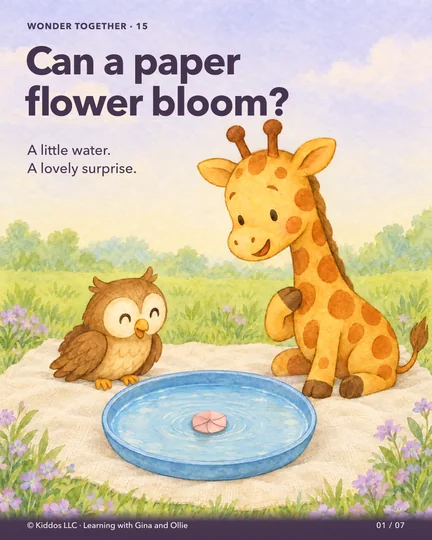
Discovery connection: compare this living bean with carousel 15, Can a paper flower bloom? The paper flower unfolds as it absorbs water; it does not grow as a living plant. Next, use carousel 19’s same-size-unit idea to describe a larger plant part without touching fragile roots. The related story How Does It Grow? uses a planted seed in a pot, not this exact viewer; gently clarify that germination can begin without soil and sunlight. No family outcome testing has been performed.
A conversation, not a quiz
Leave room for their idea.
Wait before naming a part; invite the child to point or direct your drawing.
Root or shoot? Before we begin, make a guess. Which will appear first?
A cue for the grown-up
Welcome a guess before reading the result. No correct prediction is required.
What is new since yesterday?
A cue for the grown-up
Describe the bean, first pale root or later shoot you actually see.
Is a paper flower opening the same as this bean growing?
A cue for the grown-up
No. The bean is living and grows new parts; wet paper unfolds.
A simple way in
Adult maintains one viewer; the child chooses what to record each day.
Another thing to notice
If nothing changes after a week or two, try a fresh whole bean and check moisture and room warmth. Transplanting a healthy seedling is adult-led and may fail.
Come back to it
Look back at the drawings and ask which part came first in your bean.
For teachers
A small-group discovery.
A 20-minute launch with brief daily checks afterward.
Prepare the named materials and adult setup above. One adult-led demonstration is a useful option.
- 3 min
Wonder
Read pages 1–2. Invite a prediction with words, pointing or a sketch; keep the result hidden.
- 4 min
Notice the story
Read pages 3–5. What is new since yesterday? Separate the observation from the explanation.
- 9 min
Try together
Use the materials and adult setup on this guide, then follow the activity steps in this guide. Record an unchanged bean too. Compare the first root and later shoot if it germinates.
- 4 min
Make meaning
Is a paper flower opening the same as this bean growing? Invite a drawing, a description or an adult-written note. Wait before naming a part; invite the child to point or direct your drawing.
What to listen for
Is a paper flower opening the same as this bean growing?
Answer guidance
No. The bean is living and grows new parts; wet paper unfolds.
Ways to take part
Adult maintains one viewer; the child chooses what to record each day. Accept pointing, words, a drawing or adult-directed action. Use the story alone if the activity is unsuitable.
Record an observation with a drawing, a gesture described by an adult or a sentence. No timed performance or winning prediction is needed.
All the story words.
Read aloud, enlarge the browser text, or use this text alongside the pictures.
Page 1 · What grows first?
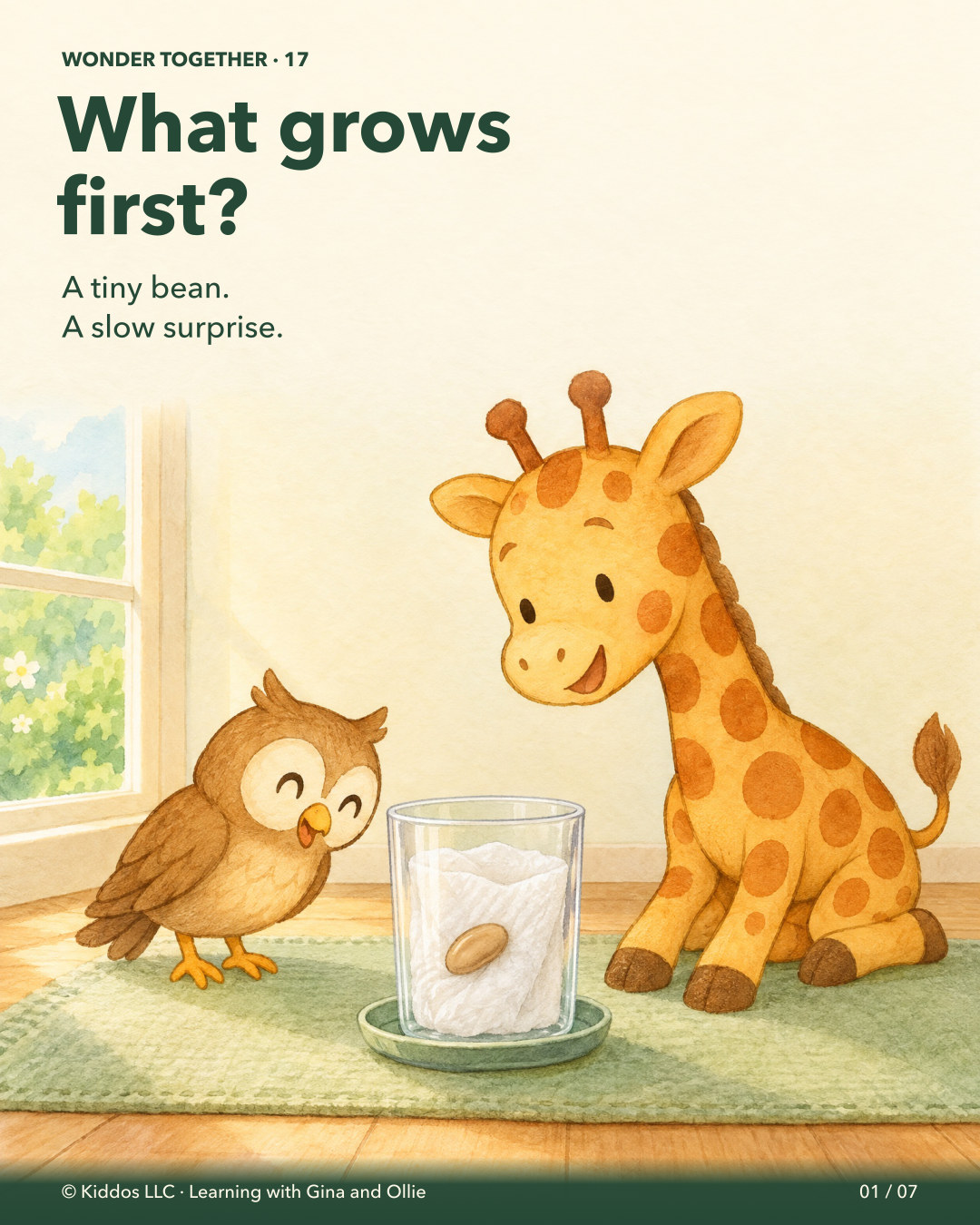
WONDER TOGETHER · 17 What grows first? A tiny bean. A slow surprise. © Kiddos LLC · Learning with Gina and Ollie 01 / 07
Picture description: Gina the yellow giraffe and smaller brown owl Ollie inspect one unsprouted bean held against damp paper inside a clear open cup. The warm indoor window-garden scene invites the question of what will emerge first.
Page 2 · Root or shoot?
GUESS BEFORE YOU SWIPE Root or shoot? Before we begin, make a guess. Which will appear first? Point to your prediction. © Kiddos LLC · Learning with Gina and Ollie 02 / 07
Picture description: Gina leans thoughtfully toward the unsprouted bean inside the clear cup while Ollie looks up at her. The same damp-paper viewer sits in the sunny nook; the root-or-shoot question invites a prediction before any growth is visible.
Page 3 · A little look. Every day.
LET’S TRY IT A little look. Every day. Gina checks her bean in damp paper. At first, no root is showing. Keep the paper damp, not flooded. © Kiddos LLC · Learning with Gina and Ollie 03 / 07
Picture description: Gina and Ollie look through the same open clear cup at the unsprouted bean. The folded towel is inside the cup; no root or leaves are visible yet.
Page 4 · A root comes first.
LOOK AGAIN A root comes first. Days later, a pale root appears. The shoot will follow. Your bean may take longer. © Kiddos LLC · Learning with Gina and Ollie 04 / 07
Picture description: From the matched view days later, a single pale root curves downward from the same bean against the damp paper. There is no shoot yet. Gina and Ollie notice the change.
Page 5 · First a root. Then a shoot.
SEED FIRST LATER ROOT SHOOT Simplified growth sequence THE PART TO REMEMBER First a root. Then a shoot. The root takes in water. The shoot grows toward the light. Growing takes time. © Kiddos LLC · Learning with Gina and Ollie 05 / 07
Picture description: A labeled simplified sequence shows a bean, then a bean with a downward root, then an upward shoot with green leaves and a longer root. The first root and later shoot are clearly distinguished.
Page 6 · Watch a bean wake.
TRY IT TOGETHER Watch a bean wake. With an adult: a whole dried bean, clear plastic cup, paper towel and water. 1 Adult tucks the bean between damp paper and the open cup wall. 2 Keep warm, bright and damp. Avoid hot direct sun. 3 Look daily. Draw the first root. Keep watching for a shoot. Draw one thing you notice each day. Adult handles the bean. No tasting. Keep out of little ones’ reach; wash hands. © Kiddos LLC · Learning with Gina and Ollie 06 / 07
Picture description: Gina and Ollie watch the bean viewer beside an open observation notebook. Three short steps explain adult setup, keeping the paper damp and watching daily; the page includes adult handling, no tasting, storage and handwashing guidance.
Page 7 · Small seed. Big story.
KEEP EXPLORING TOGETHER Small seed. Big story. Share Gina’s growing adventure in How Does It Grow? Parents: read together in Kiddos Books. Kiddos Books · Read with confidence. © Kiddos LLC · Learning with Gina and Ollie 07 / 07
Picture description: Gina and Ollie settle beside their garden to share a wordless seed-and-sprout picture book. The optional parent invitation names How Does It Grow?.
Where the explanation comes from.
Related storybooks invite further reading. The factual sources below support the investigation; illustration diagrams simplify what happens.