From story to discovery
Try it together.
Will it bend? Gina makes a flat paper bridge. Will it stay flat—or bend?
Gather
One A4 or Letter sheet, two equally thick closed books and one large lightweight age-appropriate toy without loose parts.
Adult setup — read before trying
Work on a hard level floor. Start with a gap about half the paper’s length and generous overlap. Place the toy gently in the center without pressing. An adult helps fold; no coins, scissors or tape are needed.
- With an adult, place two equally thick books on a hard floor with a gap about half the sheet’s length.
- Span the gap with the long direction of one sheet. Test one large lightweight toy gently in the middle.
- Remove the toy. Fold both long edges up. Keep the books still and test the same toy again.
- Keep the same
- Paper, toy, center load position and gap between books.
- What changes
- Flat paper becomes a channel with two upright sides.
- Look for
- Compare sagging under the same gently placed toy.
Make sense of what happened
The two upright long sides help the sheet resist bending downward. The paper material stays the same.
A bridge still has a limit. Paper, folds, gap and toy matter. If you shorten the gap or choose a lighter toy, repeat both designs with that new setup.
Full grown-up notes, setup details & honest limits
Use ordinary A4 or Letter paper, two equally thick closed books and one large, lightweight, age-appropriate toy with no loose small parts. Work with an adult on a hard, level floor. Start with a gap about half the paper’s length; lay the long direction across it with generous overlap on both books. Place the toy gently at the center; do not press. Remove it, fold both long edges upward to make two walls, and span the same gap again. Make each wall about one quarter of the sheet’s width, leaving the middle half as a flat road. The fold lines run from one book to the other. Test the same toy in the center again. No tape, scissors or coins are needed. If either result is unclear, use a lighter toy or a shorter gap, then repeat BOTH tests under that new setup with fresh matching paper if damaged. Outcomes depend on paper, folds, span and load; the illustrated result is one possible successful trial, not a weight guarantee. A child can guess, point, compare or direct while an adult folds and places the toy. Welcome the guess before explaining. The upright sides increase resistance to downward bending; the paper material has not changed. The bridge still has a limit. In a small group, ask children to explain what changed (shape) and what stayed (paper, toy and book gap), then invite a second design. The related story is about gravity, not bridge engineering. This package is an editorially reviewed activity, not evidence of measured family learning or a performed home trial.
A conversation, not a quiz
Leave room for their idea.
Ask what to change in the design and what to keep fixed before testing again.
Will it bend? Gina makes a flat paper bridge. Will it stay flat—or bend?
A cue for the grown-up
Welcome a guess before reading the result. No correct prediction is required.
What happened to the middle under the toy?
A cue for the grown-up
The flat sheet may sag more. A successful folded design bends less with the same load.
Did we use thicker paper for the second bridge?
A cue for the grown-up
No. The shape changed, not the material.
A simple way in
An adult makes folds about one quarter of the sheet’s width; the child directs toy placement.
Another thing to notice
Choose another fold design. Compare it using the same span and load.
Come back to it
Ask why the upright sides mattered when looking at a folded cardboard package.
For teachers
A small-group discovery.
Flexible 20-minute small-group session; pause or shorten as needed.
Prepare the named materials and adult setup above. One adult-led demonstration is a useful option.
- 3 min
Wonder
Read pages 1–2. Invite a prediction with words, pointing or a sketch; keep the result hidden.
- 4 min
Notice the story
Read pages 3–5. What happened to the middle under the toy? Separate the observation from the explanation.
- 9 min
Try together
Use the materials and adult setup on this guide, then follow the activity steps in this guide. Compare sagging under the same gently placed toy.
- 4 min
Make meaning
Did we use thicker paper for the second bridge? Invite a drawing, a description or an adult-written note. Ask what to change in the design and what to keep fixed before testing again.
What to listen for
Did we use thicker paper for the second bridge?
Answer guidance
No. The shape changed, not the material.
Ways to take part
An adult makes folds about one quarter of the sheet’s width; the child directs toy placement. Accept pointing, words, a drawing or adult-directed action. Use the story alone if the activity is unsuitable.
Record an observation with a drawing, a gesture described by an adult or a sentence. No timed performance or winning prediction is needed.
All the story words.
Read aloud, enlarge the browser text, or use this text alongside the pictures.
Page 1 · Can paper be a bridge?
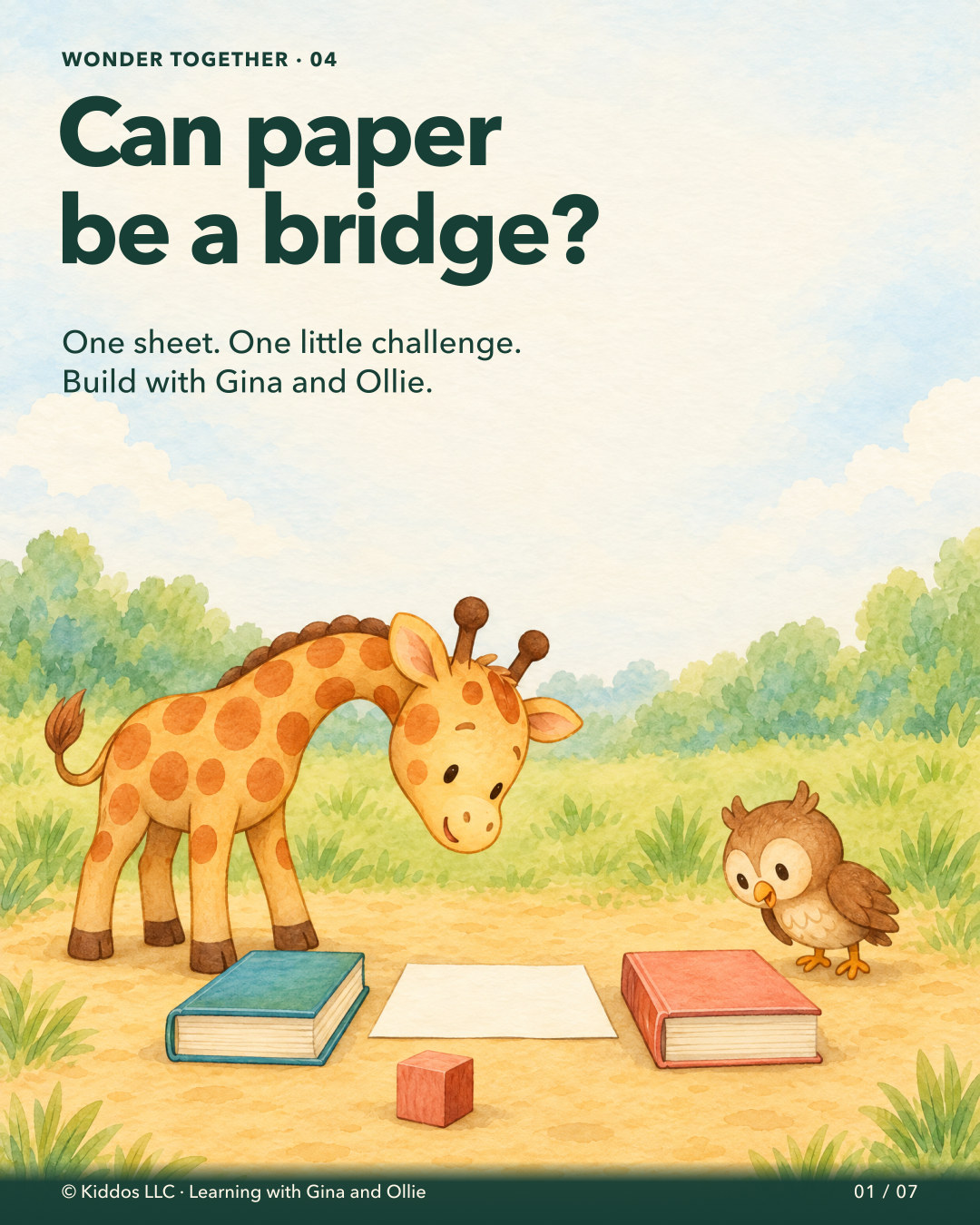
WONDER TOGETHER · 04 Can paper be a bridge? One sheet. One little challenge. Build with Gina and Ollie. © Kiddos LLC · Learning with Gina and Ollie 01 / 07
Picture description: Gina the yellow giraffe and small brown owl Ollie investigate two closed books and a sheet of paper. A chunky coral toy block waits beside the books. The title asks, Can paper be a bridge?
Page 2 · Will it bend?
GUESS BEFORE YOU SWIPE Will it bend? Gina makes a flat paper bridge. Will it stay flat—or bend? Pause. Let your child guess. © Kiddos LLC · Learning with Gina and Ollie 02 / 07
Picture description: A flat sheet spans a short gap between a teal book on the left and a coral book on the right. The coral toy block is still on the ground in front, not yet on the paper. Gina and Ollie look at the unresolved setup.
Page 3 · Oh! It bends.
TRY THE FLAT SHEET Oh! It bends. Gina tests the middle. The paper sags under the toy. What could Gina change? © Kiddos LLC · Learning with Gina and Ollie 03 / 07
Picture description: The same books stay the same distance apart. The same toy block now rests at the center of the flat sheet, making it sag into the gap. Gina looks closely at the bent paper.
Page 4 · Fold. Try again.
CHANGE THE SHAPE Fold. Try again. Gina folds both long edges up. Now her bridge holds the toy. Same paper. Same toy. Same gap. © Kiddos LLC · Learning with Gina and Ollie 04 / 07
Picture description: In the matched view, the same sheet now forms a channel: both long edges stand upward as walls running from one book to the other. The same block sits on the flat middle of the paper, supported above the same gap.
Page 5 · Same paper. Stronger shape.
END VIEW FLAT FOLDED THE PART TO REMEMBER Same paper. Stronger shape. The upright sides help the paper resist bending down. A new shape can make a difference. © Kiddos LLC · Learning with Gina and Ollie 05 / 07
Picture description: A clear side-by-side diagram compares a flat paper cross-section with a U-shaped channel. The channel has two upright sides and a flat base. A larger perspective drawing shows the upright sides running the full bridge length.
Page 6 · Your turn to build.
LONG EDGE FOLD UP FOLD UP Leave the middle flat. TRY IT TOGETHER Your turn to build. Bridge two books with a sheet. Test one lightweight toy in the middle. Fold both long edges up. Test again. Ask: “What changed? What stayed?” With an adult, on the floor. Use a large, child-safe toy. Keep the books in place. © Kiddos LLC · Learning with Gina and Ollie 06 / 07
Picture description: An editable folding diagram shows a rectangular sheet with two lengthwise fold lines, then a paper channel. Put two equally thick books a short distance apart on a hard floor and span the gap with the sheet. With an adult, test one large lightweight child-safe toy, fold both long edges up, then test the same toy again without moving the books. The child can predict, point or direct the adult.
Page 7 · More little “why?” moments.
KEEP THE WONDER GOING More little “why?” moments. Read Gina and the Great Gravity Hug together. Parents: explore the story in Kiddos Books. Kiddos Books · Read with confidence. © Kiddos LLC · Learning with Gina and Ollie 07 / 07
Picture description: Gina and Ollie settle in their meadow with an open picture book. Parents are invited to continue their curiosity with Gina and the Great Gravity Hug in Kiddos Books, a related story about gravity rather than a paper-bridge instruction book.
Where the explanation comes from.
Related storybooks invite further reading. The factual sources below support the investigation; illustration diagrams simplify what happens.