From story to discovery
Try it together.
Hang or flutter? Hold one end of a paper strip. What might a breeze do?
Gather
One short lightweight paper strip, roughly 3 × 15 cm, torn by an adult.
Adult setup — read before trying
Stay together in a safe level spot away from roads, water edges and machinery. Skip strong/stormy weather. Hold paper below the face; no strings, sticks, staples or ties. Keep hold of it and take it indoors afterward.
- Adult tears a short paper strip. Hold one end away from your face.
- Keep your hand still outside. Watch calm air, then a breeze.
- Point, say or draw the change. No breeze? Try another day.
- Keep the same
- Same strip, spot and still hand/body.
- What changes
- Air movement during a calm moment or breeze.
- Look for
- Look for the loose end hanging or fluttering while the hand stays still.
Make sense of what happened
Wind is moving air. Its effect on paper, leaves or grass can give us a clue even though we cannot see the air itself.
A moving hand, walking or touching can also move paper. A calm observation is useful; this is not a speed meter or weather forecast.
Full grown-up notes, setup details & honest limits
An adult tears a short strip of lightweight paper, roughly 3 × 15 cm. No string, stick, stapler or ties are needed. Choose a safe, level place away from roads, water edges and machinery. Keep the paper below the face and hold on to it. Stay together, skip strong or stormy weather, and bring the strip back inside so it does not become litter.
First notice the loose end during a quiet moment. Then keep the hand and body still and watch during a breeze in the same spot. If the hand waves or the child walks, the strip can move for another reason; reset and observe. The two story pictures show one calm moment followed by a breeze, not a promised weather sequence. A calm result is useful too. Try another day if there is no breeze.
Wind is moving air. A paper strip, leaves or grass can reveal its effects. The arrows on the explanation page are a model of air movement, not visible colored air. This strip is an observation aid, not a calibrated wind-speed instrument; it cannot tell us a precise speed or forecast. Avoid claiming that every moving leaf proves wind, since touching, animals and other causes can also move leaves.
Parent move: ask for the clue before the explanation: “What did you see move?” A child may hold the strip, point from a seated position, describe it or direct an adult. For a group, one adult demonstrates while others describe the calm and breezy moments. Next day ask what wind is and invite an answer in words or movement. The useful answer is air moving, with an observed effect.
Discovery connection: revisit carousel 11, Can paper stay dry underwater?, to recall that air is present even when we cannot see it. Then try carousel 02, Same paper. Different fall., for a different effect of air. Where Did My Water Go? is a related water-cycle story, not a wind experiment. No live weather trial or family learning study was performed.
A conversation, not a quiz
Leave room for their idea.
Ask for the visible clue before naming its possible cause.
Hang or flutter? Hold one end of a paper strip. What might a breeze do?
A cue for the grown-up
Welcome a guess before reading the result. No correct prediction is required.
What did you see move while your hand stayed still?
A cue for the grown-up
A loose end may lift or flutter during a breeze.
Could moving the hand make the strip flutter too?
A cue for the grown-up
Yes. Hold still to make the wind observation easier to interpret.
A simple way in
Observe an adult’s strip from a seated or standing position.
Another thing to notice
Return to the same safe place another day and compare what you notice.
Come back to it
Ask what wind is and invite “moving air” in words, gesture or an adult’s interpretation.
For teachers
A small-group discovery.
Flexible 20-minute small-group session; pause or shorten as needed.
Prepare the named materials and adult setup above. One adult-led demonstration is a useful option.
- 3 min
Wonder
Read pages 1–2. Invite a prediction with words, pointing or a sketch; keep the result hidden.
- 4 min
Notice the story
Read pages 3–5. What did you see move while your hand stayed still? Separate the observation from the explanation.
- 9 min
Try together
Use the materials and adult setup on this guide, then follow the activity steps in this guide. Look for the loose end hanging or fluttering while the hand stays still.
- 4 min
Make meaning
Could moving the hand make the strip flutter too? Invite a drawing, a description or an adult-written note. Ask for the visible clue before naming its possible cause.
What to listen for
Could moving the hand make the strip flutter too?
Answer guidance
Yes. Hold still to make the wind observation easier to interpret.
Ways to take part
Observe an adult’s strip from a seated or standing position. Accept pointing, words, a drawing or adult-directed action. Use the story alone if the activity is unsuitable.
Record an observation with a drawing, a gesture described by an adult or a sentence. No timed performance or winning prediction is needed.
All the story words.
Read aloud, enlarge the browser text, or use this text alongside the pictures.
Page 1 · Can you spot the wind?
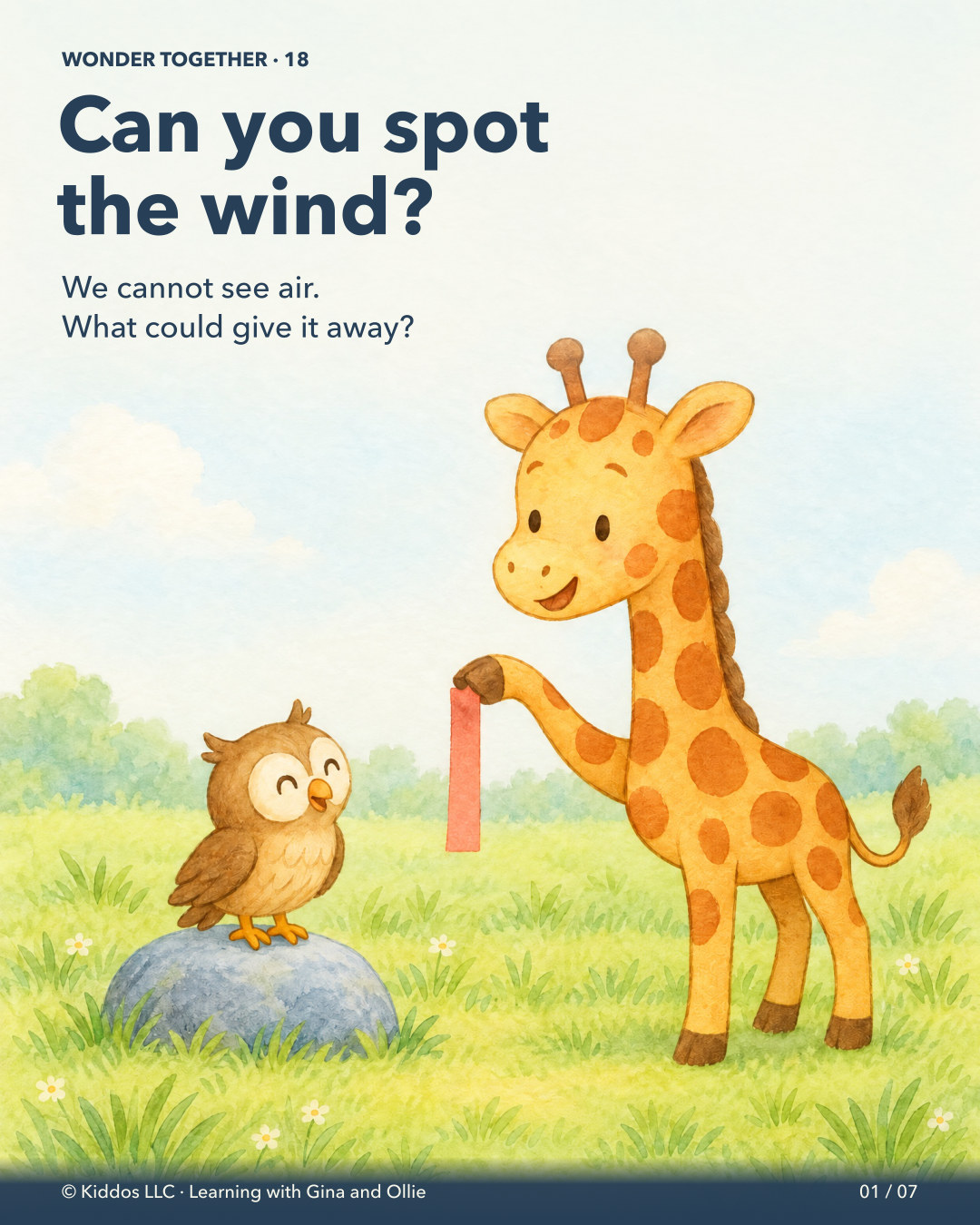
WONDER TOGETHER · 18 Can you spot the wind? We cannot see air. What could give it away? © Kiddos LLC · Learning with Gina and Ollie 01 / 07
Picture description: In a pale-blue meadow, Gina holds a short strip of paper by one end while Ollie watches. The loose end hangs down, inviting a search for evidence of invisible wind.
Page 2 · Hang or flutter?
GUESS BEFORE YOU SWIPE Hang or flutter? Hold one end of a paper strip. What might a breeze do? Make a guess. Then go outside. © Kiddos LLC · Learning with Gina and Ollie 02 / 07
Picture description: At a sheltered doorway, Gina and Ollie look at the short coral paper strip lying on a low stone before lifting it. The family guesses whether it will hang or flutter outside.
Page 3 · First, hold still.
LET’S TRY IT First, hold still. In a calm spot, Gina’s strip hangs. She keeps her hoof still. Watch the loose end. © Kiddos LLC · Learning with Gina and Ollie 03 / 07
Picture description: Gina stands still in the meadow with one attached front hoof holding the paper strip. Its loose end hangs down during a calm moment. Ollie watches from a low stone.
Page 4 · Then comes a breeze.
LOOK AGAIN Then comes a breeze. The same strip lifts and flutters. Gina’s hoof stays still. Moving air is pushing the paper. © Kiddos LLC · Learning with Gina and Ollie 04 / 07
Picture description: The same strip now bends sideways in a breeze while Gina keeps the holding hoof in the same position. Nearby grass leans gently in the same direction; the setting, characters and paper remain consistent.
Page 5 · Wind is moving air.
HELD STILL MOVING AIR PAPER MOVES Arrows show air movement THE PART TO REMEMBER Wind is moving air. We can spot what it moves: paper, leaves and grass. The moving paper is a clue. © Kiddos LLC · Learning with Gina and Ollie 05 / 07
Picture description: A diagram labels the paper’s fixed holding point, arrows representing moving air and the strip bending away from the incoming air. The arrows are an explanation aid.
Page 6 · Be a wind watcher.
TRY IT TOGETHER Be a wind watcher. With an adult: one short paper strip and a safe outdoor spot. 1 Adult tears a short paper strip. Hold one end away from your face. 2 Keep your hand still outside. Watch calm air, then a breeze. 3 Point, say or draw the change. No breeze? Try another day. What else moves when a breeze comes? Adult stays close. Skip stormy weather. Hold the strip; bring it back inside. © Kiddos LLC · Learning with Gina and Ollie 06 / 07
Picture description: Gina holds one end of the coral paper strip as it flutters beside Ollie in a calm meadow. The family instructions ask for a still hand, observation in calm air and a breeze, and a description or drawing of the change; an adult stays close.
Page 7 · Keep watching the sky.
KEEP EXPLORING TOGETHER Keep watching the sky. Follow a different weather story in Where Did My Water Go? Parents: read together in Kiddos Books. Kiddos Books · Read with confidence. © Kiddos LLC · Learning with Gina and Ollie 07 / 07
Picture description: After the observation, Gina and Ollie share a wordless cloud-and-rain book beside the meadow. The invitation names the separate water-cycle story Where Did My Water Go?.
Where the explanation comes from.
Related storybooks invite further reading. The factual sources below support the investigation; illustration diagrams simplify what happens.