From story to discovery
Try it together.
Can Gina make it fall faster? Keep it flat—or crumple it?
Gather
One intact sheet of ordinary paper.
Adult setup — read before trying
Use still indoor air away from fans. Keep feet on the floor; release without pushing from a comfortable height. Keep the landing space clear.
- With an adult, take one intact sheet and stand on the floor in still indoor air.
- Release the flat sheet roughly horizontal without pushing.
- Crumple the same sheet and drop again from the same starting height.
- Repeat and describe what changed.
- Keep the same
- The same amount of paper, starting height and gentle release.
- What changes
- The shape of the sheet: flat, then compactly crumpled.
- Look for
- Describe a fluttering fall and a more direct fall. Repeat because individual drops vary.
Make sense of what happened
Gravity pulls both shapes down. Air resists their motion, and the wide sheet usually experiences more air resistance than the compact ball.
Crumpling does not add weight. This is not evidence that heavier objects always fall faster.
Full grown-up notes, setup details & honest limits
Use one intact sheet of ordinary paper in still indoor air, away from fans. Hold the flat sheet roughly horizontal and release without a push; then crumple the same sheet into a compact ball and release from the same starting height. Keep feet on the floor. Repeat a few times: a flat sheet can flutter, tilt or drift, so individual drops vary. The crumpled sheet generally reaches the floor sooner because its compact shape experiences less air resistance. You changed shape while keeping the amount of paper, release height and gentle release the same. Crumpling does not add weight. Gravity pulls both forms downward; air resists their motion. Accept the child’s prediction before explaining. Ask them to describe the motion or direct the release; no timing, reading or grasping skill is required. This compares one paper sheet in two shapes in air, not a rule that heavier objects always fall faster. The story’s dropping scene is the literary bridge; its balloon/weight metaphor is not used as the explanation here.
A conversation, not a quiz
Leave room for their idea.
Invite descriptions such as flutter, twist or drop before introducing air resistance.
Can Gina make it fall faster? Keep it flat—or crumple it?
A cue for the grown-up
Welcome a guess before reading the result. No correct prediction is required.
How did each shape move on the way down?
A cue for the grown-up
The flat sheet may flutter or drift; the compact ball generally reaches the floor sooner.
Did we add any paper when we crumpled it?
A cue for the grown-up
No. We changed shape while keeping the same sheet.
A simple way in
An adult does the drops while the child points to the shape to try.
Another thing to notice
Repeat each shape several times and notice whether every fall looks identical.
Come back to it
Ask what you would keep the same to compare the two falls again.
For teachers
A small-group discovery.
Flexible 20-minute small-group session; pause or shorten as needed.
Prepare the named materials and adult setup above. One adult-led demonstration is a useful option.
- 3 min
Wonder
Read pages 1–2. Invite a prediction with words, pointing or a sketch; keep the result hidden.
- 4 min
Notice the story
Read pages 3–5. How did each shape move on the way down? Separate the observation from the explanation.
- 9 min
Try together
Use the materials and adult setup on this guide, then follow the activity steps in this guide. Describe a fluttering fall and a more direct fall. Repeat because individual drops vary.
- 4 min
Make meaning
Did we add any paper when we crumpled it? Invite a drawing, a description or an adult-written note. Invite descriptions such as flutter, twist or drop before introducing air resistance.
What to listen for
Did we add any paper when we crumpled it?
Answer guidance
No. We changed shape while keeping the same sheet.
Ways to take part
An adult does the drops while the child points to the shape to try. Accept pointing, words, a drawing or adult-directed action. Use the story alone if the activity is unsuitable.
Record an observation with a drawing, a gesture described by an adult or a sentence. No timed performance or winning prediction is needed.
All the story words.
Read aloud, enlarge the browser text, or use this text alongside the pictures.
Page 1 · Same paper. Different fall.
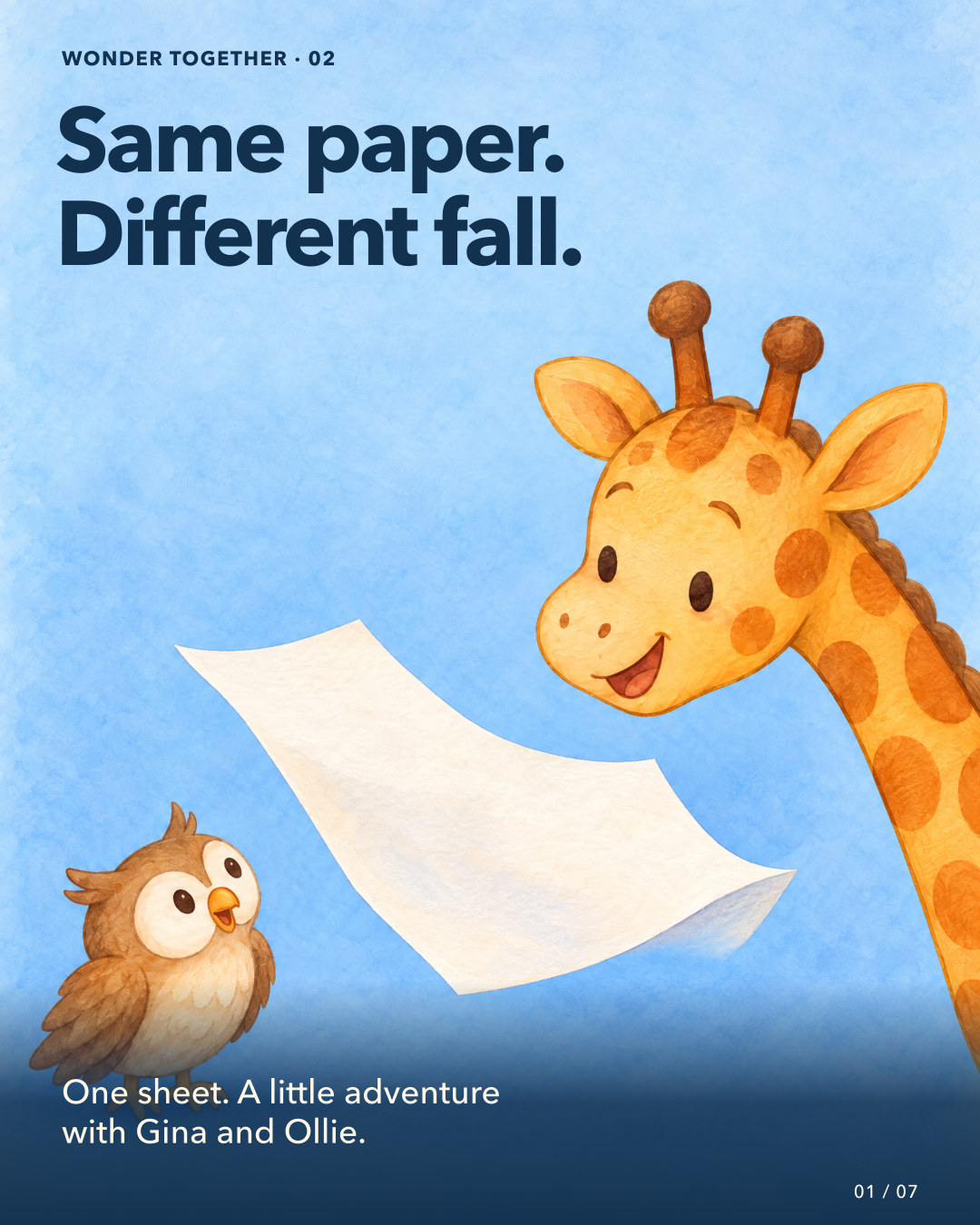
WONDER TOGETHER · 02 Same paper. Different fall. One sheet. A little adventure with Gina and Ollie. 01 / 07
Picture description: Gina and small Ollie watch a broad white sheet flutter down through a softly painted blue room. The title invites a discovery about changing how the same paper falls.
Page 2 · Can Gina make it fall faster?
GUESS BEFORE YOU SWIPE Can Gina make it fall faster? Keep it flat—or crumple it? Choose before Gina lets go. 02 / 07
Picture description: Gina holds one intact sheet level on her raised hoof, ready for the first drop. Ollie watches from the floor. The paper has not fallen yet. The question asks whether keeping it flat or crumpling it could make it fall faster.
Page 3 · Watch it flutter.
FIRST, KEEP IT FLAT Watch it flutter. Gina lets the flat sheet go. Notice how it moves through the air. 03 / 07
Picture description: In the same view, Gina has released the broad sheet. It is fluttering above the blue floor below her empty raised hoof, while Ollie watches outside the drop path.
Page 4 · A little ball. A faster fall.
NOW, CRUMPLE THE SAME SHEET A little ball. A faster fall. Gina drops it from the same height. Same paper. Same drop. New shape. 04 / 07
Picture description: The same camera, Gina, Ollie and room show the second trial. Gina has released the same sheet crumpled into a compact paper ball from the same raised-hoof height. The paper ball has reached the floor.
Page 5 · Air slows the wide sheet more.
THE PART TO REMEMBER Air slows the wide sheet more. Gravity pulls it down. Air pushes against its fall. Gravity Air Changing the shape changes the fall. 05 / 07
Picture description: A close view makes the broad falling sheet easy to see. Gentle diagram arrows added in the editable layout show gravity downward and air resistance upward. These are force directions, not visible jets of wind or a measurement of force.
Page 6 · Your child calls the drop.
TRY IT TOGETHER · ONE SHEET Your child calls the drop. Drop a flat sheet. Crumple it. Drop it again. Use the same starting height. SAME STARTING HEIGHT FLAT CRUMPLED Ask: “What changed?” With an adult. Feet stay on the floor. Let go gently—no throwing. 06 / 07
Picture description: An editable two-step diagram shows one sheet first flat and then crumpled, released from the same marked starting height. With an adult, the child can call when to release it and describe the difference. Stay on the floor and release gently.
Page 7 · One little sheet. A bigger question.
KEEP THE WONDER GOING One little sheet. A bigger question. Read Gina and the Great Gravity Hug together. Parents: explore the story in Kiddos Books. Kiddos Books · Read with confidence. 07 / 07
Picture description: Gina and Ollie share a picture book in their soft watercolor meadow. A crumpled sheet rests nearby after their discovery. The parent invitation names Gina and the Great Gravity Hug in Kiddos Books.
Where the explanation comes from.
Related storybooks invite further reading. The factual sources below support the investigation; illustration diagrams simplify what happens.