From story to discovery
Try it together.
Which familiar object fits your touch clue?
Gather
Open cloth bag without drawstrings; Large wooden spoon; Soft folded cloth; Large smooth plastic cup; Three simple picture cards showing those objects; A place to conceal unused objects.
Adult setup — read before trying
Choose a soft open cloth bag without drawstrings, a large wooden spoon, a folded cloth and a large smooth plastic cup. Prepare their three picture cards and a separate covered place for unused objects. Check surfaces and keep the bag below the face.
- Together, look at and feel three large familiar objects: spoon, folded cloth and cup. Lay out their three picture cards.
- Child looks away. Grown-up puts one object into the open cloth bag and completely conceals the other two elsewhere. Leave all three cards visible.
- Child may feel inside the bag without looking. Keep the bag below the face. Touch is optional: grown-up can feel and describe instead.
- Describe one clue, then choose a picture. Any guess is welcome.
- Pull out the object and check it against the chosen picture.
- Swap roles. Keep unused objects hidden again so the next answer cannot be found simply by noticing what is missing.
- Keep the same
- The three possible objects are the spoon, folded cloth and cup, with their three picture cards visible. During the guessing turn, the two unused real objects stay completely hidden.
- What changes
- One object is put in the bag. Benny feels, chooses a picture and pulls out the spoon to check. The next turn uses a different object and swaps roles.
- Look for
- The spoon’s long handle and rounded bowl distinguish it from the folded cloth and open cup. Feeling suggests an answer; pulling it out lets both players check.
Make sense of what happened
The spoon’s long handle and rounded bowl distinguish it from the folded cloth and open cup. Feeling suggests an answer; pulling it out lets both players check.
Touch is optional. A description suggests a choice; the reveal checks it. Keep all unused objects hidden so their absence does not give the answer away. Accept an uncertain or changed guess; this is not a test of sensory ability.
Full grown-up notes, setup details & honest limits
Let the child explore the three objects first. While they look away, put one in the bag and fully hide the unused two. Offer to feel and describe for them; wait for a picture choice, then reveal and check without scoring.
Touch is optional. A description suggests a choice; the reveal checks it. Keep all unused objects hidden so their absence does not give the answer away. Accept an uncertain or changed guess; this is not a test of sensory ability.
These are authored shared-play examples. Suggested ages and times are starting points, not an assessment or evidence of measured learning outcomes.
A conversation, not a quiz
Leave room for their idea.
Let the child explore the three objects first. While they look away, put one in the bag and fully hide the unused two. Offer to feel and describe for them; wait for a picture choice, then reveal and check without scoring.
What could a spoon feel like inside the bag?
A cue for the grown-up
A long handle with a wider rounded bowl. Use the actual large spoon to check; a grown-up may feel and describe it.
Why are the other two real objects hidden too?
A cue for the grown-up
So the child can use the touch clue rather than identify the answer by seeing which object is missing. All three picture choices stay visible.
How do we check the picture choice?
A cue for the grown-up
Pull out the object and compare it with the chosen picture. If it differs, explore which clue could help next time.
A simple way in
Use two very different objects. Touch is optional: the grown-up can feel and describe while the child chooses a card.
Another thing to notice
Let the child choose which familiar object the grown-up will feel. Help conceal the unused objects, and let the child lead the reveal and check.
Come back to it
Use the same three objects on another day, or replace one with a large safe familiar object and update its picture. Keep touch optional.
For teachers
A small-group discovery.
Flexible 15-minute small-group sequence; prepare materials first, and shorten or pause as needed.
Prepare the named materials and adult setup above. One adult-led demonstration is a useful option.
- 2 min
Meet the possible objects
Look at the spoon, cup and cloth with their cards. Offer optional touching and model describing one feature.
- 3 min
A clue before the reveal
Read to page 5. Invite a picture choice or a description, then reveal the spoon on page 6 and compare.
- 7 min
Feel or listen, choose and check
Adult hides one object in the bag and the other two elsewhere. Child may feel or listen to the adult’s description, choose a card and reveal. Swap roles and reset all unused objects out of sight.
- 3 min
Share one useful feature
Invite a gesture, texture word or shape description that helped. A revised guess is welcome.
What to listen for
The child can connect one felt or described feature to a picture choice, then compare it with the revealed object. Touching and guessing correctly are not requirements.
Answer guidance
The spoon’s long handle and rounded bowl distinguish it from the folded cloth and open cup. Feeling suggests an answer; pulling it out lets both players check.
Ways to take part
Accept pointing, showing, home-language words or directing an adult. Keep the materials within comfortable reach; no spoken answer is required. Use two very different objects. Touch is optional: the grown-up can feel and describe while the child chooses a card.
Record an observation with a drawing, a gesture described by an adult or a sentence. No timed performance or winning prediction is needed.
All the story words.
Read aloud, enlarge the browser text, or use this text alongside the pictures.
Page 1 · A mystery you can feel.
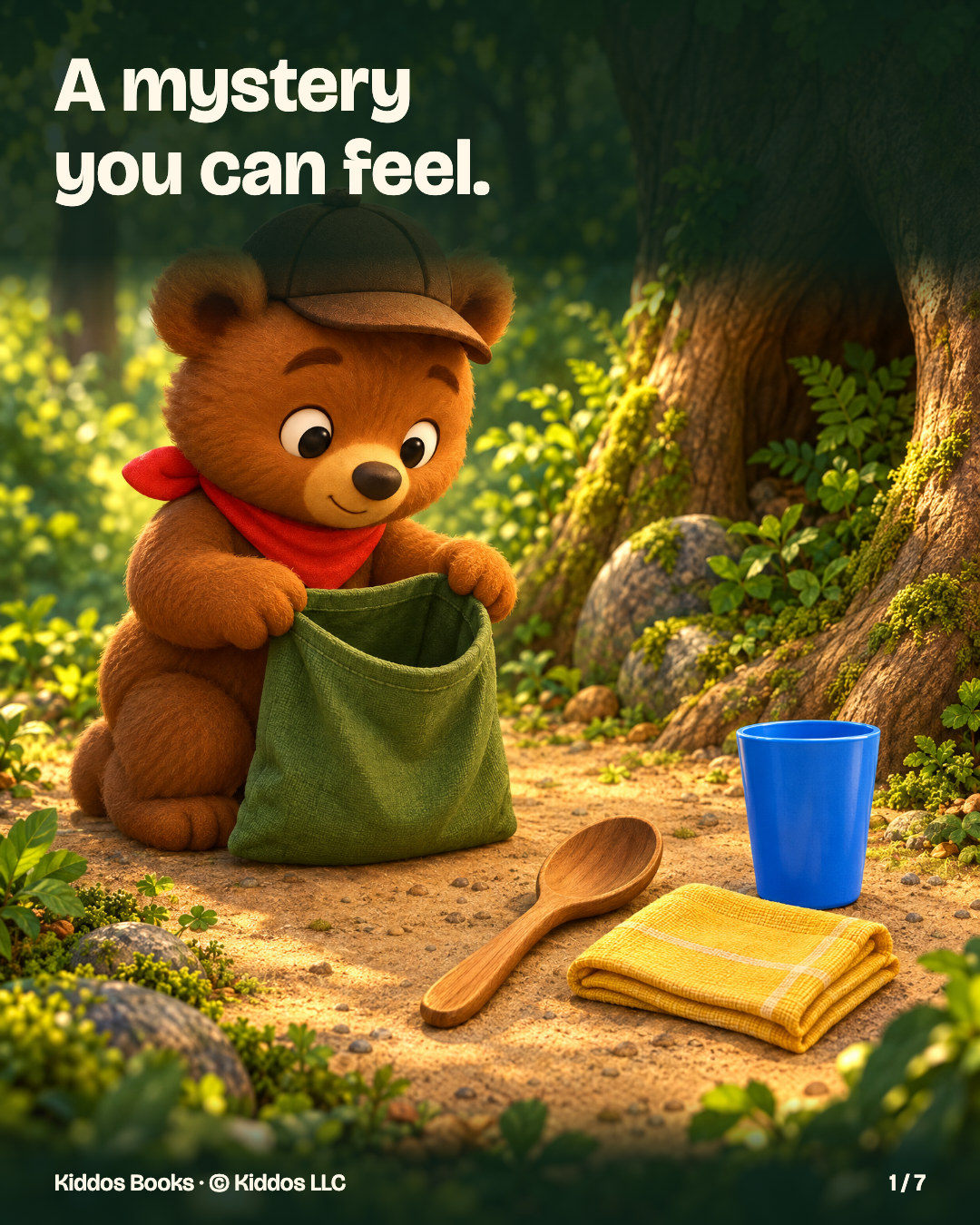
A mystery you can feel. Kiddos Books · © Kiddos LLC 1 / 7
Picture description: Page 1 of 7. A mystery you can feel. Benny holds open an empty green cloth bag. A large wooden spoon, folded yellow cloth and blue cup are laid out beside him.
Page 2 · Feel these three things together.
Feel these three things together. Kiddos Books · © Kiddos LLC 2 / 7
Picture description: Page 2 of 7. Feel these three things together. An overhead view shows Benny exploring the wooden spoon beside the yellow cloth and blue cup. Three cards picture the same familiar objects.
Page 3 · Child, look away. Grown-up, hide one.
Child, look away. Grown-up, hide one. Kiddos Books · © Kiddos LLC 3 / 7
Picture description: Page 3 of 7. Child, look away. Grown-up, hide one. Benny covers his eyes beside the green bag. The wicker basket is closed, hiding the unused objects; three picture cards lie in front.
Page 4 · Reach in. What can you feel?
Reach in. What can you feel? Kiddos Books · © Kiddos LLC 4 / 7
Picture description: Page 4 of 7. Reach in. What can you feel? Benny feels inside the opaque green bag with one paw, steadying its rim with the other. He looks away. The object remains hidden; the basket is closed.
Page 5 · Which thing fits your clue?
Which thing fits your clue? Kiddos Books · © Kiddos LLC 5 / 7
Picture description: Page 5 of 7. Which thing fits your clue? Benny points to the wooden-spoon picture among the three cards. The real object is still hidden inside the green bag.
Page 6 · Pull it out. Were you right?
Pull it out. Were you right? Kiddos Books · © Kiddos LLC 6 / 7
Picture description: Page 6 of 7. Pull it out. Were you right? Benny lifts a large wooden spoon from the green bag and compares it with the spoon picture. The other objects remain hidden in the closed basket.
Page 7 · Now hide a mystery for your grown-up.
Now hide a mystery for your grown-up. Kiddos Books · © Kiddos LLC 7 / 7
Picture description: Page 7 of 7. Now hide a mystery for your grown-up. Benny puts the yellow cloth into the green bag for a new turn. The open basket beside him holds the spoon and blue cup, and the three picture cards remain in front.
Where the explanation comes from.
Related storybooks invite further reading. The factual sources below support the investigation; illustration diagrams simplify what happens.