Five minutes together
Look. Wonder. Talk.
Our discovery: Identify and compare landforms by their shape and position.
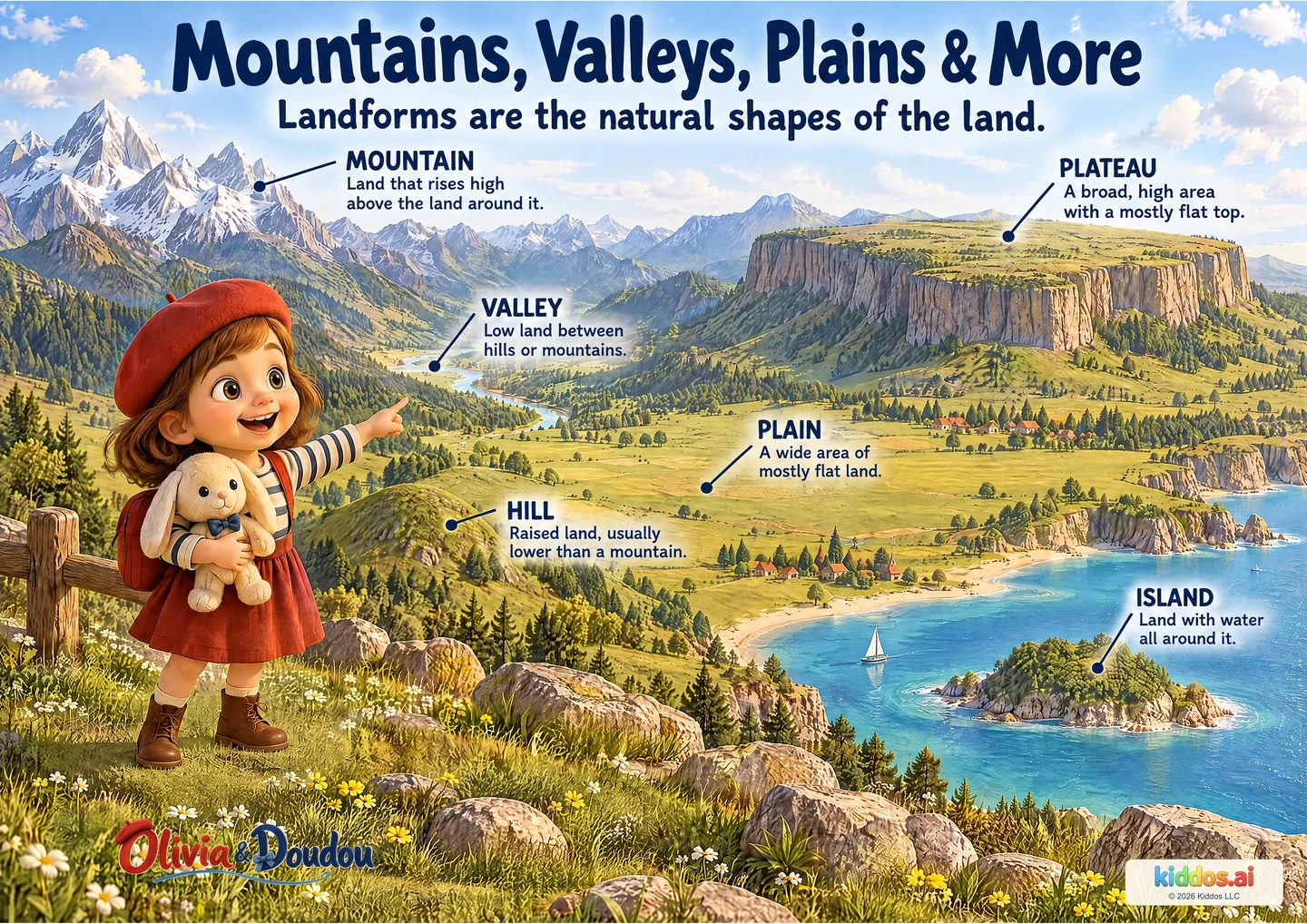
Look across the landscape with Olivia. Ask your child to choose a shape that catches their eye, then read its label together.
Which two landforms look flat? How are they different?
Start here
Offer two pictured choices and read the definitions aloud.
Explore further
Ask why a plain and plateau can both be flat but are different landforms.
Three questions to share
1Which two landforms look flat? How are they different?
Answer cue: The plain and plateau both have broad, mostly flat surfaces. The plateau is raised above the land around it. Accept pointing and 'this one is higher.'
2Where is the valley? What is on either side?
Answer cue: The valley is the low land between the mountain slopes; the river follows its low floor in this illustration.
3What makes this piece of land an island?
Answer cue: Water goes all the way around it. Trace its shore with a finger or gaze.
If your child is unsure: Offer two pictured choices and read the definitions aloud.
Something to try together
Make two land shapes
You’ll need: A sheet of scrap paper, or just your hands.
- Fold or gently scrunch paper into a raised shape, or show one with your hand.
- Keep another part flat. Decide which part could stand for a hill or plain.
- Explain one difference. This is a simple model, not an exact-sized landscape.
What this can show
Can the child indicate the plateau's raised flat top and identify water around the island? Accept gestures before technical terms. Share the looking and vocabulary. No trip, cutting or materials purchase is needed.
Return to it: Compare a plain and a plateau: both can be flat, so what else must you notice?
Get the guide and discovery recordFor teachers · About 20 minutes
A small lesson with room to explore.
Learning aim: Identify and compare landforms by their shape and position.
Prepare: Read the picture and answer cues. Have the optional explorer’s notebook available. A sheet of scrap paper, or just your hands.
- 3 min
Notice
Notice: allow one minute for silent looking or pointing.
- 4 min
Compare
Compare: read plain and plateau, and invite children to show how they differ.
- 8 min
Try together
Fold or gently scrunch paper into a raised shape, or show one with your hand. Keep another part flat. Decide which part could stand for a hill or plain. Explain one difference. This is a simple model, not an exact-sized landscape.
- 5 min
Explain
Explain: children select two landforms and give one pictured difference.
Check the idea together
Can the child indicate the plateau's raised flat top and identify water around the island? Accept gestures before technical terms.
What to listen for
The plain and plateau both have broad, mostly flat surfaces. The plateau is raised above the land around it. Accept pointing and 'this one is higher.' The valley is the low land between the mountain slopes; the river follows its low floor in this illustration. Water goes all the way around it. Trace its shore with a finger or gaze.
Describe the position and shape, not only its color; children may point, sign, speak or use eye gaze.