Five minutes together
Look. Wonder. Talk.
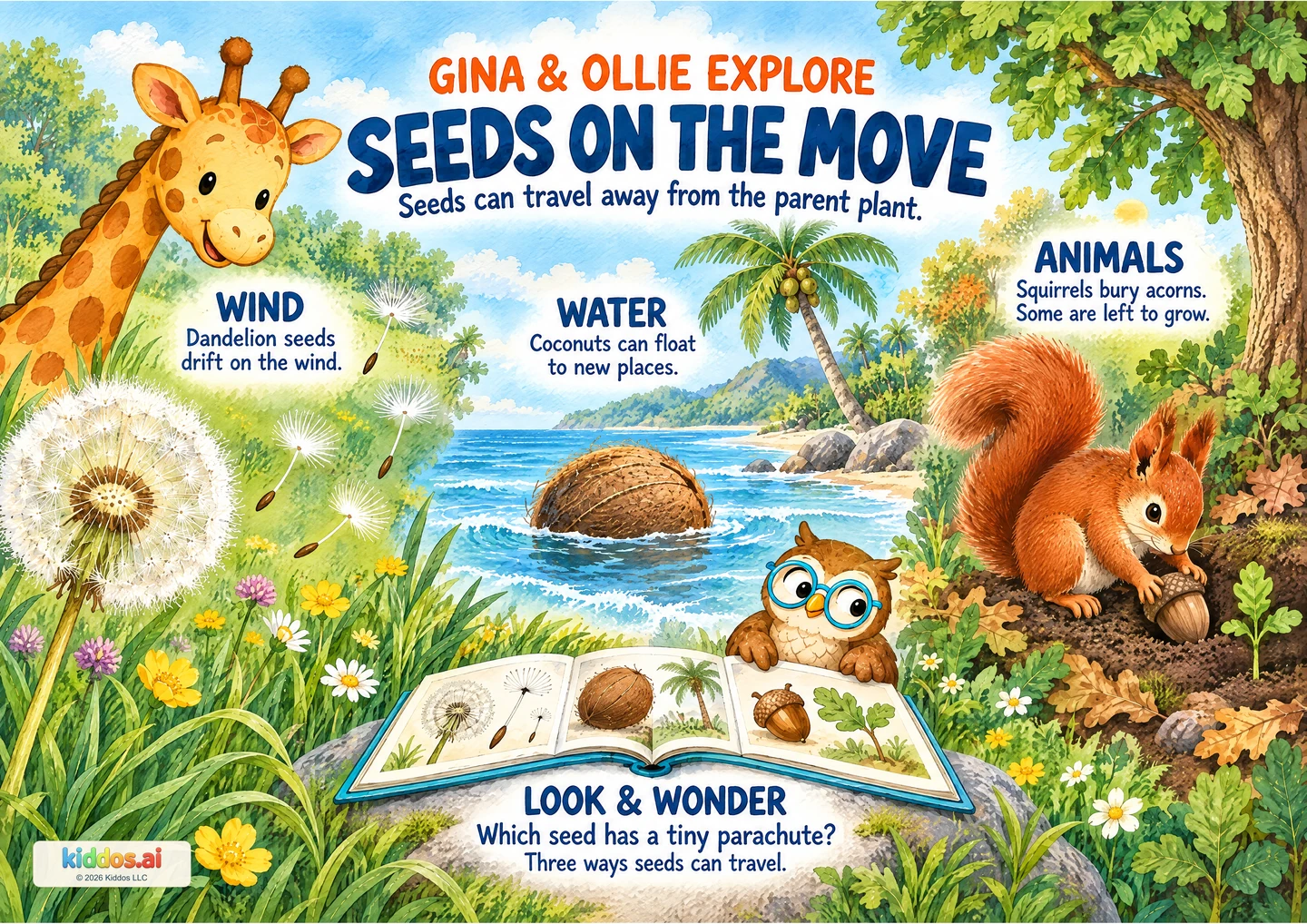
Our discovery: Match each named seed example to wind, water or an animal.
Remember: Moving pollen can help flowers make seeds. How might those new seeds reach another place?
Revisit that discoveryLook at one example at a time and ask what helps the seed move. Connect the dandelion to wind, the coconut to water and the acorn to the squirrel. Explain that some buried acorns are left to grow. These examples introduce different journeys; they are not a complete list of ways seeds spread.
Choose a seed in the picture. What might help it travel?
Start here
Find the dandelion’s parachute-like shape.
Explore further
Compare two seed journeys. Which pictured feature or helper is different?
Three questions to share
1Which seed has a parachute-like shape?
Answer cue: The dandelion seed.
2What helps the coconut travel in this example?
Answer cue: Water; it can float.
3How can a squirrel help an acorn become a new plant?
Answer cue: It buries acorns, and some are left to grow.
If your child is unsure: Let’s use one clue together. Find the dandelion’s parachute-like shape.
Something to try together
Plan a pictured seed journey
You’ll need: The poster and an adult; optional paper and drawing materials. Describing or pointing is enough.
- Choose the dandelion, coconut or acorn in the poster.
- Draw or describe its starting place, helper and possible destination.
- Use a label to explain the route. Keep imaginary details separate from the named example.
What this can show
Dandelion uses wind, coconut can float in water, and squirrels can bury acorns. These examples do not describe every seed.
Return to it: Look back at your seed journey. What would need to happen for a new plant to begin growing?
Get the guide and discovery recordFor teachers · About 20 minutes
A small lesson with room to explore.
Learning aim: Match each named seed example to wind, water or an animal.
Prepare: Read the poster, answer cues and misconception note. Prepare only the materials named in the activity; keep a picture-only or described option available.
- 3 min
Reconnect and wonder
How might a seed reach a new place? Invite an initial idea; record it without marking it right or wrong.
- 4 min
Look together
Find the dandelion’s parachute-like shape. Introduce dispersal using the poster.
- 8 min
Investigate or represent
Use “Plan a pictured seed journey.” Let pairs take turns noticing and recording, with adult help and the activity’s stated boundaries.
- 5 min
Explain and return
Ask the core check: How might a seed reach a new place? Accept pointing, words, signing or a drawing. If the learner is ready, offer this optional extension: Compare two seed journeys. Which pictured feature or helper is different?
Check the idea together
How might a seed reach a new place?
What to listen for
In these examples, wind carries dandelion seeds, water can carry coconuts, and squirrels bury acorns that may be left to grow. Dandelion uses wind, coconut can float in water, and squirrels can bury acorns. These examples do not describe every seed.
Accept pointing, speech, signing, a drawing or adult dictation. Describe the illustration and use labels/position as well as color. Offer one contrast first, and use the extension when the learner is ready.