Five minutes together
Look. Wonder. Talk.
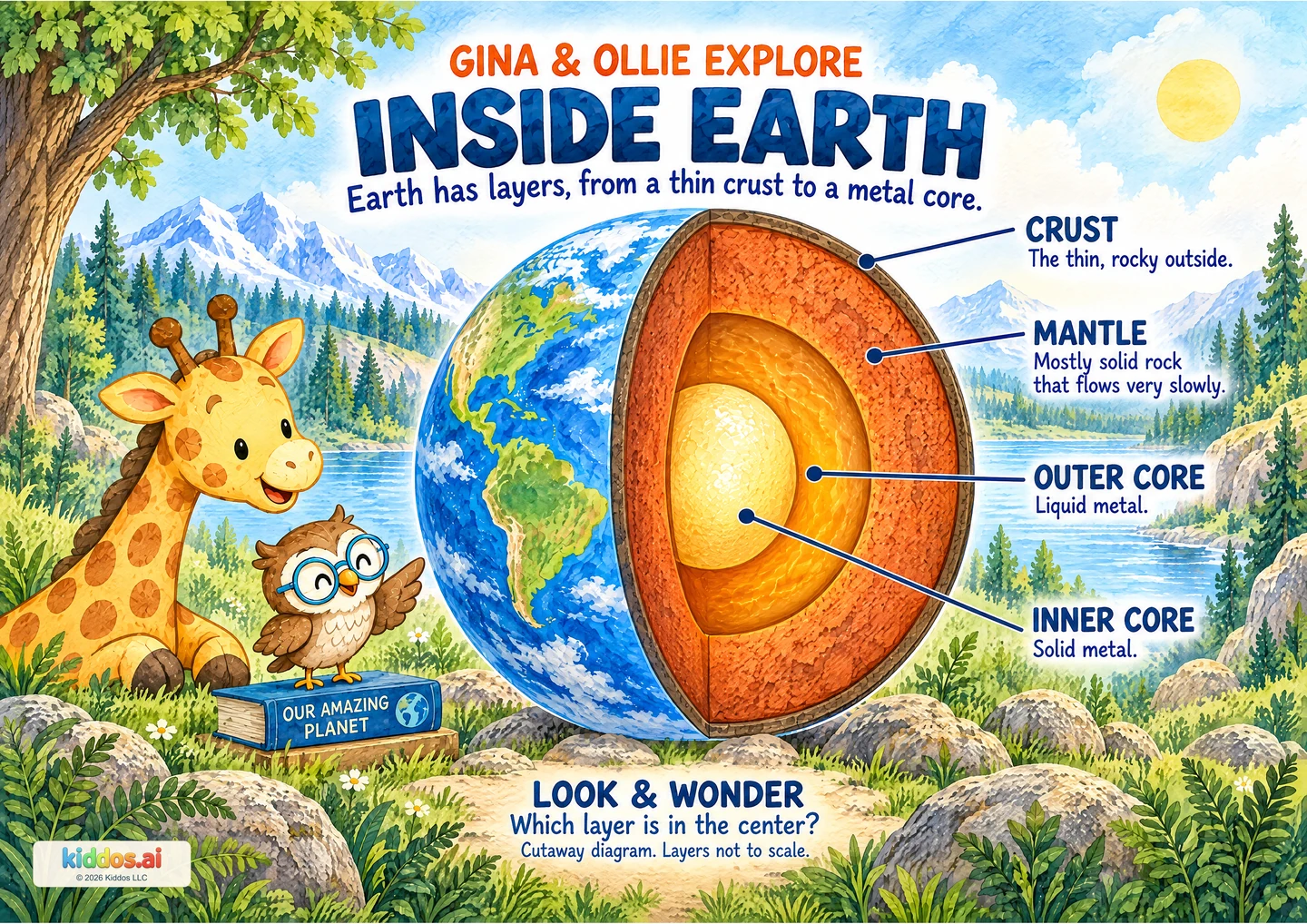
Our discovery: Name the outside and center layers and recognize the cutaway as a simplified model.
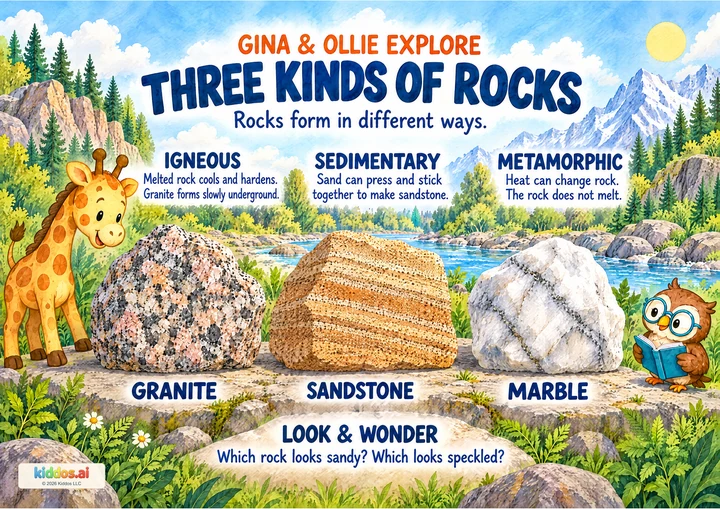
Remember: We compared rock formation stories. Now zoom out from individual rocks to a model of Earth’s layers.
Revisit that discoveryExplain that a cutaway is an imagined sliced-open view that helps us study hidden layers. Follow the labels from outside to center. Keep the contrasts clear: the crust is rocky, the mantle is mostly solid and flows very slowly, the outer core is liquid metal, and the inner core is solid metal.
Imagine we could look inside Earth. Which layer would you like to explore first?
Start here
Trace from the crust on the outside to the inner core in the center.
Explore further
Compare the solid inner core and liquid outer core without assuming all hot layers are liquid.
Three questions to share
1Which layer do we find on the outside?
Answer cue: The thin, rocky crust.
2Which core layer is liquid?
Answer cue: The outer core.
3Is the mantle a giant ocean of liquid?
Answer cue: No. It is mostly solid and can flow very slowly.
If your child is unsure: Let’s use one clue together. Trace from the crust on the outside to the inner core in the center.
Something to try together
Explain a cutaway
You’ll need: The poster and an adult; optional paper and drawing materials. Describing or pointing is enough.
- Draw nested shapes or follow the poster’s cutaway with a description.
- Label crust, mantle, outer core and inner core from the outside inward.
- Tell which parts the drawing helps explain and why its colors and layer widths should not be measured as exact reality.
What this can show
The mantle is mostly solid rock that flows very slowly; the outer core is liquid metal and inner core solid metal. The diagram is not a photograph of an opened Earth.
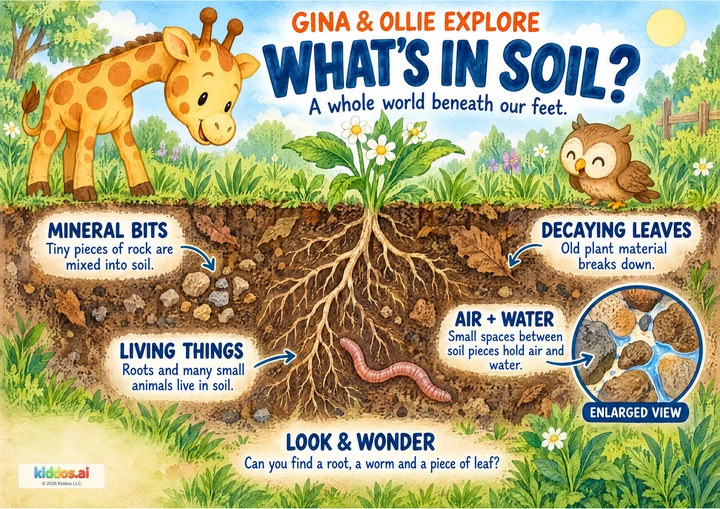
Return to it: Compare with the Soil enlarged view. How do both drawings help show something hidden, and how are their scales different?
Get the guide and discovery recordFor teachers · About 20 minutes
A small lesson with room to explore.
Learning aim: Name the outside and center layers and recognize the cutaway as a simplified model.
Prepare: Read the poster, answer cues and misconception note. Prepare only the materials named in the activity; keep a picture-only or described option available.
- 3 min
Reconnect and wonder
How can a diagram help us explore something we cannot see directly? Invite an initial idea; record it without marking it right or wrong.
- 4 min
Look together
Trace from the crust on the outside to the inner core in the center. Introduce crust using the poster.
- 8 min
Investigate or represent
Use “Explain a cutaway.” Let pairs take turns noticing and recording, with adult help and the activity’s stated boundaries.
- 5 min
Explain and return
Ask the core check: How can a diagram help us explore something we cannot see directly? Accept pointing, words, signing or a drawing. If the learner is ready, offer this optional extension: Compare the solid inner core and liquid outer core without assuming all hot layers are liquid.
Check the idea together
How can a diagram help us explore something we cannot see directly?
What to listen for
The layers from outside to center are crust, mantle, outer core and inner core. The cutaway helps show their arrangement, but is not a photograph or exact scale model. The mantle is mostly solid rock that flows very slowly; the outer core is liquid metal and inner core solid metal. The diagram is not a photograph of an opened Earth.
Accept pointing, speech, signing, a drawing or adult dictation. Describe the illustration and use labels/position as well as color. Offer one contrast first, and use the extension when the learner is ready.