Five minutes together
Look. Wonder. Talk.
Our discovery: Point to a color, pattern or outline that helps explain blending in.
Remember: We thought about an animal’s surroundings. How might those surroundings affect how easy the animal is to notice?
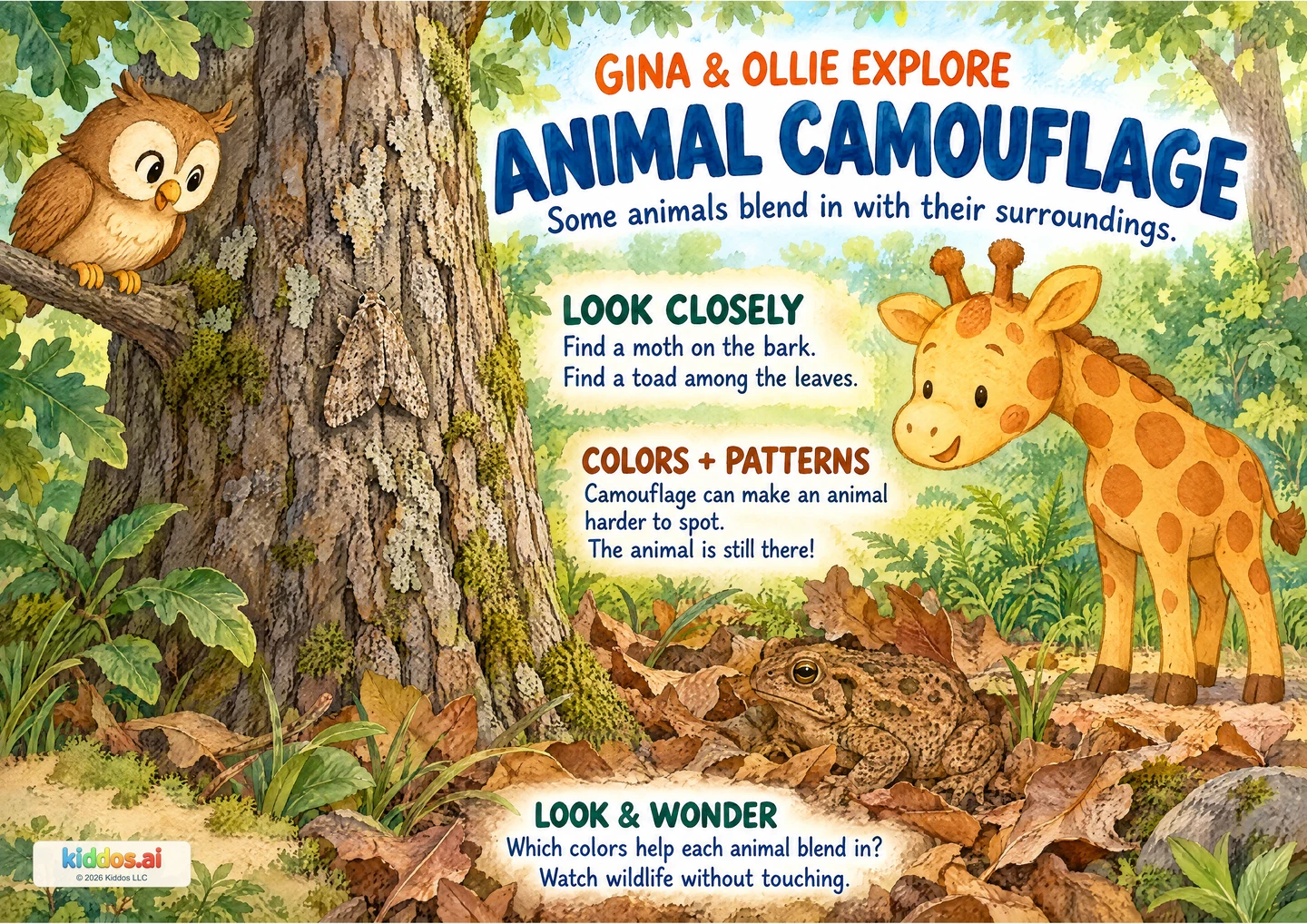
Revisit that discoveryGive your child time to search before offering clues. Begin with the moth on the bark, then look among the leaves for the toad. If either is hard to find, offer one location or shape clue and discover it together. Compare each animal with its background: similar colors and patterns can make the outline less obvious. That is camouflage. The animals are still there; they have not become invisible. You can point, describe, sign or listen together, and finding just one is enough.
Let’s take a quiet look. Do you notice an animal shape anywhere?
Start here
Take your time finding the moth or toad. Ask for one clue whenever you want.
Explore further
Imagine the moth against plain white paper. Explain which clue might become easier to see.
Three questions to share
1What helped you notice the moth or the toad?
Answer cue: Accept any visible clue: an outline, an eye, a body shape or a change in pattern. The moth is on the trunk; the toad is among the leaves.
2Which colors or patterns match each animal’s surroundings?
Answer cue: The moth’s gray-brown pattern resembles bark. The toad’s earthy brown coloring resembles the leaf litter.
3Does camouflage make the animal disappear?
Answer cue: No. The animal is still present. Its colors and patterns can make it harder to notice against that background.
If your child is unsure: Let’s use one clue together. Take your time finding the moth or toad. Ask for one clue whenever you want.
Something to try together
Change the imagined background
You’ll need: The poster and an adult; optional paper and drawing materials. Describing or pointing is enough.
- Find or have an adult describe one of the poster’s animals.
- Draw or imagine the same animal against a very different background.
- Compare the two scenes and explain which details may stand out. Finding quickly is not the goal.
What this can show
The animal remains present. Its colors and patterns can make it harder to spot; this picture does not show it choosing to change color.
Return to it: Return to the original scene. Which clue would you offer someone else without giving away the whole discovery?
Get the guide and discovery recordFor teachers · About 20 minutes
A small lesson with room to explore.
Learning aim: Point to a color, pattern or outline that helps explain blending in.
Prepare: Read the poster, answer cues and misconception note. Prepare only the materials named in the activity; keep a picture-only or described option available.
- 3 min
Reconnect and wonder
What makes an animal harder to notice against a background? Invite an initial idea; record it without marking it right or wrong.
- 4 min
Look together
Take your time finding the moth or toad. Ask for one clue whenever you want. Introduce camouflage using the poster.
- 8 min
Investigate or represent
Use “Change the imagined background.” Let pairs take turns noticing and recording, with adult help and the activity’s stated boundaries.
- 5 min
Explain and return
Ask the core check: What makes an animal harder to notice against a background? Accept pointing, words, signing or a drawing. If the learner is ready, offer this optional extension: Imagine the moth against plain white paper. Explain which clue might become easier to see.
Check the idea together
What makes an animal harder to notice against a background?
What to listen for
Matching colors or patterns can make an animal harder to notice against a particular background. The animal is still there. The animal remains present. Its colors and patterns can make it harder to spot; this picture does not show it choosing to change color.
Accept pointing, speech, signing, a drawing or adult dictation. Describe the illustration and use labels/position as well as color. Offer one contrast first, and use the extension when the learner is ready.