From story to discovery
Try it together.
Stay shut… or open? Gina has folded the petals in. What will water change?
Gather
Plain uncoated printer paper, adult-handled scissors and a wide unbreakable dish with shallow cool water.
Adult setup — read before trying
Adult cuts a palm-sized flower with broad separate petals, without cutting through the center. Fold gently inward; no glue or tape. Adult stays beside water. Keep scraps/craft from mouths; collect scraps, wipe spills and empty water afterward.
- Ask an adult to cut a flower with broad, separate petals. Plain printer paper works.
- Fold each petal inward over the center. Keep the folds gentle; no glue.
- Add shallow water to the dish. Float the flower, folds up. Wait without pushing petals.
- Keep the same
- The same paper flower placed folds-up and left untouched.
- What changes
- Paper absorbs water over time.
- Look for
- Notice which petals unfold and compare the folded and open shapes.
Make sense of what happened
Water enters the paper’s tiny spaces. Fibers absorb water and swell, helping creases relax and petals unfold.
This is not living growth. Paper, coatings, tight folds and overlapping petals affect opening; some flowers sink or soften first.
Full grown-up notes, setup details & honest limits
Set up together. An adult cuts a simple palm-sized flower from ordinary uncoated printer paper, with several broad, distinct petals joined to a center. Six petals are shown, but an exact count is not required. Avoid deep cuts through the center and narrow petals that interlock. A child can choose the shape, predict or direct the adult. Fold each petal gently inward over the center. Use no tape or glue. Coloring is optional: a little colored pencil is enough; plain white paper works well. Heavy crayon, glossy coatings and thick card can slow or prevent wetting.
Float, then wait. Put a shallow layer of cool or room-temperature water in a wide unbreakable dish on a level, protected surface. An adult stays beside the child. Place the folded flower flat on the surface with the folded petals facing up. Let go and watch for up to a few minutes without pushing petals, submerging the flower or moving the dish. Ask what changed and which petal moved first. There is no promised opening time or required order. Wipe spills and empty the water after use; keep paper scraps away from mouths and collect them.
Explain what changed. Paper contains plant fibers. Water enters the paper, including through tiny spaces by capillary action. As the fibers absorb water and swell, the creased paper can relax and the petals unfold. The diagram is simplified and not to scale; no visible force, plant growth or life is being created. The same cut paper has changed shape. Real plants grow through living processes, so this craft is not a model of how a seed becomes a plant.
If it stays folded, investigate calmly. Paper type, thickness, coatings, petal overlap and tight creases affect the result. Try a fresh flower with broad petals, gentle folds and ordinary thin uncoated paper. Give it time. Do not add heat, soap or other liquids. Some petals may open unevenly; some flowers sink or soften before fully opening. Stop before the paper breaks up, then clear it away. For a second test, keep shape and folds similar and change only the paper type; compare observations without declaring one result a failure.
Reuse the observation. A small group can predict with words, pointing or a drawing while the adult places the flower. Children can draw the folded and open shapes or describe one difference. For a stronger comparison, make two similar flowers from the same paper, fold them alike and leave one on a dry plate while placing the other on water. Keep both away from breezes, observe for the same period, and note whether either dry fold loosens on its own. How Does It Grow? is optional related reading about living plants, not the source of this paper experiment. Do not taste the craft or imitate eating an unidentified plant. No live family trial or measured learning improvement is claimed.
A conversation, not a quiz
Leave room for their idea.
Leave space for waiting, without pushing petals open to match the picture.
Stay shut… or open? Gina has folded the petals in. What will water change?
A cue for the grown-up
Welcome a guess before reading the result. No correct prediction is required.
Which part moved first?
A cue for the grown-up
Describe the actual petals; there is no required order or opening time.
Did we grow a living flower?
A cue for the grown-up
No. The same cut paper unfolded as it became wet.
A simple way in
Use broad petals and gentle folds in plain paper with no heavy wax coating.
Another thing to notice
Compare two similarly folded flowers: one on a dry plate and one on water.
Come back to it
Ask what is different between this paper flower and a living seedling.
For teachers
A small-group discovery.
Flexible 20-minute small-group session; pause or shorten as needed.
Prepare the named materials and adult setup above. One adult-led demonstration is a useful option.
- 3 min
Wonder
Read pages 1–2. Invite a prediction with words, pointing or a sketch; keep the result hidden.
- 4 min
Notice the story
Read pages 3–5. How did the flower’s shape change between the pictures? These still pictures do not tell us which petal moved first. Separate the observation from the explanation.
- 9 min
Try together
Use the materials and adult setup on this guide, then follow the activity steps in this guide. Notice which petals unfold and compare the folded and open shapes.
- 4 min
Make meaning
Did we grow a living flower? Invite a drawing, a description or an adult-written note. Leave space for waiting, without pushing petals open to match the picture.
What to listen for
Did we grow a living flower?
Answer guidance
No. The same cut paper unfolded as it became wet.
Ways to take part
Use broad petals and gentle folds in plain paper with no heavy wax coating. Accept pointing, words, a drawing or adult-directed action. Use the story alone if the activity is unsuitable.
Record an observation with a drawing, a gesture described by an adult or a sentence. No timed performance or winning prediction is needed.
All the story words.
Read aloud, enlarge the browser text, or use this text alongside the pictures.
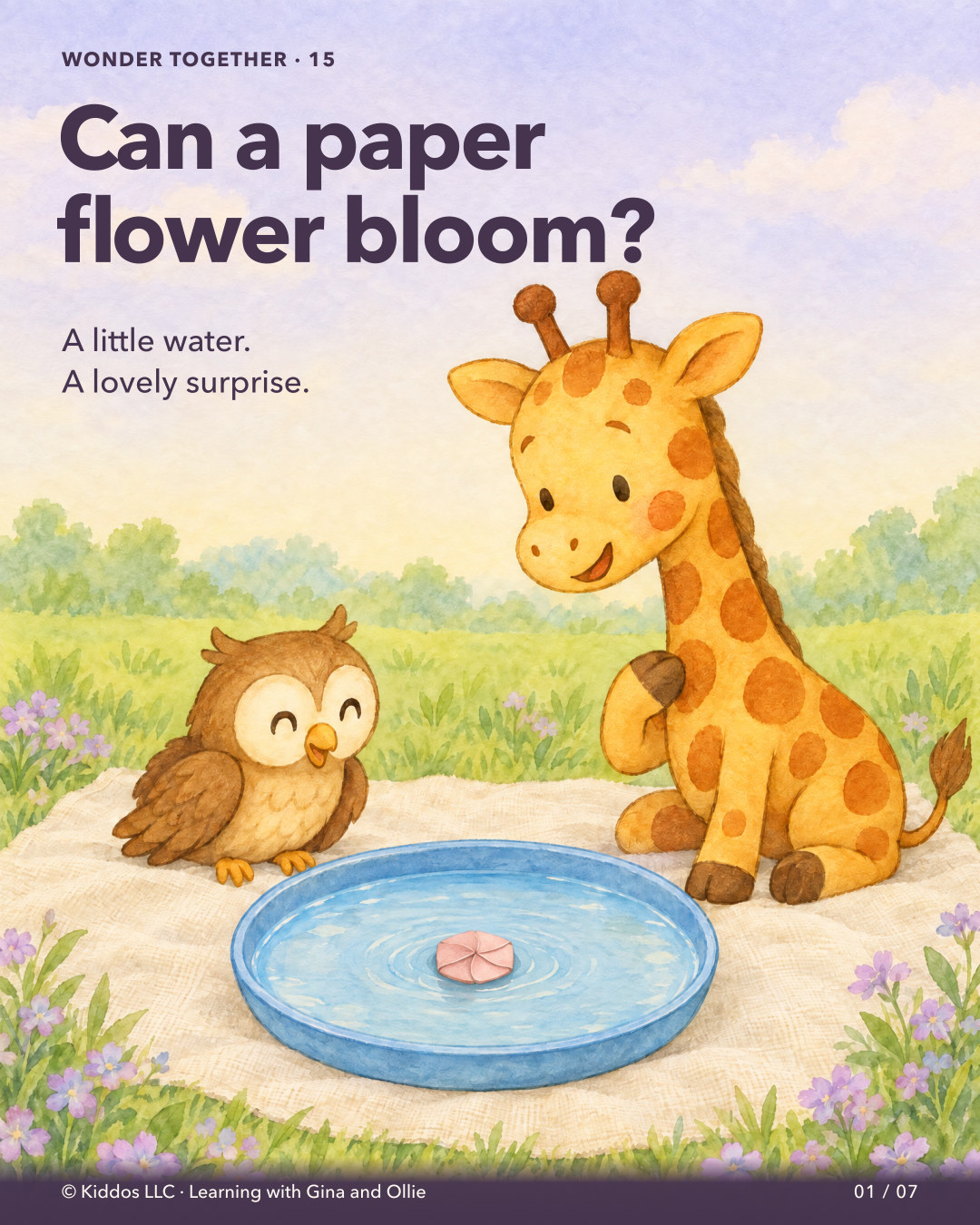
Page 1 · Can a paper flower bloom?
WONDER TOGETHER · 15 Can a paper flower bloom? A little water. A lovely surprise. © Kiddos LLC · Learning with Gina and Ollie 01 / 07
Picture description: Gina the golden giraffe and small brown owl Ollie watch a closed, folded pink paper flower floating in a shallow blue dish on a cream ground cloth in their meadow. The overlapping petals still hide the center.
Page 2 · Stay shut… or open?
GUESS BEFORE YOU SWIPE Stay shut… or open? Gina has folded the petals in. What will water change? Make a guess together. © Kiddos LLC · Learning with Gina and Ollie 02 / 07
Picture description: The folded pink paper flower rests dry on the cream cloth beside the blue water dish. Gina and Ollie look at its overlapping inward-folded petals. The result remains hidden.
Page 3 · Float. Then wait.
TRY ONE SMALL CHANGE Float. Then wait. Gina sets it on the water, folded petals facing up. Look closely. Give it time. © Kiddos LLC · Learning with Gina and Ollie 03 / 07
Picture description: The same folded pink paper flower now floats at the center of the same blue dish. Its petals still overlap inward. Gina has withdrawn her hoof, leaving the flower untouched while Ollie watches.
Page 4 · Hello, petals!
WATCH WHAT CHANGES Hello, petals! The folds relax. The petals open out. Same paper. A new shape. © Kiddos LLC · Learning with Gina and Ollie 04 / 07
Picture description: From the same viewpoint, the same pink paper flower has unfolded on the water, showing six rounded petals and its center. The blue dish, water level, characters and light remain the same; neither character touches the flower.
Page 5 · Water wakes the folds.
FOLDED OPENED DRY FIBERS WET FIBERS Simplified view THE PART TO REMEMBER Water wakes the folds. Paper has tiny fibers. They take in water and swell. The folds can relax and open. It unfolds. It does not grow. © Kiddos LLC · Learning with Gina and Ollie 05 / 07
Picture description: A simplified diagram compares a folded pink paper flower with its opened shape on water. An arrow shows the sequence. A small diagram below compares thinner dry paper fibers with swollen wet fibers; labels explain water absorption. This is a model, not a magnified photograph.
Page 6 · Make a paper bloom.
1 Ask an adult to cut a flower with broad, separate petals. Plain printer paper works. 2 Fold each petal inward over the center. Keep the folds gentle; no glue. 3 Add shallow water to the dish. Float the flower, folds up. Wait without pushing petals. TRY IT TOGETHER Make a paper bloom. With an adult: plain paper, scissors, a shallow unbreakable dish and cool water. Which petal opens first? Adult handles scissors and stays close. Wipe spills; empty the dish when finished. © Kiddos LLC · Learning with Gina and Ollie 06 / 07
Picture description: Three illustrated steps show a simple flower cut from plain paper, petals folded toward the center, and the folded flower placed on shallow water with the folds facing up. The adult handles scissors and stays close. The family watches without pushing the petals.
Page 7 · Paper unfolds. Plants grow.
KEEP EXPLORING TOGETHER Paper unfolds. Plants grow. Meet a real growing plant in How Does It Grow? Parents: read together in Kiddos Books. Kiddos Books · Read with confidence. © Kiddos LLC · Learning with Gina and Ollie 07 / 07
Picture description: After the activity is cleared away, Gina and Ollie share a wordless picture book showing a seedling and a leafy plant in a pot. The invitation names How Does It Grow?, a separate story about living plants.
Where the explanation comes from.
Related storybooks invite further reading. The factual sources below support the investigation; illustration diagrams simplify what happens.