From story to discovery
Try it together.
Only the tip will dip. Will the water stay at the bottom— or travel up the towel?
Gather
A stable unbreakable cup, a little room-temperature water and absorbent paper towel.
Adult setup — read before trying
An adult tears a narrow strip and holds it upright over a wipeable surface. Dip only the bottom tip and keep it immersed. Optional food coloring is adult-handled; no drinking experiment water. Wipe spills and empty the cup afterward.
- With an adult, put a little room-temperature water in a stable unbreakable cup.
- Tear a narrow paper-towel strip; hold it upright and dip only the bottom tip.
- Keep the bottom immersed and wait while the child watches the wet edge.
- Describe where the paper became wet, then wipe up any spills.
- Keep the same
- The same strip, cup, water level and immersed tip.
- What changes
- Time passes as water spreads through the paper.
- Look for
- Find the wet edge above the water surface in the cup.
Make sense of what happened
Water is attracted to the paper fibers and to other water molecules. It can move through tiny spaces in the towel by capillary action.
Gravity still acts and limits the rise. Towel type changes timing and height; blue color is only a visibility aid.
Full grown-up notes, setup details & honest limits
Put a stable unbreakable cup with a little room-temperature water on a wipeable surface. An adult tears a narrow strip of absorbent paper towel, holds it vertically and lowers only its bottom tip into the water. Keep that end immersed and the rest above the water surface. Watch the wet edge spread; timing and height vary with the towel and setup. Try a fresh dry strip if it folds into the cup or the wet area is hard to see. Optional food coloring helps visibility; an adult handles it, and the experiment water is not for drinking. A child can guess, point, describe or direct the adult without gripping or reading. Accept their first idea before explaining. Paper contains tiny fibers and spaces. Attraction between water and the fibers, together with water’s attraction to itself, helps draw water through these spaces. This is capillary action; gravity still acts and limits how far water can rise. The blue tint is a visibility aid, not the cause. The enlarged fiber diagram is simplified, not to scale. The related book explores the water cycle; it is an invitation to another water adventure, not the factual source for this experiment.
A conversation, not a quiz
Leave room for their idea.
Wait with your child before pointing out the wet edge; let them spot the change.
Only the tip will dip. Will the water stay at the bottom— or travel up the towel?
A cue for the grown-up
Welcome a guess before reading the result. No correct prediction is required.
Is the wet patch only below the cup’s waterline?
A cue for the grown-up
An absorbent towel can become wet above that waterline.
Would coloring be needed to make the water move?
A cue for the grown-up
No. Plain water can move through the towel too.
A simple way in
Use a fresh dry narrow strip with a clear, easy-to-see wet edge.
Another thing to notice
Try a second towel type with the same tip depth and compare what you actually see.
Come back to it
Notice a paper towel soaking up a spill and connect the wet spreading to this test.
For teachers
A small-group discovery.
Flexible 20-minute small-group session; pause or shorten as needed.
Prepare the named materials and adult setup above. One adult-led demonstration is a useful option.
- 3 min
Wonder
Read pages 1–2. Invite a prediction with words, pointing or a sketch; keep the result hidden.
- 4 min
Notice the story
Read pages 3–5. Is the wet patch only below the cup’s waterline? Separate the observation from the explanation.
- 9 min
Try together
Use the materials and adult setup on this guide, then follow the activity steps in this guide. Find the wet edge above the water surface in the cup.
- 4 min
Make meaning
Would coloring be needed to make the water move? Invite a drawing, a description or an adult-written note. Wait with your child before pointing out the wet edge; let them spot the change.
What to listen for
Would coloring be needed to make the water move?
Answer guidance
No. Plain water can move through the towel too.
Ways to take part
Use a fresh dry narrow strip with a clear, easy-to-see wet edge. Accept pointing, words, a drawing or adult-directed action. Use the story alone if the activity is unsuitable.
Record an observation with a drawing, a gesture described by an adult or a sentence. No timed performance or winning prediction is needed.
All the story words.
Read aloud, enlarge the browser text, or use this text alongside the pictures.
Page 1 · Can water climb?
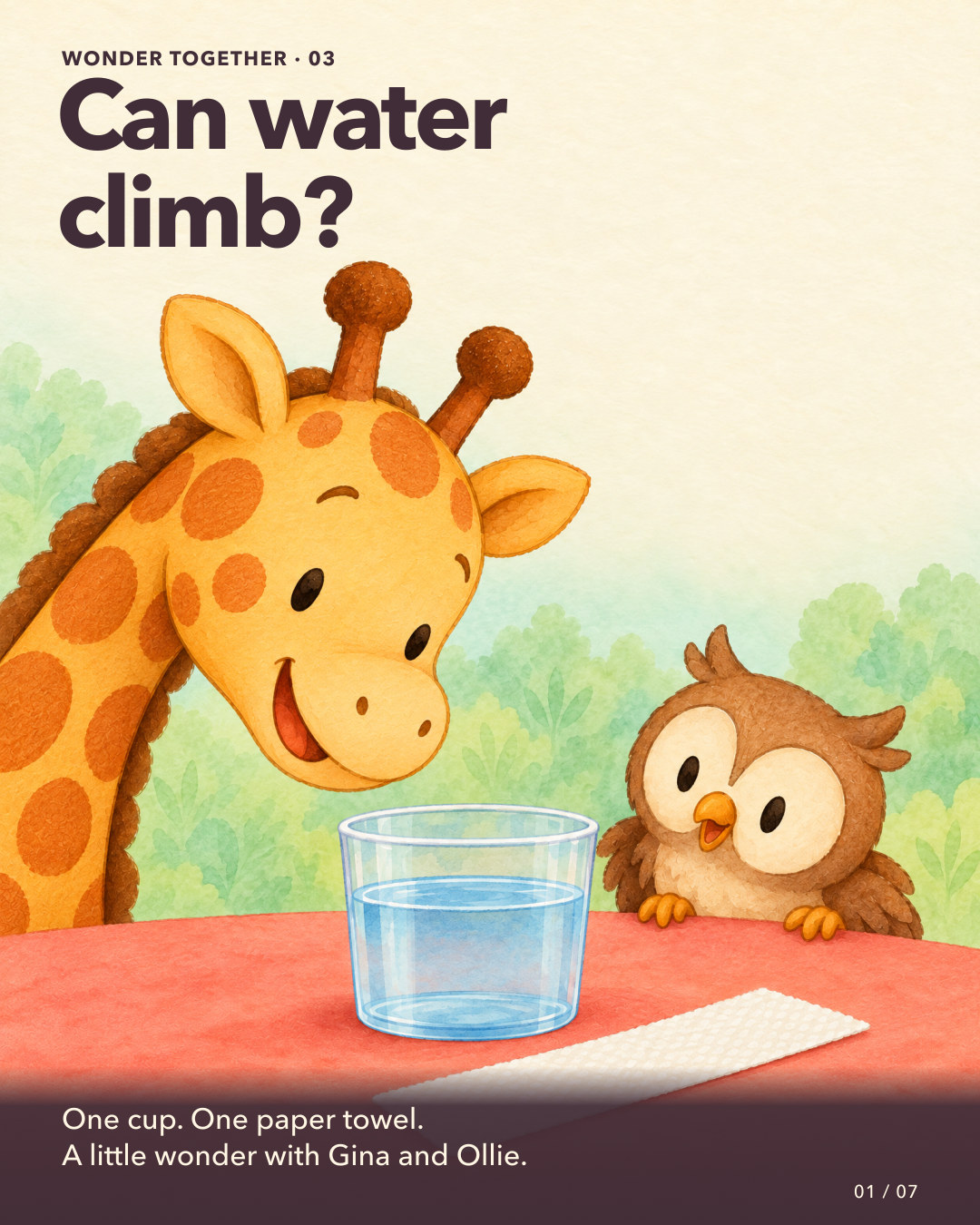
WONDER TOGETHER · 03 Can water climb? One cup. One paper towel. A little wonder with Gina and Ollie. 01 / 07
Picture description: Gina and little Ollie lean toward a clear cup of blue-tinted water and a dry paper-towel strip. The large title asks whether water can climb.
Page 2 · Only the tip will dip.
GUESS BEFORE YOU SWIPE Only the tip will dip. Will the water stay at the bottom— or travel up the towel? Make a guess together. 02 / 07
Picture description: Gina holds one dry paper-towel strip vertically above the water in a clear cup. Its bottom end has not touched the water. Ollie watches. Predict whether the water will stay at the bottom of the towel or travel upward.
Page 3 · A little dip. A wet tip.
FIRST, DIP A little dip. A wet tip. Gina dips just the bottom end. Keep the rest above the water. 03 / 07
Picture description: In the same tabletop view, Gina lowers the same strip until only its bottom end enters the water. The wet patch is still near the tip; most of the paper towel remains dry above the water surface.
Page 4 · Look how far it traveled!
NOW, WAIT AND WATCH Look how far it traveled! The wet patch is above the water in the cup. Same cup. Same towel. More time. 04 / 07
Picture description: The cup, water surface, Gina’s holding position and camera remain the same as the first dip. After waiting, a blue wet patch has spread higher along the towel, clearly above the water surface. The towel’s bottom end remains in the water.
Page 5 · Tiny spaces. A way up.
DRY WET SIMPLIFIED CLOSE-UP THE PART TO REMEMBER Tiny spaces. A way up. Water clings to the paper’s fibers, drawing more water along. This is called capillary action. 05 / 07
Picture description: A simplified enlarged drawing shows tangled paper fibers with wet blue spaces below and dry spaces above. A small upward arrow indicates the direction the wet region spreads. It is a diagram, not a microscopic photograph or pipes inside the towel.
Page 6 · Your child spots the climb.
HOLD HERE WATER LEVEL TRY IT TOGETHER Your child spots the climb. Tear a strip of paper towel. Hold it upright. Dip just the tip in a little water. Wait and watch. Optional: an adult adds a drop of food coloring. Ask: “Where is it wet now?” With an adult. Use an unbreakable cup. Keep the tip dipped. Wipe up spills. 06 / 07
Picture description: A clear diagram shows a paper-towel strip held upright, with its bottom tip immersed in a small amount of water in a stable unbreakable cup. The upper towel stays out of the water. With an adult, the child can point to the wet edge while the adult holds the strip. Wipe up spills.
Page 7 · Where will water go next?
KEEP THE WONDER GOING Where will water go next? Read Where Did My Water Go? together. Parents: explore the story in Kiddos Books. Kiddos Books · Read with confidence. 07 / 07
Picture description: Gina and small Ollie share an open picture book beside a quiet meadow puddle. The final invitation is for parents to read the water-cycle story Where Did My Water Go? together in Kiddos Books.
Where the explanation comes from.
Related storybooks invite further reading. The factual sources below support the investigation; illustration diagrams simplify what happens.