From story to discovery
Try it together.
Just black? Gina made one black dot. What might water reveal?
Gather
A white paper coffee filter, suitable water-soluble washable black marker, plastic plate, blunt teaspoon and a little room-temperature water.
Adult setup — read before trying
Follow the marker age/use label. Adult controls caps and helps drops; keep materials from mouths/eyes. Water only: no permanent markers, alcohol or solvents. Protect the surface; no tasting or using the filter for food. Wash hands/equipment and dispose of water afterward.
- Make a black dot on a dry white coffee filter. Rest it on a plastic plate.
- Drop water onto the dot. Just a few drops. Wait a few minutes.
- What colors can you see? Try another washable marker on a fresh filter.
- Keep the same
- The same dot and filter as water moves outward.
- What changes
- Adding a few drops of water, then waiting.
- Look for
- Look for differently placed bands, lighter areas or colors in the spreading ink.
Make sense of what happened
Water carries mobile colorants through paper. Different interactions with water and paper can separate some components of the ink.
Water does not create colors. Marker formulas differ: the story’s blue, pink and gold are one example, not a promised result.
Full grown-up notes, setup details & honest limits
Prepare together. Use a white paper coffee filter, a child-appropriate black water-soluble washable marker, a plastic plate, a blunt teaspoon and a small amount of room-temperature water in a plastic cup. Read the marker label and follow its age and use instructions. This version uses water only: do not substitute permanent markers, rubbing alcohol or other solvents. No cutting, glass or heated water is needed. Protect the surface; ink can stain. An adult stays beside the activity, controls marker caps and helps with drops. Keep ink, wet paper and caps away from mouths and eyes. Do not taste the water or use the wet filter for food. Wash hands and the plate/spoon afterward and dispose of leftover water promptly.
Try the reveal. Flatten the dry filter on the plate. Make one solid black dot about 1 cm across at its center, then cap the marker. Ask for a prediction before adding water. Put a little water in the teaspoon and let a few small drops fall onto the dot with adult help. Add water slowly rather than pouring a spoonful. Pause as it soaks through the paper; observe for a few minutes. Add another drop or two if the damp patch stops spreading before any separation appears. Stop before the filter is flooded or a puddle forms. Keep the plate still. The first and later pictures represent the same filter as time passes.
Understand the result. Many black marker inks contain several colorants. Water dissolves mobile components and carries them through the paper. Their differing interactions with the water and paper can separate them into visible bands: paper chromatography. Water does not create the colors. The illustrated blue, pink and gold are one example, not a guaranteed set, order or timing. Some washable markers separate only a little; paper type and ink formulation also matter. A permanent marker that does not move in water is not evidence that it contains only one color. Describe the result without blame. If needed, start again with a fresh filter and another suitable washable marker; never add another solvent.
Give the child a role. Welcome guesses without ranking them. Children can add drops with adult help, point to a band, compare its position, describe light and dark regions or draw what changed. No exact color name is required. Ask “What changed after we added water?” and “Were those colors already in the ink?” For a small group, prepare one supervised plate per turn and let children record a before/after sketch. To compare markers, keep the filter type, dot size and water amounts as similar as practical; change only the marker. Dry filters can become a record of the observation, kept away from younger children.
Read on. The Fizzy Volcano follows Gina and Ollie through a separate baking-soda-and-vinegar story. It does not contain this marker experiment. The current carousel separates an existing mixture; it does not claim that chromatography is the fizzy chemical reaction in that story. Illustrations and diagrams are editorial examples; no live family trial or measured learning improvement is claimed.
A conversation, not a quiz
Leave room for their idea.
Accept descriptions of shapes and light/dark without requiring exact color names.
Just black? Gina made one black dot. What might water reveal?
A cue for the grown-up
Welcome a guess before reading the result. No correct prediction is required.
What appeared as the water spread?
A cue for the grown-up
Describe any bands or light/dark areas, even when few colors separate.
Were the revealed colors made by the water?
A cue for the grown-up
No. They were components already in the ink.
A simple way in
Make a solid dot about 1 cm across, then use just a few small drops.
Another thing to notice
Compare another suitable marker on a fresh filter, keeping dot size and water similar.
Come back to it
Look at a dried filter and tell the before-and-after story.
For teachers
A small-group discovery.
Flexible 20-minute small-group session; pause or shorten as needed.
Prepare the named materials and adult setup above. One adult-led demonstration is a useful option.
- 3 min
Wonder
Read pages 1–2. Invite a prediction with words, pointing or a sketch; keep the result hidden.
- 4 min
Notice the story
Read pages 3–5. What appeared as the water spread? Separate the observation from the explanation.
- 9 min
Try together
Use the materials and adult setup on this guide, then follow the activity steps in this guide. Look for differently placed bands, lighter areas or colors in the spreading ink.
- 4 min
Make meaning
Were the revealed colors made by the water? Invite a drawing, a description or an adult-written note. Accept descriptions of shapes and light/dark without requiring exact color names.
What to listen for
Were the revealed colors made by the water?
Answer guidance
No. They were components already in the ink.
Ways to take part
Make a solid dot about 1 cm across, then use just a few small drops. Accept pointing, words, a drawing or adult-directed action. Use the story alone if the activity is unsuitable.
Record an observation with a drawing, a gesture described by an adult or a sentence. No timed performance or winning prediction is needed.
All the story words.
Read aloud, enlarge the browser text, or use this text alongside the pictures.
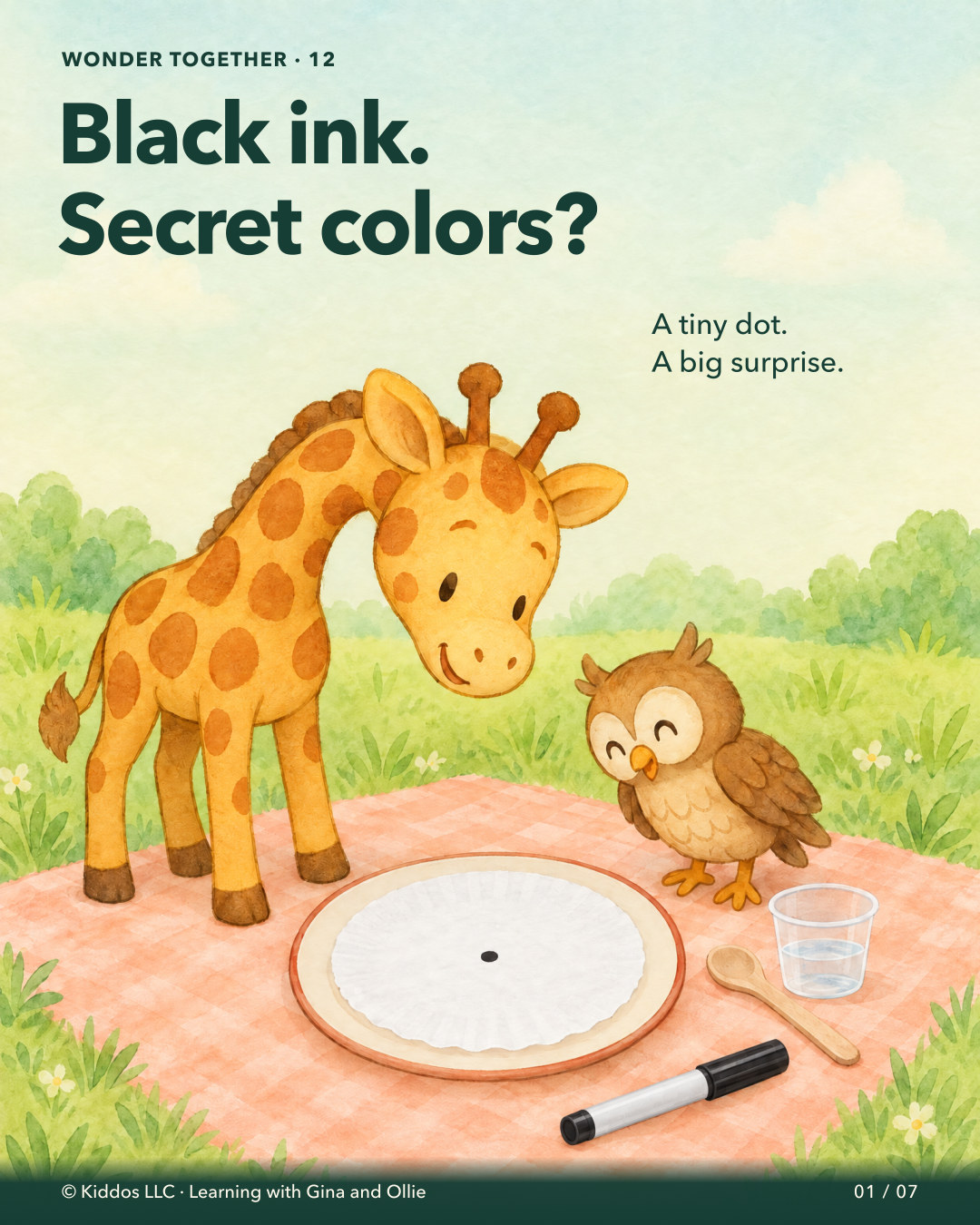
Page 1 · Black ink. Secret colors?
WONDER TOGETHER · 12 Black ink. Secret colors? A tiny dot. A big surprise. © Kiddos LLC · Learning with Gina and Ollie 01 / 07
Picture description: Gina the yellow giraffe and small brown owl Ollie lean toward a white coffee filter with one black ink dot, on a cream plastic plate. A black washable marker and water cup wait nearby on a warm peach picnic cloth. No separated colors are shown.
Page 2 · Just black?
GUESS BEFORE YOU SWIPE Just black? Gina made one black dot. What might water reveal? Share your guess before we try. © Kiddos LLC · Learning with Gina and Ollie 02 / 07
Picture description: The same dry white coffee filter has one black dot in its center. The cream plastic plate, capped marker and small water cup are unchanged. Gina and Ollie pause; no water has been added and the answer is not visible.
Page 3 · Drop. Wait. Watch.
ADD WATER, THEN WATCH Drop. Wait. Watch. Gina adds a few water drops. The paper starts to get wet. Give the water time to spread. © Kiddos LLC · Learning with Gina and Ollie 03 / 07
Picture description: Gina holds a small blunt teaspoon over the black dot on the coffee filter. A clear water drop falls onto the dot. The paper near the dot is just damp; distinct colored rings have not appeared yet. Ollie watches.
Page 4 · Colors were hiding!
A FEW MINUTES LATER Colors were hiding! Some colors travel farther. Now we can see them. Your marker may reveal different colors. © Kiddos LLC · Learning with Gina and Ollie 04 / 07
Picture description: In the same plate and camera view, the black dot has spread into irregular blue, pink and golden bands on the damp white coffee filter. A dark center remains. Gina and Ollie notice the change; the spoon now rests beside the plate. These colors illustrate one possible marker result.
Page 5 · One ink. A color mix.
BEFORE AFTER WATER SAME INK EXAMPLE RESULT THE PART TO REMEMBER One ink. A color mix. Many black markers mix colored inks. Water helps separate them. The colors were already there. © Kiddos LLC · Learning with Gina and Ollie 05 / 07
Picture description: A labeled diagram compares a filter with one black dot before water and the same filter with a dark center and separated color bands after water spreads. An arrow connects the before and after. This is a simplified example, not a promise of particular colors.
Page 6 · Reveal the colors.
1 Make a black dot on a dry white coffee filter. Rest it on a plastic plate. 2 Drop water onto the dot. Just a few drops. Wait a few minutes. 3 What colors can you see? Try another washable marker on a fresh filter. TRY IT TOGETHER Reveal the colors. With an adult: a black washable marker, a white coffee filter, a plastic plate, a teaspoon and a little water. Notice together. Every result is a clue. Water only. No tasting. Adult beside you. Keep caps from mouths. Wash hands. © Kiddos LLC · Learning with Gina and Ollie 06 / 07
Picture description: Three apparatus diagrams show making a black dot on a dry white coffee filter on a plastic plate, adding a few water drops with a teaspoon and waiting, then comparing another washable marker on a fresh filter. Written instructions call for adult supervision, no tasting, keeping caps from mouths and handwashing.
Page 7 · From colors to curious stories.
KEEP EXPLORING TOGETHER From colors to curious stories. Explore another science surprise in The Fizzy Volcano. Parents: read together in Kiddos Books. Kiddos Books · Read with confidence. © Kiddos LLC · Learning with Gina and Ollie 07 / 07
Picture description: Gina and Ollie settle together with an open picture book on a dry peach picnic cloth after tidying the marker activity away. A small illustrated toy volcano appears on the book pages. The parent invitation names The Fizzy Volcano as a separate science story.
Where the explanation comes from.
Related storybooks invite further reading. The factual sources below support the investigation; illustration diagrams simplify what happens.