From story to discovery
Try it together.
Which real place matches the star on your map?
Gather
A blue cloth; A yellow cushion; A small open basket; One familiar large toy; Paper and crayon.
Adult setup — read before trying
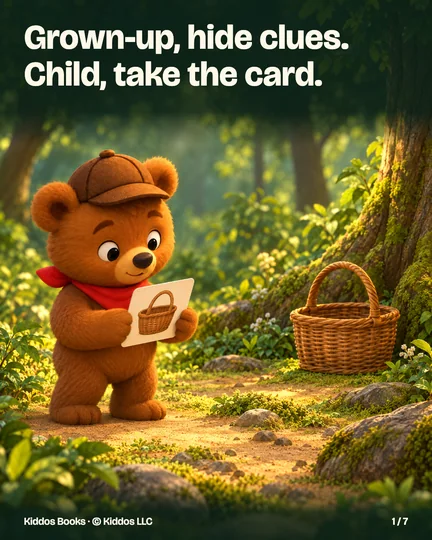
Arrange the cloth left, cushion right, and basket farther between them. Grown-up draws these places and stars the basket. Child looks away while the adult hides the toy fully below the basket rim, laying it on its side if needed. Then give the child the map.
- Grown-up arranges three familiar landmarks in one clear, reachable floor area. Draw them in the same arrangement and mark the chosen hiding place with a star.
- Child looks away while the adult hides the toy at the marked place. In the pictured basket, lay the duck fully below the rim, on its side if needed. Then hand over the map.
- Together, turn the map until its landmarks line up with the real space.
- Child points to the star, identifies the matching place, and looks there.
- Compare the found toy with the marked place, then let the child hide a toy and make a map for the adult.
- Keep the same
- The cloth is near-left, cushion near-right and basket farther between them. The first map keeps these three places and stars the basket.
- What changes
- Benny draws, hides, orients the map, follows its star and checks the basket. A new turn marks the cushion instead.
- Look for
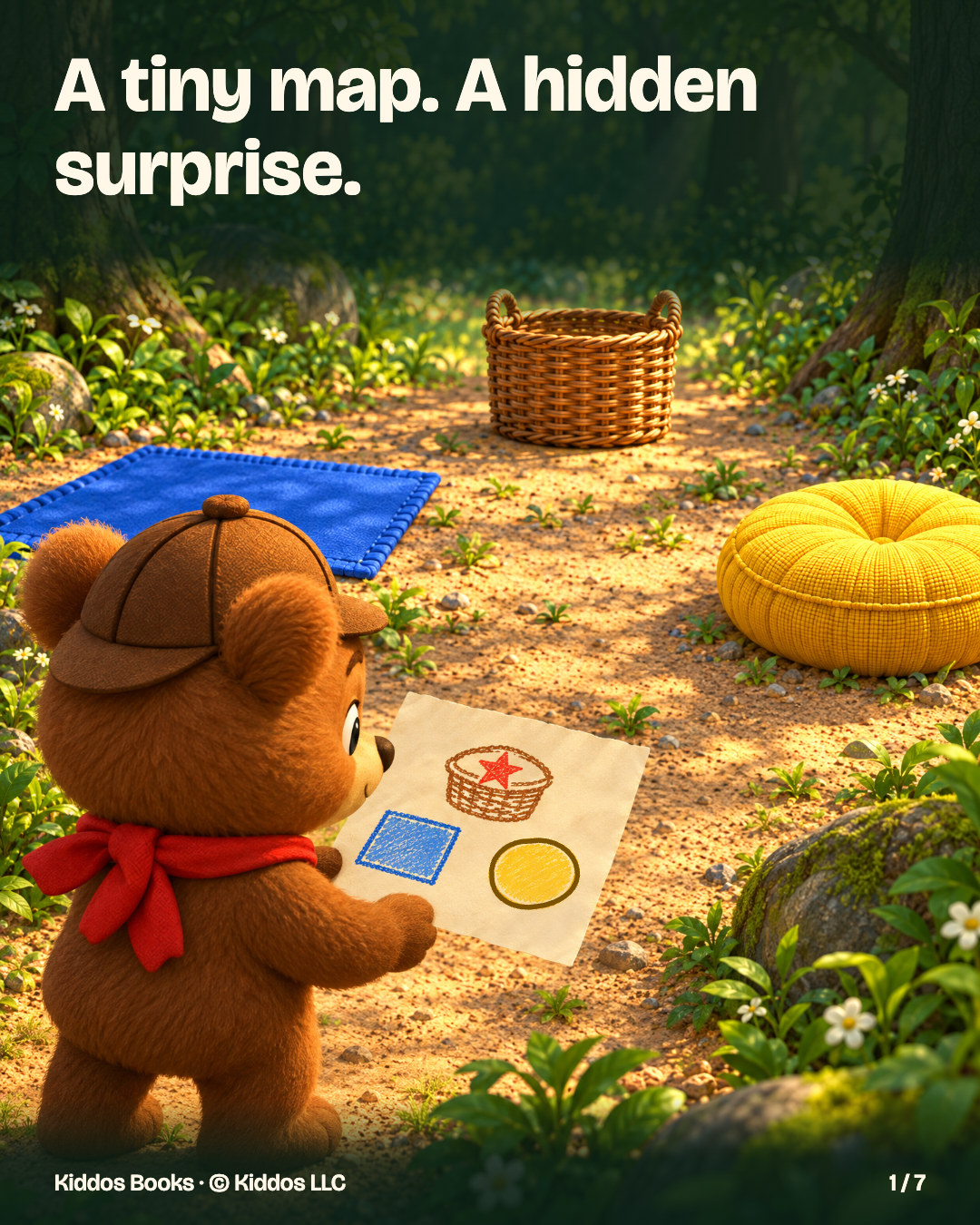
- In the pictured map, the blue cloth is left, yellow cushion right, and basket beyond them. The star is on the basket drawing, so Benny checks the real basket and finds the toy duck.
Make sense of what happened
In the pictured map, the blue cloth is left, yellow cushion right, and basket beyond them. The star is on the basket drawing, so Benny checks the real basket and finds the toy duck.
This is a map of one small play area, not a chain of picture clues or a test of left and right. Turn the paper to align familiar landmarks. Hide the toy out of sight before the finder receives the map.
Full grown-up notes, setup details & honest limits
Ask “What is the same on your paper and in our play space?” Help turn the map; point out a landmark without naming the hiding place.
This is a map of one small play area, not a chain of picture clues or a test of left and right. Turn the paper to align familiar landmarks. Hide the toy out of sight before the finder receives the map.
These are authored shared-play examples. Suggested ages and times are starting points, not an assessment or evidence of measured learning outcomes.
A conversation, not a quiz
Leave room for their idea.
Ask “What is the same on your paper and in our play space?” Help turn the map; point out a landmark without naming the hiding place.
What does this little drawing stand for?
A cue for the grown-up
Point to the matching cloth, cushion or basket in the play space.
What could we do if the map seems the wrong way round?
A cue for the grown-up
Turn it until the landmarks line up with the real places. Walk around together only if comfortable.
Why did you look in that place?
A cue for the grown-up
The star is on its picture. Let the child point on the paper and in the play space.
A simple way in
Start with two landmarks or draw together. A child can point and direct the adult to retrieve the toy.
Another thing to notice
Keep three landmarks and move the hiding mark to another reachable place. Turn the map together before searching.
Come back to it
On another day, make a map for one small area with different familiar landmarks.
For teachers
A small-group discovery.
Flexible 15-minute small-group sequence; prepare materials first and shorten or pause as needed.
Prepare the named materials and adult setup above. One adult-led demonstration is a useful option.
- 3 min
Match paper and place
Set three large landmarks in one clear area. Draw their arrangement and invite children to point between paper and real places.
- 4 min
Prepare the hiding turn
Mark the basket, ask the finder to look away and hide the toy fully below its rim. Show the map and turn it together to match the space.
- 5 min
Find, check and swap
Follow the mark and compare it with where the toy was found. Help the child make a new map and hide the toy at a reachable marked place for the adult.
- 3 min
Explain the match
Ask the child to point to one place on the paper and in the play area. A seated child may direct an adult throughout.
What to listen for
Ask the child to point to the same place on the map and in the play space.
Answer guidance
In the pictured map, the blue cloth is left, yellow cushion right, and basket beyond them. The star is on the basket drawing, so Benny checks the real basket and finds the toy duck.
Ways to take part
Accept pointing, gestures, home-language words or directing an adult. Start with two landmarks or draw together. A child can point and direct the adult to retrieve the toy.
Record an observation with a drawing, a gesture described by an adult or a sentence. No timed performance or winning prediction is needed.
All the story words.
Read aloud, enlarge the browser text, or use this text alongside the pictures.
Page 1 · A tiny map. A hidden surprise.
A tiny map. A hidden surprise. Kiddos Books · © Kiddos LLC 1 / 7
Picture description: Page 1 of 7. A tiny map. A hidden surprise. Benny stands at the edge of a small clearing, holding a map. A blue cloth lies near-left, a yellow cushion near-right, and a basket farther between them. The map shows the same arrangement, with a star on the basket.
Page 2 · Draw the places. Mark the hiding place.
Draw the places. Mark the hiding place. Kiddos Books · © Kiddos LLC 2 / 7
Picture description: Page 2 of 7. Draw the places. Mark the hiding place. Benny draws a red star on the basket picture on a large cream map. A blue rectangle is below left and a yellow circle below right, matching the nearby cloth and cushion. The toy duck is visible in the real basket during this map-making setup.
Page 3 · Child, look away. Grown-up, hide the toy.
Child, look away. Grown-up, hide the toy. Kiddos Books · © Kiddos LLC 3 / 7
Picture description: Page 3 of 7. Child, look away. Grown-up, hide the toy. Benny lowers a large yellow toy duck into a wicker basket. A blue cloth lies nearer on the left and a round yellow cushion nearer on the right.
Page 4 · Turn your map to match the space.
Turn your map to match the space. Kiddos Books · © Kiddos LLC 4 / 7
Picture description: Page 4 of 7. Turn your map to match the space. From behind Benny, we see the map in his paws and the same three places ahead: blue cloth left, yellow cushion right, basket farther between them. A red star marks the basket on the map. No duck is visible above the real basket rim.
Page 5 · Which place has the star? Go and look.
Which place has the star? Go and look. Kiddos Books · © Kiddos LLC 5 / 7
Picture description: Page 5 of 7. Which place has the star? Go and look. Benny walks between the blue cloth and yellow cushion toward the basket, pointing to it with one paw and holding his map in the other. The red star remains on the basket drawing; the toy is still out of sight.
Page 6 · There it is! Your map led you here.
There it is! Your map led you here. Kiddos Books · © Kiddos LLC 6 / 7
Picture description: Page 6 of 7. There it is! Your map led you here. Benny holds up the yellow toy duck beside the basket and shows the map in his other paw. The star marks the basket where he found the toy.
Page 7 · Now make a map for your grown-up.
Now make a map for your grown-up. Kiddos Books · © Kiddos LLC 7 / 7
Picture description: Page 7 of 7. Now make a map for your grown-up. Benny draws a new map with the basket farther up the paper, blue cloth near-left and yellow cushion near-right. One red star marks the cushion this time. The real landmarks have the same arrangement; the previous map lies face down and no duck is visible.
Where the explanation comes from.
Related storybooks invite further reading. The factual sources below support the investigation; illustration diagrams simplify what happens.