Kiddos

Hidden Wonders · Gina & Ollie

Little Clues, Big Discoveries

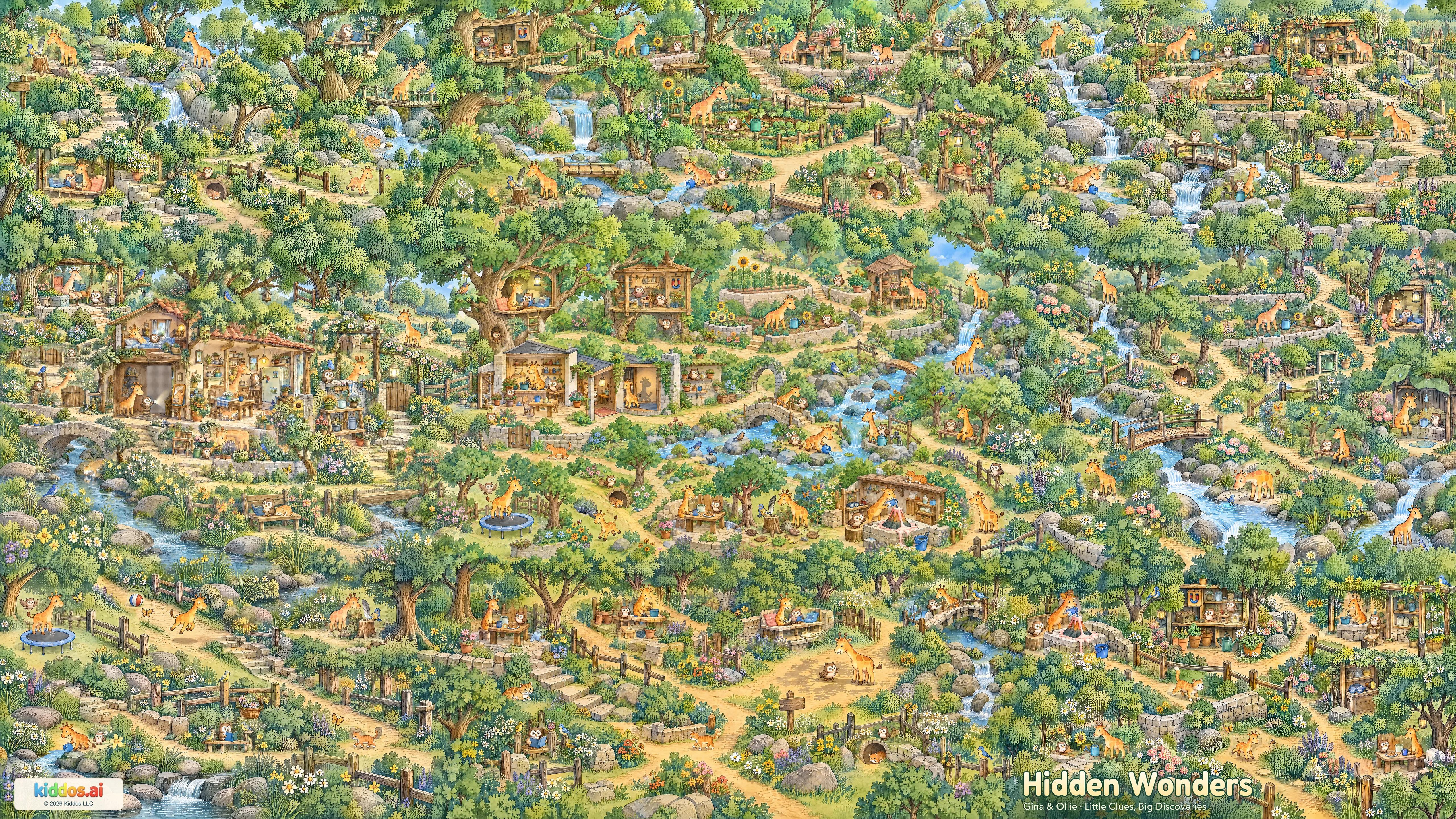
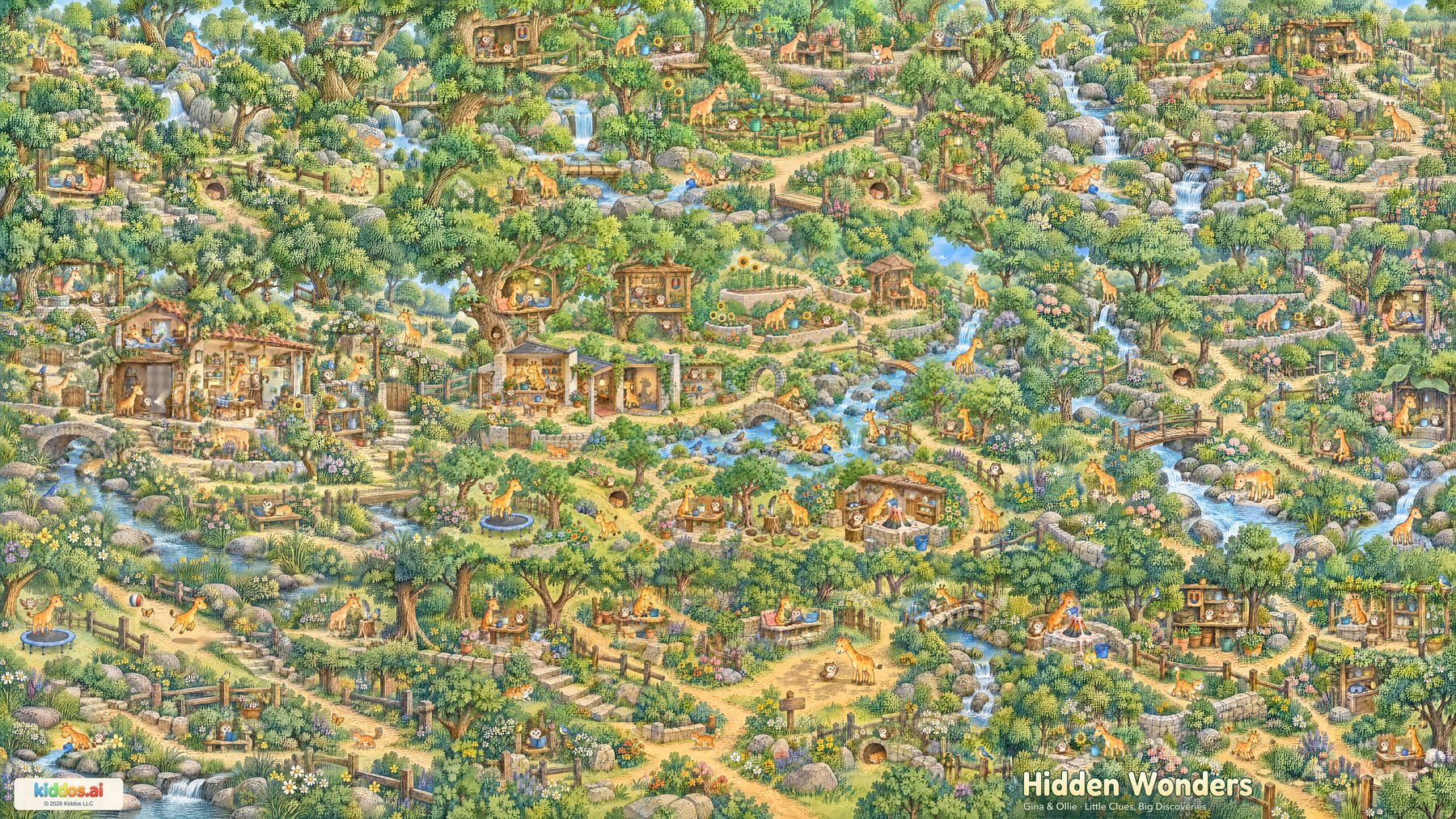
Gina and Ollie fill a green valley with little questions: a cup of water, growing sunflowers, a flashlight, a springy trampoline and a wonderfully fizzy model volcano.

For shared looking, ages 2–8. Start with the larger clues; tiny details suit older children or adult help. Difficulty labels are editorial suggestions, not a child assessment.

Look together

Every corner has a story.

Gina the yellow giraffe and Ollie the brown owl appear throughout a watercolor garden of streams, tree nooks, cottages, growing beds and small discovery stations.

A few things to notice

Follow a clue. Or your curiosity.

Choose any three if you like. Each clue shows one particular place in the picture—even when a friend appears more than once.

What catches your eye?

Start anywhere. You can choose a clue, name something you notice, or simply look together.

No timer. No score. Just things to notice together.

Discovery marks stay only while this picture page is open. Read the picture description or choose written clues for another way to join in.

The picture in words.

Gina the yellow giraffe and Ollie the brown owl appear throughout a watercolor garden of streams, tree nooks, cottages, growing beds and small discovery stations.

Use the written clues and answer descriptions in the player, or invite someone to describe a part of the picture with you. These words support shared exploration; the picture contains many more small visual details.

Make it your kind of together time

For parents & teachers.

At home

You do not need to explain the science before you play. Begin with “I notice…” and let one small question grow from the picture.

Settle in

Choose the garden, the cottage or the experiment shelter. Zoom until one pair of friends and the nearby objects are comfortably visible.

A little support

Start with Gina on the trampoline or the blue book. Offer the butterfly or tiny magnet later. The picture is an invitation to wonder, not instructions for copying experiments; any real activity needs an adult to choose suitable materials.

Leave room for their ideas

What do you notice before we try to explain it?

Separate the visible detail from an idea: “I see pink foam” can come before “I wonder why.”

Which place might sound quiet?

Compare a reading nook with the rushing water without demanding a single right answer.

What question would you ask Ollie?

Write or repeat the child’s question. It can stay unanswered today.

A gentle finish

Look around your own room or garden together. Find one safe thing that makes you say “I wonder…” and keep that question for another day.
In the classroom

About 15 minutes · Adapt to your group

Practice careful observation, distinguish noticing from guessing, and use language to form a question.

Bring along

  • A screen with the picture or a printed panorama
  • Optional picture clues
  • Paper and pencils for a next-story drawing
  1. Look together

    Invite observations about the stream, growing beds and little buildings. Echo “I see…” statements without correcting imaginative play.

  2. Find three things

    Find something for reading, something for caring for a plant and something used for looking closely.

  3. Describe one without pointing

    Describe its color, shape and position. Let a partner find one matching example.

  4. Invent what happens next

    Choose Gina and Ollie at one station. Imagine a question, a gentle attempt and a discovery to share.

Make room for everyone

Use larger characters for a first search and tiny props only as optional challenges. Accept spoken, signed, drawn or home-language questions. A child can be the question-maker while an adult operates the zoom.

Reflect together

Which question would you like to keep wondering about?

Follow a little curiosity

There is more to explore.

Another little adventure?