Five minutes together
Look. Wonder. Talk.
Our discovery: Count six legs attached to the middle body region and distinguish antennae from legs.
Remember: We compared features such as fur and feathers. Now let’s describe another animal by looking at its body parts and legs.
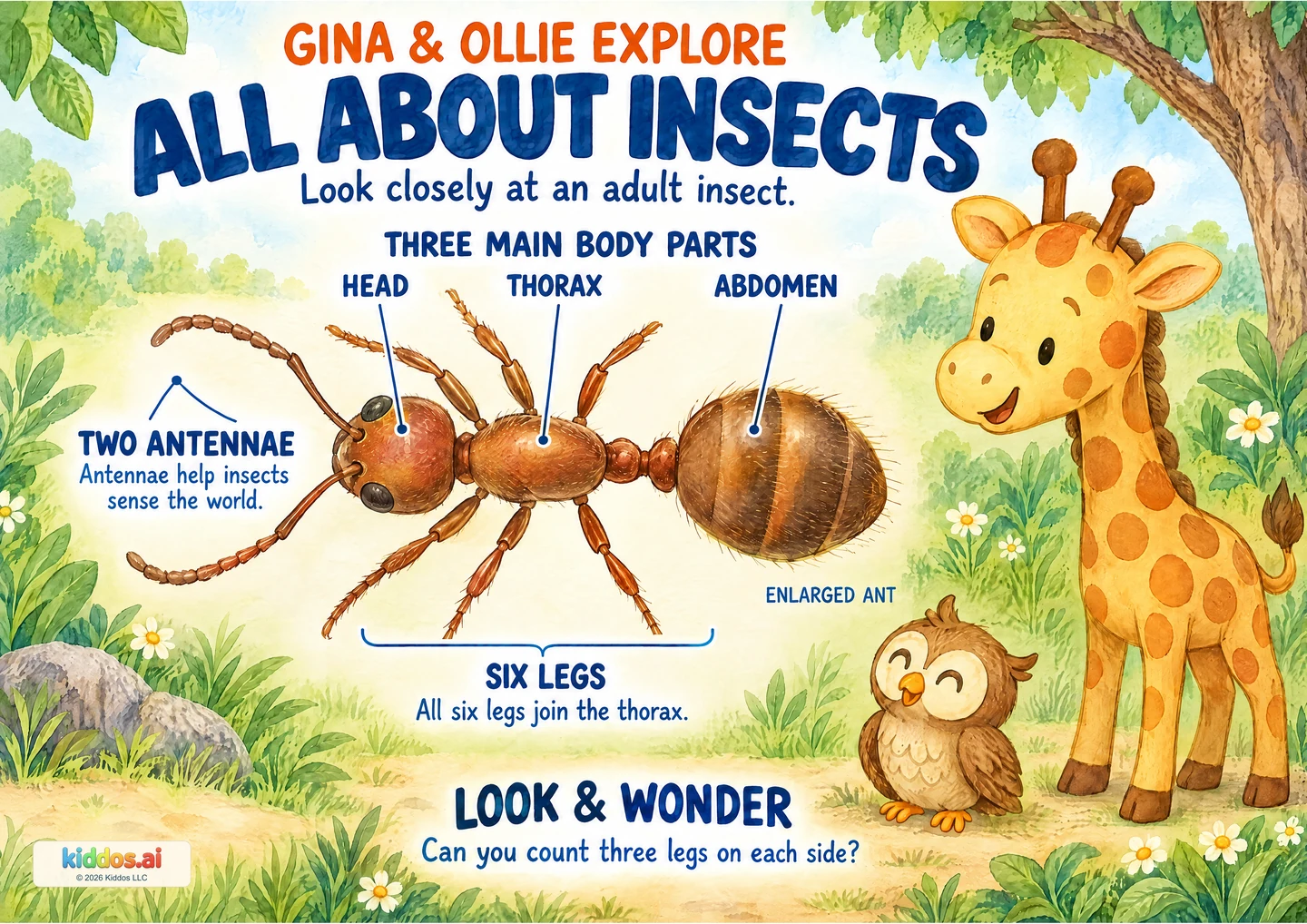
Revisit that discoveryStart with the legs before introducing new words. Invite your child to count three on one side and three on the other. Follow them inward: all six attach to the thorax. Then look for the head and abdomen, and find the two antennae extending from the head. Antennae help an insect sense its surroundings. This enlarged diagram shows an adult worker ant; it is not the ant’s real size. Read “thorax” and “abdomen” for your child and let noticing matter more than remembering the names.
Before we read, what could we count on this ant?
Start here
Follow three legs on one side, then three on the other.
Explore further
Use the attachment points to explain why the antennae are not extra legs.
Three questions to share
1How many legs can you find on each side? How many altogether?
Answer cue: Three on each side makes six legs. The two feelers at the head are antennae, not extra legs.
2Where do all six legs join the body?
Answer cue: The thorax, the middle leg-bearing body region. Follow each leg back to its attachment.
3What can you find on the head that is not a leg?
Answer cue: Two antennae. These sensory feelers help the ant detect information about the world around it.
If your child is unsure: Let’s use one clue together. Follow three legs on one side, then three on the other.
Something to try together
Build an insect diagram on paper
You’ll need: The poster and an adult; optional paper and drawing materials. Describing or pointing is enough.
- Draw or describe three main body regions: head, thorax and abdomen.
- Add three legs on each side of the thorax and two antennae on the head.
- Check each attachment against the enlarged ant, then label the picture as an adult insect model.
What this can show
All six legs join the thorax. The adult ant is an example; young insects can look different and wings are not required for every adult.
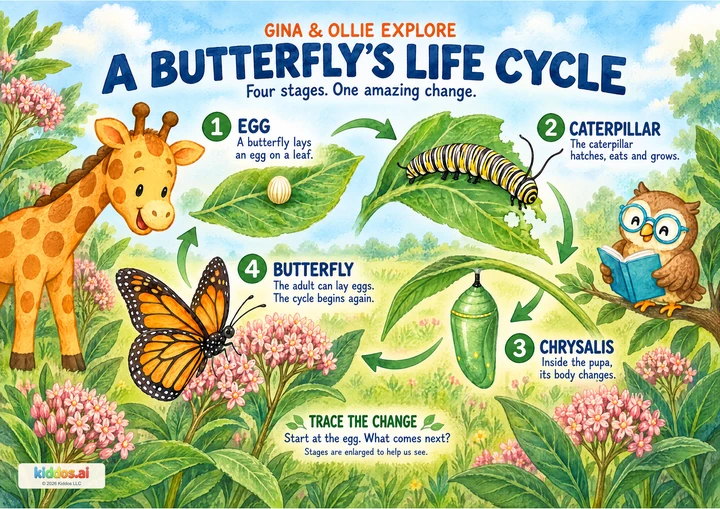
Return to it: Compare the adult butterfly and caterpillar in the Butterfly Life Cycle poster. Which stage does our adult-insect description concern?
Get the guide and discovery recordFor teachers · About 20 minutes
A small lesson with room to explore.
Learning aim: Count six legs attached to the middle body region and distinguish antennae from legs.
Prepare: Read the poster, answer cues and misconception note. Prepare only the materials named in the activity; keep a picture-only or described option available.
- 3 min
Reconnect and wonder
How can we recognize the main parts of an adult insect? Invite an initial idea; record it without marking it right or wrong.
- 4 min
Look together
Follow three legs on one side, then three on the other. Introduce thorax using the poster.
- 8 min
Investigate or represent
Use “Build an insect diagram on paper.” Let pairs take turns noticing and recording, with adult help and the activity’s stated boundaries.
- 5 min
Explain and return
Ask the core check: How can we recognize the main parts of an adult insect? Accept pointing, words, signing or a drawing. If the learner is ready, offer this optional extension: Use the attachment points to explain why the antennae are not extra legs.
Check the idea together
How can we recognize the main parts of an adult insect?
What to listen for
The adult insect has head, thorax and abdomen, six legs attached to the thorax, and two antennae on its head. All six legs join the thorax. The adult ant is an example; young insects can look different and wings are not required for every adult.
Accept pointing, speech, signing, a drawing or adult dictation. Describe the illustration and use labels/position as well as color. Offer one contrast first, and use the extension when the learner is ready.