From story to discovery
Try it together.
Cooler to touch. Slower to melt? Metal can feel cooler than plastic. Which bowl would you choose to keep an ice cube longer?
Gather
Similar plain metal and plastic unbreakable bowls, two equal-size ice cubes from the same tray and a stable tray.
Adult setup — read before trying
Let both dry bowls reach the same room temperature well in advance. Avoid insulated/coated metal and direct sun, heaters or fans. An adult adds cubes together. No salt, heat or added water; keep ice/meltwater out of mouths, avoid prolonged ice contact and wipe spills. Empty and dispose of the meltwater afterward.
- Adult selects similar metal/plastic bowls at room temperature.
- Adult adds equal ice cubes together; place side by side away from sun/heaters.
- Watch every few minutes; compare ice remaining, keeping ice out of mouths and cleaning spills.
- Keep the same
- Room, starting time, similar bowls and matched cubes.
- What changes
- Bowl material; other bowl properties cannot be perfectly matched at home.
- Look for
- Compare solid ice remaining every few minutes, not just puddle size.
Make sense of what happened
Both room-temperature bowls are warmer than the ice. Metal commonly transfers heat into it faster than plastic.
Feeling cooler does not prove a lower temperature. Bowl thickness, coatings, mass, ice contact and room conditions affect the result; never heat a bowl to force it.
Full grown-up notes, setup details & honest limits
Use two dry, unbreakable bowls of similar size and shape: one plain metal and one plastic. Avoid insulated, double-wall or coated metal bowls, which can hide the effect. Set both in the same comfortable room well in advance so neither is cold from a fridge or hot from washing. Keep them side by side on a stable tray away from sunlight, heaters and fans. Before adding ice, an adult may invite a brief touch of the outside of each room-temperature bowl; feeling cooler does not prove a lower starting temperature. The adult places one equal-size ice cube from the same tray in each empty bowl at nearly the same time. Do not add water, salt or heat. Observe every few minutes and compare how much solid ice remains; puddle spread alone is unreliable. Metal commonly conducts heat into the ice faster than plastic. Heat comes from the warmer bowls and room; metal does not make heat or contain cold. The same quick transfer carries heat away from a warm hand into room-temperature metal, making it feel cooler. Actual times and differences vary with room conditions, bowl material, thickness, mass, coatings, ice contact and cube size; this is a qualitative home exploration, not a measurement of conductivity or heat capacity. If results are close, discuss that honestly, re-equilibrate the bowls, and repeat with fresh matched cubes; never heat a bowl to force the illustrated result. Ask the child what stayed the same and what changed. Let them point, predict, describe the shrinking ice or direct the adult. For a repeat, swap left and right positions while keeping materials and setup the same. Small groups can compare predictions and draw the amount of ice left; no child needs to touch ice or read independently. Adult supervision throughout; no ice or experiment water in mouths, no prolonged skin contact with ice, and wipe spills promptly. Dispose of meltwater after. The related book is a water-cycle story, not the source of this activity or evidence that melting and evaporation are the same process. This package is editorially reviewed; no live home trial or measured learning outcome is claimed.
A conversation, not a quiz
Leave room for their idea.
Treat a surprising or similar result as something to describe, not something the child got wrong.
Cooler to touch. Slower to melt? Metal can feel cooler than plastic. Which bowl would you choose to keep an ice cube longer?
A cue for the grown-up
Welcome a guess before reading the result. No correct prediction is required.
Which cube has more solid ice left?
A cue for the grown-up
In the story the metal bowl’s cube shrinks faster; report your actual result.
Does the metal make heat?
A cue for the grown-up
No. It passes heat from the warmer bowl and surroundings toward the ice.
A simple way in
Draw or point to the amount of ice remaining at two checks.
Another thing to notice
Let bowls return to room temperature, swap positions and repeat with fresh matched cubes.
Come back to it
Ask why metal can feel cool to a warm hand yet help ice melt faster.
For teachers
A small-group discovery.
A 20-minute session; melting may need longer, with brief observation breaks.
Prepare the named materials and adult setup above. One adult-led demonstration is a useful option.
- 3 min
Wonder
Read pages 1–2. Invite a prediction with words, pointing or a sketch; keep the result hidden.
- 4 min
Notice the story
Read pages 3–5. Which cube has more solid ice left? Separate the observation from the explanation.
- 9 min
Try together
Use the materials and adult setup on this guide, then follow the activity steps in this guide. Compare solid ice remaining every few minutes, not just puddle size.
- 4 min
Make meaning
Does the metal make heat? Invite a drawing, a description or an adult-written note. Treat a surprising or similar result as something to describe, not something the child got wrong.
What to listen for
Does the metal make heat?
Answer guidance
No. It passes heat from the warmer bowl and surroundings toward the ice.
Ways to take part
Draw or point to the amount of ice remaining at two checks. Accept pointing, words, a drawing or adult-directed action. Use the story alone if the activity is unsuitable.
Record an observation with a drawing, a gesture described by an adult or a sentence. No timed performance or winning prediction is needed.
All the story words.
Read aloud, enlarge the browser text, or use this text alongside the pictures.
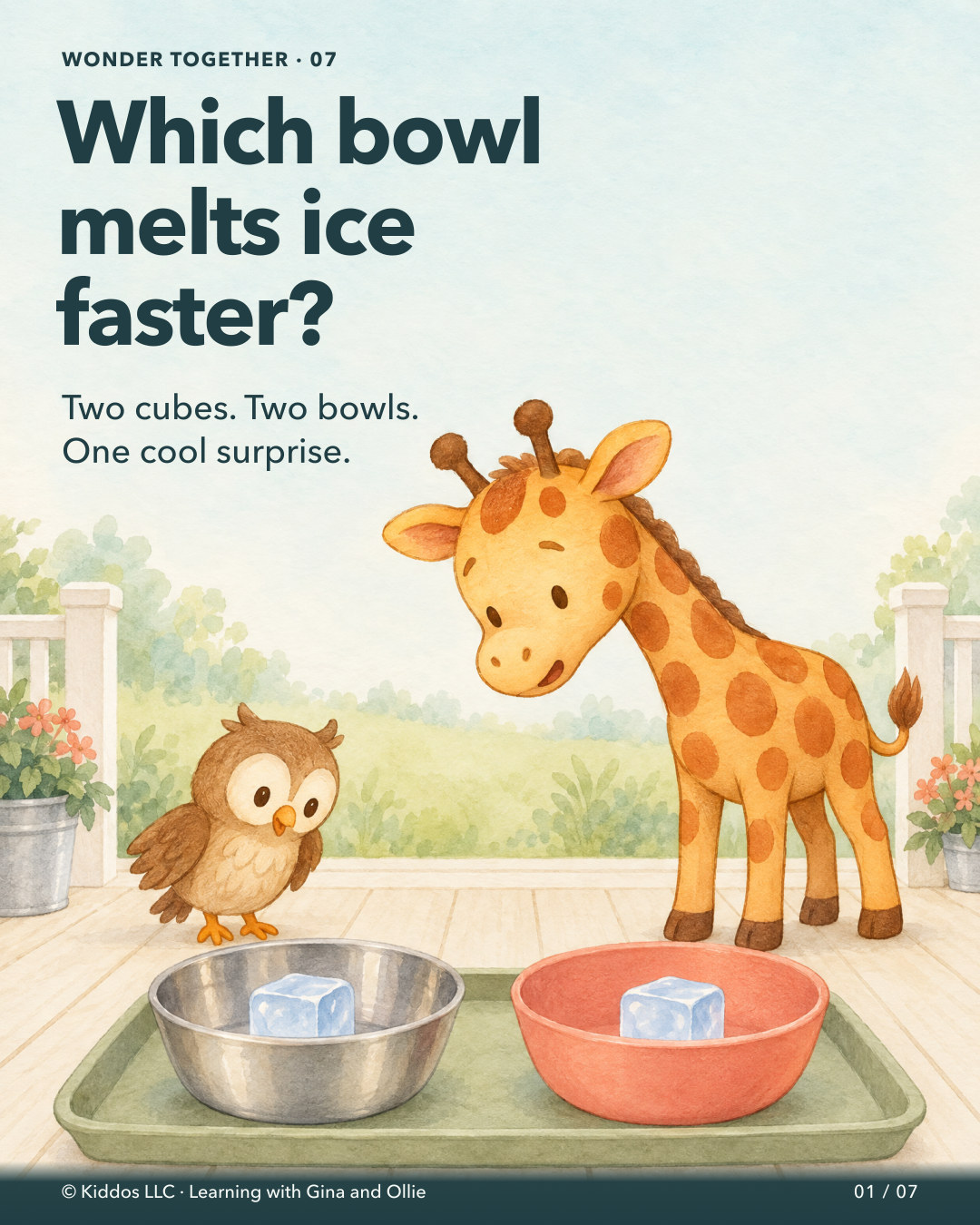
Page 1 · Which bowl melts ice faster?
WONDER TOGETHER · 07 Which bowl melts ice faster? Two cubes. Two bowls. One cool surprise. © Kiddos LLC · Learning with Gina and Ollie 01 / 07
Picture description: Gina the yellow giraffe and small brown owl Ollie examine two equal ice cubes in shallow bowls: silver metal on the left, matte coral plastic on the right. The title asks which bowl melts ice faster. Neither bowl shows a winning result.
Page 2 · Cooler to touch. Slower to melt?
GUESS BEFORE YOU SWIPE Cooler to touch. Slower to melt? Metal can feel cooler than plastic. Which bowl would you choose to keep an ice cube longer? Make a guess before the test. METAL PLASTIC © Kiddos LLC · Learning with Gina and Ollie 02 / 07
Picture description: Two empty bowls wait side by side on a low floor tray, silver metal left and matte coral plastic right. Gina and Ollie look at them before adding ice. Both bowls have been in the same room. The family is invited to predict which will keep an ice cube longer.
Page 3 · A fair start.
READY, SET… WATCH A fair start. Gina and Ollie add equal cubes together. Same room. Same start. One cube in each room-temperature bowl. METAL PLASTIC © Kiddos LLC · Learning with Gina and Ollie 03 / 07
Picture description: In the same view and tray, an equal-size ice cube now rests in each bowl. Metal remains left and plastic right. Gina and Ollie watch the beginning of the comparison; neither ice cube is smaller yet.
Page 4 · The surprise? Metal!
AFTER A FEW MINUTES The surprise? Metal! Gina spots the smaller cube. The ice in metal melts faster. Look at the ice left in each bowl. METAL PLASTIC © Kiddos LLC · Learning with Gina and Ollie 04 / 07
Picture description: The matched comparison later shows a small rounded ice remnant in a visible puddle in the metal bowl on the left, and a larger rounded cube with less meltwater in the plastic bowl on the right. Gina notices the contrast while Ollie watches. The bowls, camera and lighting are unchanged.
Page 5 · Heat moves. Ice melts.
METAL PLASTIC FASTER HEAT TRANSFER SLOWER HEAT TRANSFER Metal also takes heat from your hand faster. That is why it can feel cooler. THE PART TO REMEMBER Heat moves. Ice melts. Both bowls are warmer than the ice. Metal passes heat to it faster. Cool to touch can still melt ice fast. © Kiddos LLC · Learning with Gina and Ollie 05 / 07
Picture description: A simple explanatory diagram shows a room-temperature metal bowl and plastic bowl with ice, labeled by material. Three bold arrows point from the metal bowl toward the ice and one thinner arrow points from plastic toward ice, showing faster and slower heat transfer, not numerical measurements. A note explains that metal also takes heat from your hand faster, so it feels cooler.
Page 6 · Make your own ice test.
1 ROOM-TEMPERATURE BOWLS 2 EQUAL CUBES · START TOGETHER 3 SIDE BY SIDE · OUT OF DIRECT SUN TRY IT TOGETHER Make your own ice test. Use similar metal and plastic bowls. Let both reach room temperature. Add equal ice cubes at the same time. Watch together. Which cube shrinks faster? With an adult. Keep ice out of mouths. Wipe up spills. No heating needed. © Kiddos LLC · Learning with Gina and Ollie 06 / 07
Picture description: Three illustrated steps show two similar empty bowls at room temperature, one equal ice cube placed in each, then observation side by side away from direct sun. The adult prepares and handles the ice, the child predicts and compares. Keep ice out of mouths, wipe spills and do not heat the bowls.
Page 7 · From an ice cube to a bigger story.
KEEP THE WONDER FLOWING From an ice cube to a bigger story. Read Where Did My Water Go? together. Parents: explore the story in Kiddos Books. Kiddos Books · Read with confidence. © Kiddos LLC · Learning with Gina and Ollie 07 / 07
Picture description: Gina and Ollie settle beside an open blue picture book on a shaded porch overlooking their meadow. Parents are invited to read Where Did My Water Go? in Kiddos Books, a related water-cycle story rather than instructions for this ice experiment.
Where the explanation comes from.
Related storybooks invite further reading. The factual sources below support the investigation; illustration diagrams simplify what happens.