From story to discovery
Try it together.
Will we still see the grains? Gina has a little sugar. What will happen in water?
Gather
A clear unbreakable cup, half a cup of cool water, one level teaspoon of plain white granulated sugar, a spoon and a tray.
Adult setup — read before trying
An adult measures named ingredients and supervises gentle stirring on a level tray. No tasting or unknown powders, heat or extra liquids. Keep materials away from mouths; wipe spills, empty the cup and wash equipment/hands afterward.
- Pour half a cup of cool water into a clear unbreakable cup. Keep it on a level tray.
- Add one level teaspoon of ordinary white sugar. Look for the grains.
- Stir gently. Pause and look. Keep stirring until the grains are no longer visible.
- Keep the same
- Same cup, amount of water and water temperature.
- What changes
- Sugar is added and mixed; visible grains become harder to see.
- Look for
- Look for grains before and after gentle mixing, including at the bottom.
Make sense of what happened
Sugar molecules separate from one another and mix through the water. They remain sugar molecules, too small to see individually.
Sugar did not turn into water, melt or evaporate. The diagram is a model; a clear cup alone cannot prove what is present. Stirring helps but is not required for dissolving.
Full grown-up notes, setup details & honest limits
Prepare a small observation. Put a clear unbreakable cup on a level tray. An adult measures about half a cup (120 mL) of cool or room-temperature water and one level teaspoon of ordinary white granulated table sugar. Use a small spoon that reaches the bottom. The illustration uses a wooden spoon; any suitable household teaspoon works. Use only the named ingredients. The adult stays beside the child and can do all pouring or stirring when needed. This is an observation activity, with no tasting. Wipe spills, empty the cup and wash the equipment and hands afterward.
Invite a prediction before adding sugar: will the grains stay visible? Add the sugar, look at the bottom, then stir gently. Pause to look and stir again if grains remain. Do not promise a fixed number of seconds. Compare the same cup before and after, keeping the water amount and temperature the same. Ask the child to describe what they can actually see before offering the explanation. The illustrated first instant shows grains; small grains may dissolve before the child can study them closely.
Explain the invisible part. Sugar grains contain many tiny sugar molecules. Water allows those molecules to separate from one another and mix through the water. They remain sugar molecules; the molecule itself does not shrink or break into smaller atoms. The page-five symbols are a teaching model, not something eyes or an ordinary magnifying glass can see. Their count illustrates that sugar remains, not a measured count of the cup. Water molecules are omitted for clarity. A clear-looking cup alone does not prove that sugar is absent or present; we know what we added and use the scientific model to explain the change.
If grains remain, keep the test small and patient. Check that only one level teaspoon went into about half a cup of water, stir gently near the bottom and allow more time. Coarse crystals can take longer. Avoid adding more sugar, heat, other liquids or unknown powders. If the water becomes cloudy because the material was not plain granulated sugar, start fresh with the named ingredients. We are observing dissolving, not comparing brands or testing how much sugar water can hold.
Make the learning usable. A child may stir with support, point to the cup, draw before and after, or direct the adult. Accept every initial guess calmly. Ask “What changed?” (the visible grains) and “What stayed?” (the same cup and the sugar in the water). For a small group, use one adult-led demonstration and invite observations in turn. For another observation, use fresh water and the same small amount of sugar; let a spoonful sit without stirring first. Sugar can dissolve without stirring too, though mixing helps it happen faster. Do not present stirring as a magical switch.
Continue the story only after the lesson. Where Did My Water Go? is related reading about a different change: water moving through the water cycle. This sugar activity is editorial and is not in that book. Dissolving sugar is not melting it or turning it into water vapor. The shared question is “What happened to something we can no longer see?” This package is designed for ages 5–7 with an adult; it is not a tested learning intervention, and no live family experiment was performed.
A conversation, not a quiz
Leave room for their idea.
Ask for observations first, then label the invisible-particle explanation as a model.
Will we still see the grains? Gina has a little sugar. What will happen in water?
A cue for the grown-up
Welcome a guess before reading the result. No correct prediction is required.
What can you see at the bottom after mixing?
A cue for the grown-up
The visible grains can disappear from view; coarse grains may need more time.
Have the sugar molecules shrunk or changed into water?
A cue for the grown-up
No. They remain sugar, spread through the water.
A simple way in
Use only the small measured amount; pause, look and stir gently again if grains remain.
Another thing to notice
In a fresh matching setup, watch the same small amount before stirring; it can dissolve without stirring too.
Come back to it
Explain to someone why “I cannot see it” is different from “it is gone.”
For teachers
A small-group discovery.
Flexible 20-minute small-group session; pause or shorten as needed.
Prepare the named materials and adult setup above. One adult-led demonstration is a useful option.
- 3 min
Wonder
Read pages 1–2. Invite a prediction with words, pointing or a sketch; keep the result hidden.
- 4 min
Notice the story
Read pages 3–5. What can you see at the bottom after mixing? Separate the observation from the explanation.
- 9 min
Try together
Use the materials and adult setup on this guide, then follow the activity steps in this guide. Look for grains before and after gentle mixing, including at the bottom.
- 4 min
Make meaning
Have the sugar molecules shrunk or changed into water? Invite a drawing, a description or an adult-written note. Ask for observations first, then label the invisible-particle explanation as a model.
What to listen for
Have the sugar molecules shrunk or changed into water?
Answer guidance
No. They remain sugar, spread through the water.
Ways to take part
Use only the small measured amount; pause, look and stir gently again if grains remain. Accept pointing, words, a drawing or adult-directed action. Use the story alone if the activity is unsuitable.
Record an observation with a drawing, a gesture described by an adult or a sentence. No timed performance or winning prediction is needed.
All the story words.
Read aloud, enlarge the browser text, or use this text alongside the pictures.
Page 1 · Where did the sugar go?
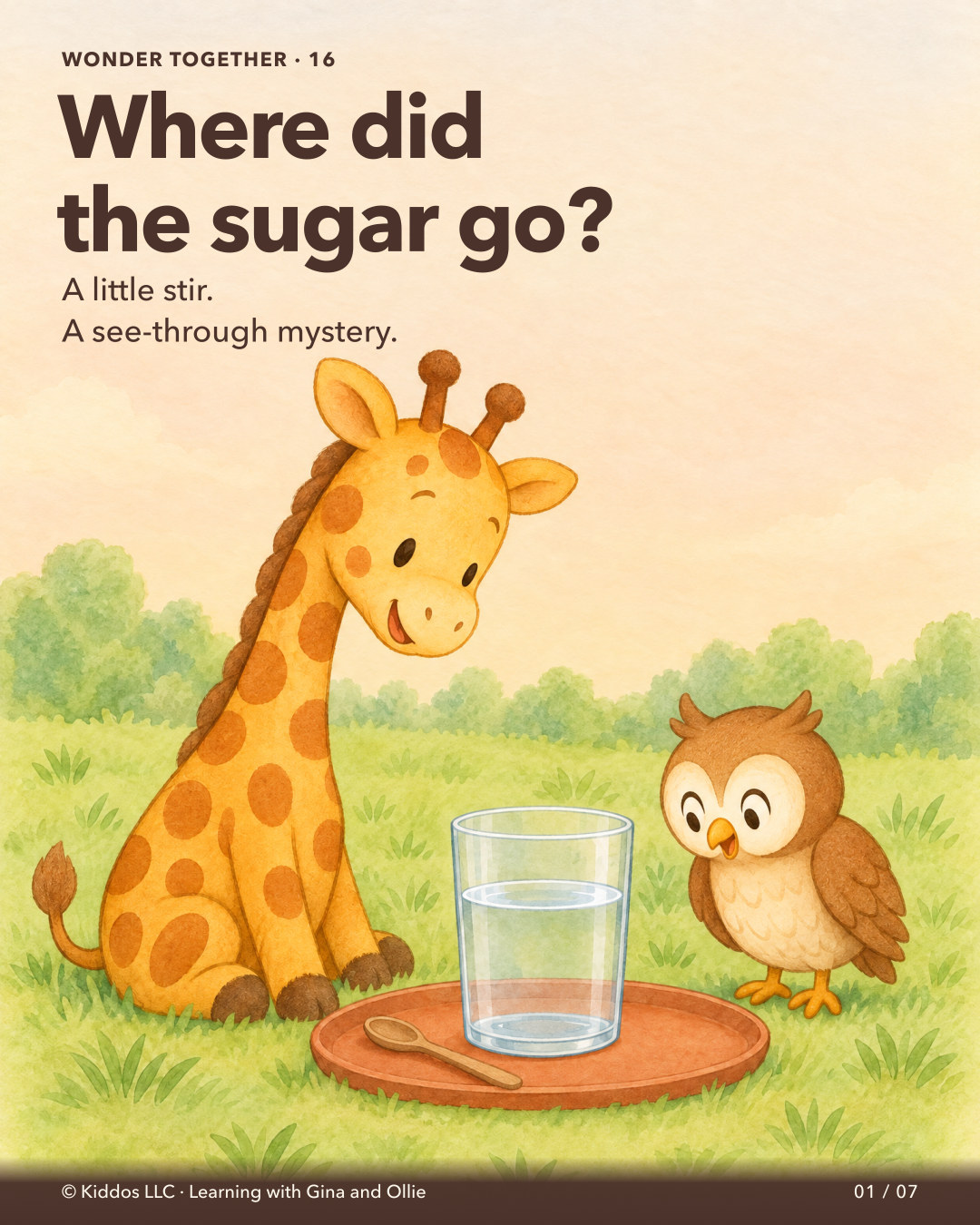
WONDER TOGETHER · 16 Where did the sugar go? A little stir. A see-through mystery. © Kiddos LLC · Learning with Gina and Ollie 01 / 07
Picture description: Gina the golden giraffe and small brown owl Ollie peer into a clear cup of water on a terracotta-colored tray in a meadow picnic spot. A wooden spoon rests on the tray. No sugar grains are visible; this opening mystery is explained by the sequence that follows.
Page 2 · Will we still see the grains?
GUESS BEFORE YOU SWIPE Will we still see the grains? Gina has a little sugar. What will happen in water? Make a guess together. © Kiddos LLC · Learning with Gina and Ollie 02 / 07
Picture description: An editable close-up drawing shows a level spoonful of white sugar held above a clear unbreakable cup half-filled with water on a terracotta tray. No sugar has entered the water. The unresolved setup invites a guess before the illustrated test.
Page 3 · In goes the sugar.
LET’S TRY IT In goes the sugar. Gina adds it and stirs gently. Look for the white grains. Watch the bottom of the cup. © Kiddos LLC · Learning with Gina and Ollie 03 / 07
Picture description: The sugar has just been added to the cup. White grains are visible at the bottom, and Gina gently stirs with the wooden spoon while Ollie watches. This view establishes the cup, tray, water level and camera used again in the matched result on slide 4.
Page 4 · Clear again!
LOOK AGAIN Clear again! Now we cannot see the grains. The sugar has dissolved. It is still in the water. © Kiddos LLC · Learning with Gina and Ollie 04 / 07
Picture description: From the matched viewpoint, the cup looks clear after stirring; no sugar grains remain visible at the bottom. Gina has placed the empty spoon on the tray. The same cup, water, characters and light remain in place.
Page 5 · Too small to see. Still there.
BEFORE AFTER Sugar particles Not to scale. Water particles not shown. THE PART TO REMEMBER Too small to see. Still there. Sugar is made of tiny particles. In water, they separate and spread out. Dissolving is not disappearing. © Kiddos LLC · Learning with Gina and Ollie 05 / 07
Picture description: A simplified model shows twelve identical sugar-particle symbols clustered together before dissolving, then the same twelve spread through water. The particles keep their size and shape. Labels state that this model is not to scale and water particles are not shown.
Page 6 · Make a clear mystery.
1 Pour half a cup of cool water into a clear unbreakable cup. Keep it on a level tray. 2 Add one level teaspoon of ordinary white sugar. Look for the grains. 3 Stir gently. Pause and look. Keep stirring until the grains are no longer visible. TRY IT TOGETHER Make a clear mystery. With an adult: sugar, a teaspoon, a clear unbreakable cup and cool water. What changed? What stayed? Adult stays close. No tasting. Wipe spills; empty and wash up afterward. © Kiddos LLC · Learning with Gina and Ollie 06 / 07
Picture description: Three illustrated steps show half a cup of cool water, one level teaspoon of sugar added to the water, and gentle stirring followed by looking for remaining grains. An adult stays close; there is no tasting. Cleanup instructions are included.
Page 7 · Another cup. Another mystery.
KEEP EXPLORING TOGETHER Another cup. Another mystery. Follow water’s journey in Where Did My Water Go? Parents: read together in Kiddos Books. Kiddos Books · Read with confidence. © Kiddos LLC · Learning with Gina and Ollie 07 / 07
Picture description: After cleanup, Gina and Ollie share a wordless picture book showing a puddle and a rain cloud. The quiet invitation names Where Did My Water Go?, a separate story about the water cycle, not the sugar experiment.
Where the explanation comes from.
Related storybooks invite further reading. The factual sources below support the investigation; illustration diagrams simplify what happens.