From story to discovery
Try it together.
Both, one or neither? Which tray will our magnet stick to?
Gather
One large intact enclosed age-appropriate toy magnet, a prechecked steel baking tray and a plain aluminum tray.
Adult setup — read before trying
Adult operates and stores the magnet, following its instructions. No loose/small magnets, magnetic balls, powerful rare-earth magnets, damaged toys or detachable parts. Use clean cool smooth-edged trays; no hot cookware, sharp foil, nails, coins or clips. Keep away from mouths, younger children, pets and sensitive devices. Stop if a magnet is missing/damaged; suspected swallowing requires immediate medical attention. If suitable equipment is unavailable, use the illustrated story. Keep each tray supported during the gentle pull; notice resistance rather than trying to lift a heavy tray.
- Check: large, intact, enclosed toy magnet.
- Touch steel. Pull gently.
- Try aluminum. Then put it away.
- Keep the same
- Same magnet, supported trays and contact followed by a gentle pull.
- What changes
- Tray material.
- Look for
- Notice resistance to the gentle pull; a heavy tray does not need to lift.
Make sense of what happened
An ordinary magnet sticks to some metals. The tested steel tray attracts it; aluminum does not make it stick in this activity.
Shininess cannot tell us. Steel composition varies, especially stainless steel; precheck the selected tray. Do not generalize to every metal or every response to magnetic fields.
Full grown-up notes, setup details & honest limits
This is an adult-operated demonstration for ages 5–7. Use one age-appropriate, large, intact enclosed toy magnet with no accessible or detachable magnet pieces. Do not use small fridge decorations, loose magnets, magnetic balls, powerful rare-earth magnets or a damaged toy. The adult controls and stores the magnet; the child predicts and observes. Keep it away from mouths, younger children, pets and sensitive devices, and follow its manufacturer’s instructions. If any magnet is missing or damaged, stop. Suspected swallowing requires immediate medical attention.
Choose two clean, cool, smooth-edged trays: a steel baking tray that the adult has privately checked attracts this magnet, and a plain aluminum tray. Metal composition varies, especially stainless steel, so never promise that every steel-looking kitchen object will behave alike. Do not use hot cookware, sharp cut foil, nails, coins or small clips. If suitable equipment is unavailable, use the illustrated sequence as a prediction-and-discussion activity.
The pictures use one large red U-shaped enclosed teaching magnet. Its shape introduces the tool; the same magnet is used for both trays. A large intact enclosed age-appropriate toy magnet of another shape can be used for the family activity under its manufacturer’s instructions. The adult brings the same magnet into contact with each tray and gently pulls away while the tray stays supported. A resisting pull is the useful observation; a heavy tray need not lift. The steel picture shows the magnet attached; the aluminum picture shows the same magnet withdrawn after contact. Describe the result, not the child’s guess, as the evidence.
The lesson is a narrow everyday rule: not every metal sticks to an ordinary magnet. Aluminum is a useful counterexample to “shiny means magnetic.” Avoid claiming all shiny things are metal, all steel is magnetic, or only metals ever respond to magnetic fields. We are not comparing magnet strength or teaching magnetic poles here. The related source story includes a broad metal simplification; clarify “some metals” during shared reading.
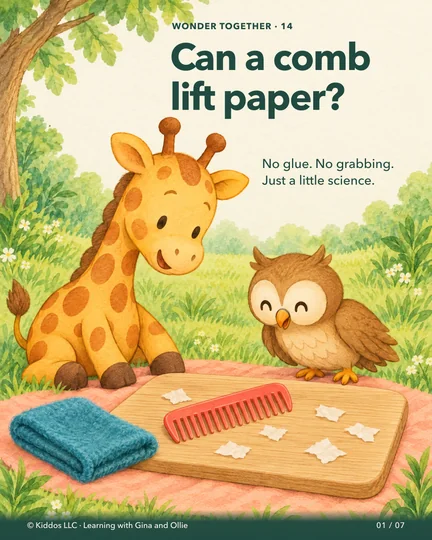
Parent move: model changing your mind cheerfully: “I guessed both. The test gave me a new idea.” Invite a point, spoken prediction, drawing or adult-directed choice. For a group, keep the magnet in the demonstrator’s control. Later ask whether shininess alone tells us what will stick; the useful answer is that we need to test the material. Connect with carousel 14, Can a comb lift paper?: a rubbed comb’s static attraction is a different effect, not proof that paper is magnetic. This editorial tray test is not the exact activity in Gina and the Magnet Mystery. No live family trial was performed.
A conversation, not a quiz
Leave room for their idea.
Model revising a guess cheerfully: “The test gave me a new idea.”
Both, one or neither? Which tray will our magnet stick to?
A cue for the grown-up
Welcome a guess before reading the result. No correct prediction is required.
Which tray resisted pulling the magnet away?
A cue for the grown-up
The prechecked steel tray does; the aluminum tray does not in this test.
Can shininess alone tell us what will stick?
A cue for the grown-up
No. We need to test the material.
A simple way in
Child predicts and points; adult keeps control of all equipment.
Another thing to notice
Compare this result with the comb story in words: magnetic and static attraction are distinct effects.
Come back to it
Ask whether both shiny trays had to behave the same, and what the test showed.
For teachers
A small-group discovery.
Flexible 20-minute small-group session; pause or shorten as needed.
Prepare the named materials and adult setup above. One adult-led demonstration is a useful option.
- 3 min
Wonder
Read pages 1–2. Invite a prediction with words, pointing or a sketch; keep the result hidden.
- 4 min
Notice the story
Read pages 3–5. Which tray resisted pulling the magnet away? Separate the observation from the explanation.
- 9 min
Try together
Use the materials and adult setup on this guide, then follow the activity steps in this guide. Notice resistance to the gentle pull; a heavy tray does not need to lift.
- 4 min
Make meaning
Can shininess alone tell us what will stick? Invite a drawing, a description or an adult-written note. Model revising a guess cheerfully: “The test gave me a new idea.”
What to listen for
Can shininess alone tell us what will stick?
Answer guidance
No. We need to test the material.
Ways to take part
Child predicts and points; adult keeps control of all equipment. Accept pointing, words, a drawing or adult-directed action. Use the story alone if the activity is unsuitable.
Record an observation with a drawing, a gesture described by an adult or a sentence. No timed performance or winning prediction is needed.
All the story words.
Read aloud, enlarge the browser text, or use this text alongside the pictures.
Page 1 · Does shiny mean magnetic?
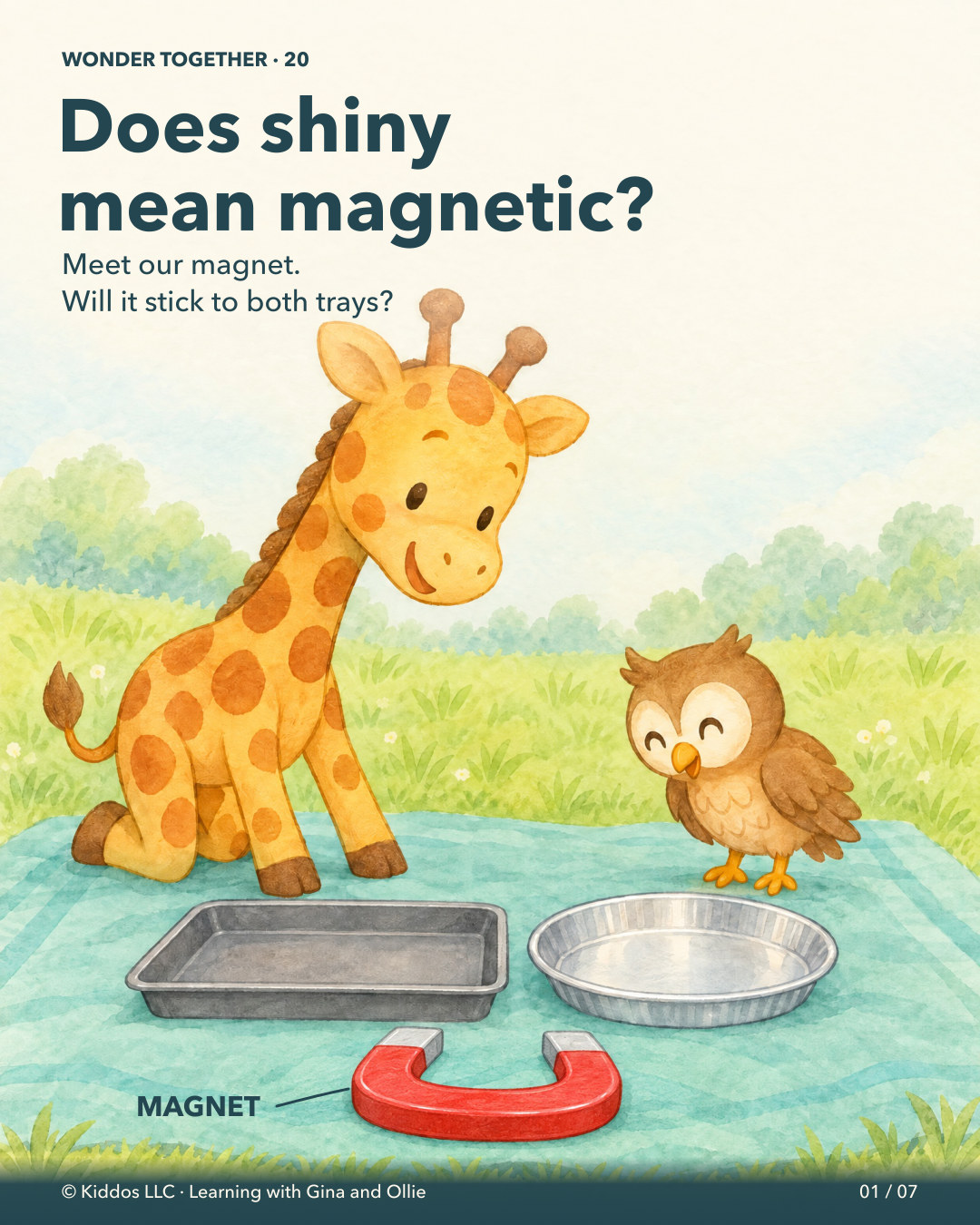
MAGNET WONDER TOGETHER · 20 Does shiny mean magnetic? Meet our magnet. Will it stick to both trays? © Kiddos LLC · Learning with Gina and Ollie 01 / 07
Picture description: Gina and Ollie study two shiny trays on their sea-green picnic mat. A large red U-shaped teaching magnet lies separately in front. A MAGNET label names it before either tray is tested.
Page 2 · Both, one or neither?
MAGNET STEEL TRAY ALUMINUM TRAY GUESS BEFORE YOU SWIPE Both, one or neither? Which tray will our magnet stick to? Make a guess. Then swipe to test. © Kiddos LLC · Learning with Gina and Ollie 02 / 07
Picture description: Gina and Ollie pause with the same untested setup. Labels identify the red U-shaped magnet, the rectangular steel tray on the left and the round aluminum tray on the right. The child is invited to predict which will attract the magnet.
Page 3 · The magnet sticks to steel.
LET’S TRY IT The magnet sticks to steel. Ollie touches the tray, then pulls gently. The magnet holds on. The tray stays on the mat. © Kiddos LLC · Learning with Gina and Ollie 03 / 07
Picture description: Ollie holds the curved top of the red U-shaped magnet with one wing while Gina watches. The two ends touch the inside base of the steel tray. Both trays remain supported on the mat. The text says the magnet holds on during a gentle pull.
Page 4 · The magnet does not stick to aluminum.
LOOK AGAIN The magnet does not stick to aluminum. Ollie touches the tray, then pulls gently. The magnet comes away. Same magnet. Different metal. © Kiddos LLC · Learning with Gina and Ollie 04 / 07
Picture description: Ollie holds the same red U-shaped magnet clear above the aluminum tray after touching it. Gina notices the gap. Both trays remain on the mat, and the magnet has the same design and orientation as the steel test.
Page 5 · Shiny does not tell us.
STEEL TRAY ALUMINUM TRAY STICKS DOES NOT STICK Same magnet; different metal THE PART TO REMEMBER Shiny does not tell us. A magnet sticks to some metals. A test tells us which. Predict. Test. Change your mind. © Kiddos LLC · Learning with Gina and Ollie 05 / 07
Picture description: A precise labeled comparison shows a red U-shaped magnet in contact with steel and the same magnet separated from aluminum. It explains that shininess alone does not tell us what a magnet will stick to.
Page 6 · Try a magnet test.
TRY IT TOGETHER Try a magnet test. Child predicts. Adult tests. 1 Check: large, intact, enclosed toy magnet. 2 Touch steel. Pull gently. 3 Try aluminum. Then put it away. Use smooth, cool trays. No small, loose or high-powered magnets. Keep from mouths. Adult stores the magnet. © Kiddos LLC · Learning with Gina and Ollie 06 / 07
Picture description: Gina and Ollie revisit the two trays and the large red U-shaped enclosed teaching magnet on the teal mat. Three numbered steps and supervision text describe the adult-operated family test.
Page 7 · A pull. A push. A new question.
KEEP EXPLORING TOGETHER A pull. A push. A new question. Share the next discovery in Gina and the Magnet Mystery. Parents: read together in Kiddos Books. Kiddos Books · Read with confidence. © Kiddos LLC · Learning with Gina and Ollie 07 / 07
Picture description: With the experiment put away, Gina and Ollie share a wordless magnet picture book on the picnic cloth. The optional invitation names Gina and the Magnet Mystery.
Where the explanation comes from.
Related storybooks invite further reading. The factual sources below support the investigation; illustration diagrams simplify what happens.