From story to discovery
Try it together.
What might happen after rubbing the comb?
Gather
A dry blunt-toothed plastic comb, dry wool cloth and a few adult-torn pieces of thin single-layer tissue roughly 5 mm across.
Adult setup — read before trying
Use a calm dry indoor surface away from fans. Adult handles small pieces; keep them from mouths, noses, eyes, younger children and pets. Do not blow. Collect pieces afterward. No balloons, heat, batteries, sockets or appliances.
- Hold the comb just above the paper without touching. What do you notice?
- Rub the comb on dry wool several times, away from the paper.
- Bring it back just as close. Keep it still. Watch, compare, then rub again to retry.
- Keep the same
- Comb, tissue, still air and a similar close non-touching gap.
- What changes
- Rubbing the comb with dry wool before the second approach.
- Look for
- Look for tissue beginning to move before the comb touches it.
Make sense of what happened
Rubbing can transfer electric charge. The charged comb can attract nearby neutral paper strongly enough to lift some pieces.
This is static electricity, not magnetism. Humidity, plastic, wool, weight and distance matter; the first comb may already have charge and not every piece must lift.
Full grown-up notes, setup details & honest limits
Prepare a calm test. An adult stays beside the activity and tears a few roughly 5 mm pieces of thin, single-layer tissue. Use a clean, dry plastic comb with blunt teeth and a dry wool cloth or wool sweater. Spread the paper on a smooth, dry, flat surface, indoors away from fans or breezes. The illustrated sheltered meadow is story staging; still indoor air is easier for a real test. Keep small pieces away from eyes, noses and mouths, do not blow or taste, and collect them afterward. Keep younger siblings and pets away from the small pieces. No balloons, glass, batteries, sockets or appliances are involved.
Compare one change. First bring the unrubbed comb slowly to within about 5 mm of the paper, without touching it, and hold still. Notice the starting behavior; a comb can already carry some charge, so an absolutely motionless control is not guaranteed. Move the comb away, rub it several times on dry wool, then return to a similar close gap and hold still. Compare what happens. A few pieces may rise, jump or stick; others may stay down. Watch for the first movement before contact. Do not sweep the comb through the paper, blow on it or treat all movement as proof of static attraction.
Explain the invisible pull. Contact and separation during rubbing can transfer charge between the materials, leaving the plastic comb electrically charged. Its electric field shifts charge slightly within nearby neutral paper, causing attraction. The paper does not need an initial net positive charge. If the upward electric force is strong enough relative to the paper’s weight, the paper lifts. The simplified arrow on slide 5 indicates pull direction, not a physical beam, wind or magic. This is static electricity, not magnetism; rubbing has not turned the comb into a magnet.
If the first try is quiet, stay curious. Dryness, plastic type, the wool, paper weight and distance all matter. Try thinner, smaller single-layer tissue, a closer non-touching gap or another ordinary plastic comb and wool cloth. Rub again if the effect fades, then wait for your hand and the air to settle. Humid conditions can weaken the demonstration. A few pieces may stick or fall away after touching the comb; this is not a reliable permanent hold. Do not heat materials or add powered equipment. The child can predict, point, draw the before/after, or direct the adult instead of handling tiny pieces.
Reuse the question. For a small group, let one adult run the demonstration while children predict or describe the difference. Compare the same comb, paper and gap before and after rubbing; a winning guess or exact count is unnecessary. Gina and the Magnet Mystery is a separate story about magnetic pulls and pushes, not the source of this static experiment. Do not generalize its metal wording to all metals. These are editorial illustrations and reviewed instructions; no live family trial or measured learning improvement is claimed.
A conversation, not a quiz
Leave room for their idea.
Hold the comb still near the tissue so movement is easier to interpret.
What might happen after rubbing the comb?
A cue for the grown-up
Welcome a guess before reading the result. No correct prediction is required.
Did any piece move before the comb touched it?
A cue for the grown-up
A rise or jump before contact is useful evidence; sweeping or blowing is not.
Did rubbing turn the comb into a magnet?
A cue for the grown-up
No. This electric attraction is a different effect from a magnet’s pull.
A simple way in
Adult runs the comparison while the child predicts, points or directs.
Another thing to notice
If quiet, try a closer gap without contact or thinner tissue; keep powered equipment out.
Come back to it
Compare this pull with the magnet story without calling them the same force.
For teachers
A small-group discovery.
Flexible 20-minute small-group session; pause or shorten as needed.
Prepare the named materials and adult setup above. One adult-led demonstration is a useful option.
- 3 min
Wonder
Read pages 1–2. Invite a prediction with words, pointing or a sketch; keep the result hidden.
- 4 min
Notice the story
Read pages 3–5. Did any piece move before the comb touched it? Separate the observation from the explanation.
- 9 min
Try together
Use the materials and adult setup on this guide, then follow the activity steps in this guide. Look for tissue beginning to move before the comb touches it.
- 4 min
Make meaning
Did rubbing turn the comb into a magnet? Invite a drawing, a description or an adult-written note. Hold the comb still near the tissue so movement is easier to interpret.
What to listen for
Did rubbing turn the comb into a magnet?
Answer guidance
No. This electric attraction is a different effect from a magnet’s pull.
Ways to take part
Adult runs the comparison while the child predicts, points or directs. Accept pointing, words, a drawing or adult-directed action. Use the story alone if the activity is unsuitable.
Record an observation with a drawing, a gesture described by an adult or a sentence. No timed performance or winning prediction is needed.
All the story words.
Read aloud, enlarge the browser text, or use this text alongside the pictures.
Page 1 · Can a comb lift paper?
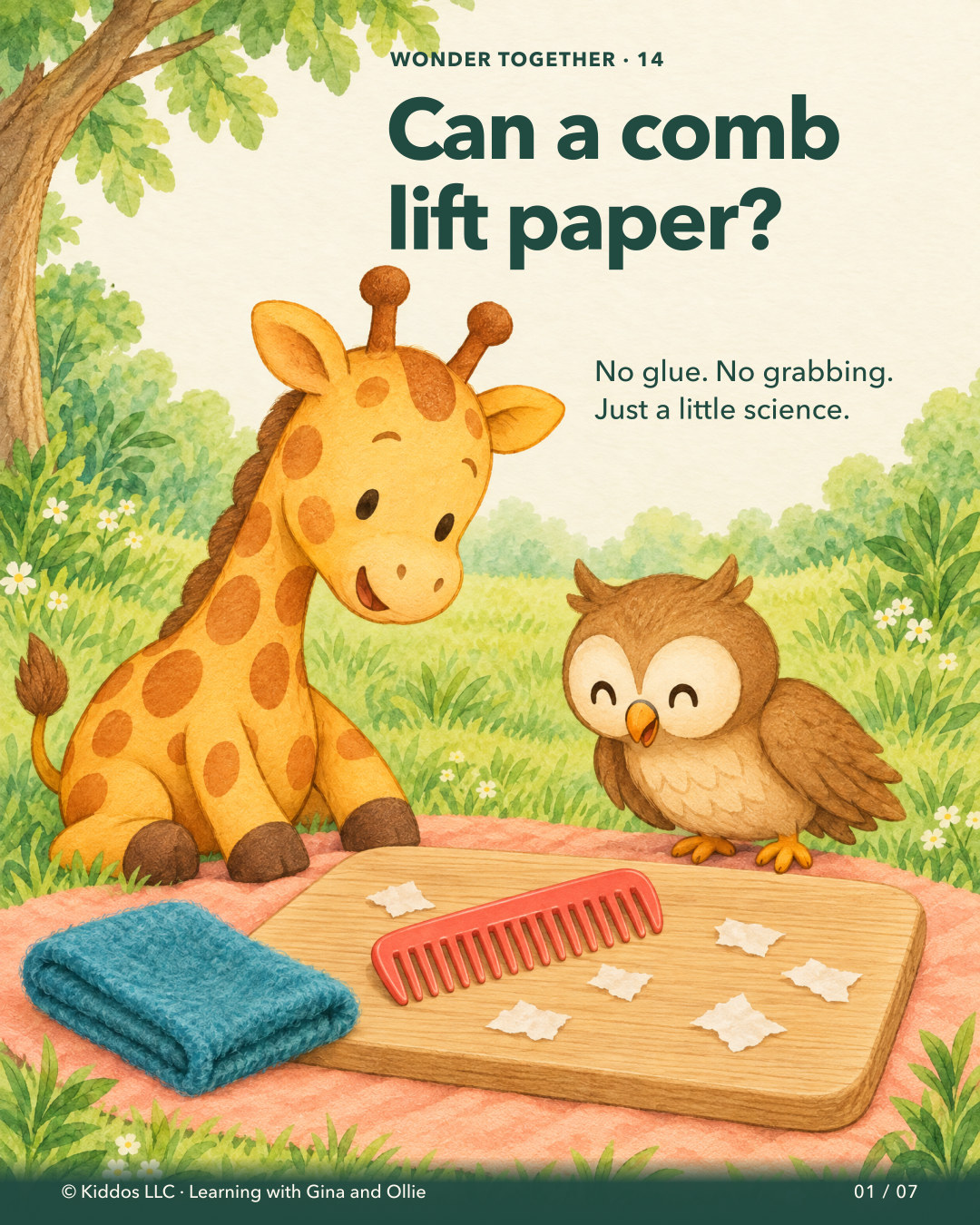
WONDER TOGETHER · 14 Can a comb lift paper? No glue. No grabbing. Just a little science. © Kiddos LLC · Learning with Gina and Ollie 01 / 07
Picture description: Gina the yellow giraffe and her small owl friend Ollie study a coral plastic comb, a folded wool cloth and small pieces of tissue paper on a low wooden board in their meadow. The paper is still resting on the board.
Page 2 · Will it move?
GUESS BEFORE YOU SWIPE Will it move? First, Gina holds the comb close. The paper stays on the board. What might happen after rubbing the comb? © Kiddos LLC · Learning with Gina and Ollie 02 / 07
Picture description: Gina holds the unrubbed coral comb horizontally just above small tissue-paper pieces on the wooden board, with its teeth facing down. All paper rests flat. Ollie watches from the right; the folded wool cloth waits nearby.
Page 3 · Rub. Then try again.
CHANGE ONE THING Rub. Then try again. Gina rubs the same plastic comb on a dry wool cloth. Same comb. Same paper. A new test. © Kiddos LLC · Learning with Gina and Ollie 03 / 07
Picture description: Gina rubs the same coral comb against the dry teal wool cloth, away from the paper. Her two front hooves support the comb and cloth. The small tissue pieces remain on the wooden board; Ollie watches.
Page 4 · Up it comes!
LOOK AT THE GAP Up it comes! Back above the paper… some pieces lift toward the comb. It pulls before they touch. © Kiddos LLC · Learning with Gina and Ollie 04 / 07
Picture description: In the same view as the first test, Gina holds the rubbed comb over the board. A few tissue-paper pieces lift toward its downward teeth; others remain on the board. A visible air gap separates the rising paper from the comb.
Page 5 · An invisible pull.
CHARGED COMB ELECTRIC PULL LIGHT PAPER THE PART TO REMEMBER An invisible pull. Rubbing can give the comb a static electric charge. That charge can attract light paper. Attract means pull closer. © Kiddos LLC · Learning with Gina and Ollie 05 / 07
Picture description: An enlarged diagram shows a plastic comb above light paper. An arrow from a paper piece toward the comb is labeled electric pull. The paper and comb do not touch. The diagram shows the direction of the force, not a visible beam or a magnet.
Page 6 · Try the paper lift.
1 Hold the comb just above the paper without touching. What do you notice? 2 Rub the comb on dry wool several times, away from the paper. 3 Bring it back just as close. Keep it still. Watch, compare, then rub again to retry. TRY IT TOGETHER Try the paper lift. With an adult: a dry plastic comb, wool cloth and small torn pieces of single-layer tissue. Use a dry, flat surface away from breezes. What changed after rubbing? Adult stays close. No blowing or tasting. Keep pieces away from faces; collect them after. © Kiddos LLC · Learning with Gina and Ollie 06 / 07
Picture description: Three diagrams show a comb held near resting tissue paper, the comb rubbed on wool, and paper lifting toward the comb. Instructions call for an adult, dry materials, a still-air surface, a close gap without touching, and comparison before and after rubbing. Safety says no blowing or tasting and to keep small pieces away from faces and collect them afterward.
Page 7 · More pulls to discover.
KEEP EXPLORING TOGETHER More pulls to discover. Explore a different kind of pull: Gina and the Magnet Mystery. Parents: read together in Kiddos Books. Kiddos Books · Read with confidence. © Kiddos LLC · Learning with Gina and Ollie 07 / 07
Picture description: With the experiment cleared away, Gina and Ollie share an open picture book beneath a leafy tree. Its wordless pictures show two bar magnets. The parent invitation names Gina and the Magnet Mystery, a separate story about a different kind of force.
Where the explanation comes from.
Related storybooks invite further reading. The factual sources below support the investigation; illustration diagrams simplify what happens.