From story to discovery
Try it together.
A leaf in hiding. Gina covers the leaf with paper. What will a crayon reveal?
Gather
A safe flexible fallen leaf, thin plain paper and a large non-toxic age-appropriate crayon.
Adult setup — read before trying
An adult chooses a clean leaf with raised veins, avoiding unknown, irritating, thorny or decaying plants, and removes the crayon wrapper. Work on a protected smooth hard surface. Keep leaves/crayon out of mouths; wash hands afterward.
- An adult selects a safe flexible fallen leaf and prepares an unwrapped crayon.
- Put the leaf bumpy-side up on a smooth hard surface. Cover with thin plain paper and hold still.
- Rub with the crayon’s long side. Lift the paper and match the outline and lines to the leaf.
- Keep the same
- Leaf and paper stay still over the same hard surface.
- What changes
- Crayon wax collects as you rub across the covered leaf.
- Look for
- Match the rubbing’s outline and branching lines with the original leaf.
Make sense of what happened
Raised veins make higher areas under the paper where more crayon marks collect.
The leaf’s green pigment does not pass through the paper. A rubbing may miss tiny veins; it is not a plant-identification or tasting guide.
Full grown-up notes, setup details & honest limits
An adult selects a clean, safe, flexible fallen leaf with easy-to-feel raised veins, avoiding unknown, irritating, thorny or decaying plants. No picking living plants is needed. Use thin plain paper and a large, age-appropriate non-toxic crayon with its wrapper removed by the adult. Work on a smooth hard surface, protecting it as needed. Let the child feel the leaf gently and make a guess first. Put the bumpy vein side upward, cover the leaf completely with paper, and hold both still. Use the long side of the crayon, not its point, to rub lightly back and forth over the covered leaf. One person can hold while the other rubs. Continue across the whole leaf area, then lift the paper and compare outline and vein branches. Darker wax gathers over raised areas; the leaf’s green pigment does not pass through the sheet. Rubbings may be faint or patchy: try thinner paper, a darker crayon, a flexible leaf with more pronounced veins, or steadier holding. Do not promise a perfect copy of every tiny vein. For a second challenge, make rubbings of two safe leaves and ask your child to match each print to its leaf using shape and lines. A child can choose the crayon, feel the ridges, predict, point or direct an adult without needing a particular grip. Keep leaves and crayons out of mouths and wash hands after handling leaves. Teachers can offer leaf/rubbing pairs for a small-group matching task and ask children what evidence helped them choose. The illustrated leaf is a generic broad leaf, not a species-identification guide. The related story explores plant growth; its nibbling scene is not permission to taste collected plants. This is editorially reviewed, not a performed family trial or proof of measured learning.
A conversation, not a quiz
Leave room for their idea.
Ask the child to find one matching feature before naming veins.
A leaf in hiding. Gina covers the leaf with paper. What will a crayon reveal?
A cue for the grown-up
Welcome a guess before reading the result. No correct prediction is required.
Which lines in your rubbing match the leaf?
A cue for the grown-up
Look for the outer shape, central vein and branching veins.
Where did the color on the paper come from?
A cue for the grown-up
From the crayon wax, not from the leaf’s green pigment.
A simple way in
One person holds the paper while the other rubs with the crayon’s long side.
Another thing to notice
Make two rubbings and match them to two safe leaves using shapes and lines.
Come back to it
Look at a different safe leaf and predict which raised lines would show.
For teachers
A small-group discovery.
Flexible 20-minute small-group session; pause or shorten as needed.
Prepare the named materials and adult setup above. One adult-led demonstration is a useful option.
- 3 min
Wonder
Read pages 1–2. Invite a prediction with words, pointing or a sketch; keep the result hidden.
- 4 min
Notice the story
Read pages 3–5. Which lines in your rubbing match the leaf? Separate the observation from the explanation.
- 9 min
Try together
Use the materials and adult setup on this guide, then follow the activity steps in this guide. Match the rubbing’s outline and branching lines with the original leaf.
- 4 min
Make meaning
Where did the color on the paper come from? Invite a drawing, a description or an adult-written note. Ask the child to find one matching feature before naming veins.
What to listen for
Where did the color on the paper come from?
Answer guidance
From the crayon wax, not from the leaf’s green pigment.
Ways to take part
One person holds the paper while the other rubs with the crayon’s long side. Accept pointing, words, a drawing or adult-directed action. Use the story alone if the activity is unsuitable.
Record an observation with a drawing, a gesture described by an adult or a sentence. No timed performance or winning prediction is needed.
All the story words.
Read aloud, enlarge the browser text, or use this text alongside the pictures.
Page 1 · Can you draw a hidden leaf?
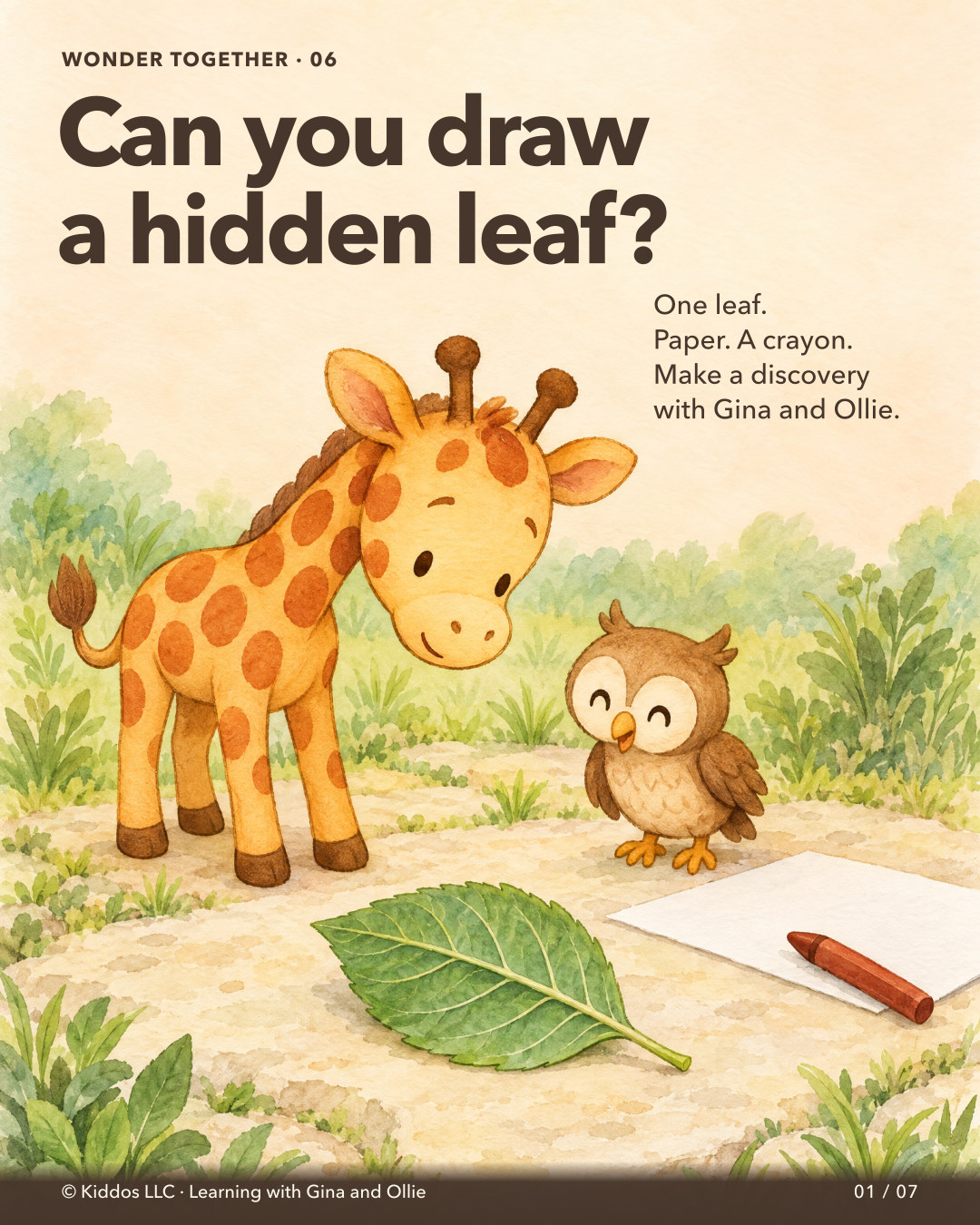
WONDER TOGETHER · 06 Can you draw a hidden leaf? One leaf. Paper. A crayon. Make a discovery with Gina and Ollie. © Kiddos LLC · Learning with Gina and Ollie 01 / 07
Picture description: Gina the yellow giraffe and little brown owl Ollie discover a broad green leaf with raised veins beside blank paper and a dark rust-colored crayon. The title asks, Can you draw a hidden leaf?
Page 2 · A leaf in hiding.
GUESS BEFORE YOU SWIPE A leaf in hiding. Gina covers the leaf with paper. What will a crayon reveal? Pause. Let your child guess. © Kiddos LLC · Learning with Gina and Ollie 02 / 07
Picture description: A white sheet covers the leaf on a smooth ground-level stone. Only a tiny bit of leaf stem peeks from the paper edge. The sheet is still blank and the rust-colored crayon waits beside it. Gina and Ollie look at the unresolved setup.
Page 3 · Little lines appear…
TRY A GENTLE RUB Little lines appear… Gina rubs with the crayon’s side. Ollie helps keep the paper still. Look closely. What can you see? © Kiddos LLC · Learning with Gina and Ollie 03 / 07
Picture description: In the matched scene, Gina uses one naturally attached front hoof to move the crayon on its side across the paper. Ollie holds a paper corner with a wing. A partial rust-colored rubbing reveals some of the hidden leaf’s veins; the rest remains uncolored.
Page 4 · There it is!
THE HIDDEN PATTERN There it is! The leaf’s shape and veins appear. Gina made a leaf rubbing. Same leaf. Same paper. Keep looking. © Kiddos LLC · Learning with Gina and Ollie 04 / 07
Picture description: The same sheet now has a complete rust-colored leaf rubbing, with its oval outline, central vein and branching veins visible. The actual leaf remains underneath. The crayon rests beside the paper, and Gina and Ollie look at the revealed pattern.
Page 5 · Little bumps. Darker marks.
RAISED VEINS DARKER MARKS SIDE VIEW · ENLARGED CRAYON PAPER LEAF THE PART TO REMEMBER Little bumps. Darker marks. Raised veins make bumps under the paper. The crayon leaves darker marks there. © Kiddos LLC · Learning with Gina and Ollie 05 / 07
Picture description: A green leaf and a rust-colored rubbing are shown side by side with matching outlines and vein patterns. Labels identify raised veins and darker marks. A simple enlarged side view shows paper rising over a vein, with the crayon on top. The diagram explains how texture becomes a visible pattern.
Page 6 · Make a leaf mystery.
1 BUMPY SIDE UP 2 COVER + HOLD 3 RUB WITH THE SIDE TRY IT TOGETHER Make a leaf mystery. Leaf bumpy-side up, on a hard surface. Cover with thin paper. Hold it still. Rub with the side of an unwrapped crayon. Lift the paper. Match the lines to the leaf. With an adult: choose a safe fallen leaf. Keep leaves and crayons out of mouths. © Kiddos LLC · Learning with Gina and Ollie 06 / 07
Picture description: Three illustrated steps show a safe fallen leaf with raised veins facing up on a hard surface, paper laid over it, and an unwrapped crayon used on its side. With an adult, hold the paper still and rub, then lift it and match the rubbing to the real leaf. Keep leaves and crayons out of mouths. The child may feel, predict, point or direct the adult.
Page 7 · A little leaf. A bigger “why?”
KEEP THE WONDER GROWING A little leaf. A bigger “why?” Read How Does It Grow? together. Parents: explore the story in Kiddos Books. Kiddos Books · Read with confidence. © Kiddos LLC · Learning with Gina and Ollie 07 / 07
Picture description: Gina and Ollie share a picture book beside a leafy garden edge, with a small potted plant nearby. Parents are invited to read How Does It Grow? in Kiddos Books, a related story about growing plants rather than a leaf-rubbing instruction book.
Where the explanation comes from.
Related storybooks invite further reading. The factual sources below support the investigation; illustration diagrams simplify what happens.