From story to discovery
Try it together.
Where should Ollie stand? To make his shadow smaller: near the flashlight, or near the wall?
Gather
A cool LED flashlight, a plain wall and one hand.
Adult setup — read before trying
An adult holds the flashlight still, aimed at a wall. Use a clear indoor space with enough light to move safely. Keep the beam away from eyes; do not use lasers or sunlight. The child can direct the adult’s hand.
- An adult holds the flashlight still, aimed at a wall, while the child predicts which hand position will make a smaller shadow.
- Place the same hand shape in the beam, first near the flashlight, then nearer the wall. Keep the light and wall fixed.
- Compare shadow sizes. Let the child direct another position without changing the hand’s shape.
- Keep the same
- Flashlight, wall, hand size and hand shape.
- What changes
- The hand’s position between the flashlight and wall.
- Look for
- Compare the edges of the shadow when the same hand is near the light and near the wall.
Make sense of what happened
A nearby flashlight sends light out in different directions. A hand nearer the light blocks a wider part of the beam before it reaches the fixed wall.
This nearby-flashlight comparison is not a distance rule for sunlight. A changed hand shape, moving flashlight or shifted wall changes the comparison.
Full grown-up notes, setup details & honest limits
Gina directs the test as the curious learner; Ollie cooperates and helps her notice the result.
Pause on slide 2 and accept a prediction without correcting it. With flashlight and wall fixed, moving the same blocker toward the flashlight enlarges its shadow; moving it toward the wall makes the shadow smaller. On slide 6, let your child choose and test. The hand’s position and shadow size change; the hand’s shape and size, flashlight and wall stay fixed. A child can point, describe, or direct your hand. If the result surprises you, check those fixed parts and try again. This is a nearby-flashlight experiment, not a distance rule for sunlight.
The nearby flashlight, fixed wall, unchanged pose and unchanged owl size are the controlled comparison. Illustrations are not dimensioned apparatus drawings.
A conversation, not a quiz
Leave room for their idea.
Let the child choose a position before you move the hand. Keep the first guess welcome.
Where should Ollie stand? To make his shadow smaller: near the flashlight, or near the wall?
A cue for the grown-up
Welcome a guess before reading the result. No correct prediction is required.
Which shadow covers more of the wall?
A cue for the grown-up
The shadow is bigger when the same hand is nearer the nearby flashlight.
Did the hand grow when its shadow grew?
A cue for the grown-up
No. The hand stayed the same; its position changed.
A simple way in
Try just two clearly different positions with the same open hand.
Another thing to notice
Choose a position between the two and predict a medium-sized shadow.
Come back to it
At another time, ask your child to direct you to make the shadow smaller.
For teachers
A small-group discovery.
Flexible 20-minute small-group session; pause or shorten as needed.
Prepare the named materials and adult setup above. One adult-led demonstration is a useful option.
- 3 min
Wonder
Read pages 1–2. Invite a prediction with words, pointing or a sketch; keep the result hidden.
- 4 min
Notice the story
Read pages 3–5. Which shadow covers more of the wall? Separate the observation from the explanation.
- 9 min
Try together
Use the materials and adult setup on this guide, then follow the activity steps in this guide. Compare the edges of the shadow when the same hand is near the light and near the wall.
- 4 min
Make meaning
Did the hand grow when its shadow grew? Invite a drawing, a description or an adult-written note. Let the child choose a position before you move the hand. Keep the first guess welcome.
What to listen for
Did the hand grow when its shadow grew?
Answer guidance
No. The hand stayed the same; its position changed.
Ways to take part
Try just two clearly different positions with the same open hand. Accept pointing, words, a drawing or adult-directed action. Use the story alone if the activity is unsuitable.
Record an observation with a drawing, a gesture described by an adult or a sentence. No timed performance or winning prediction is needed.
All the story words.
Read aloud, enlarge the browser text, or use this text alongside the pictures.
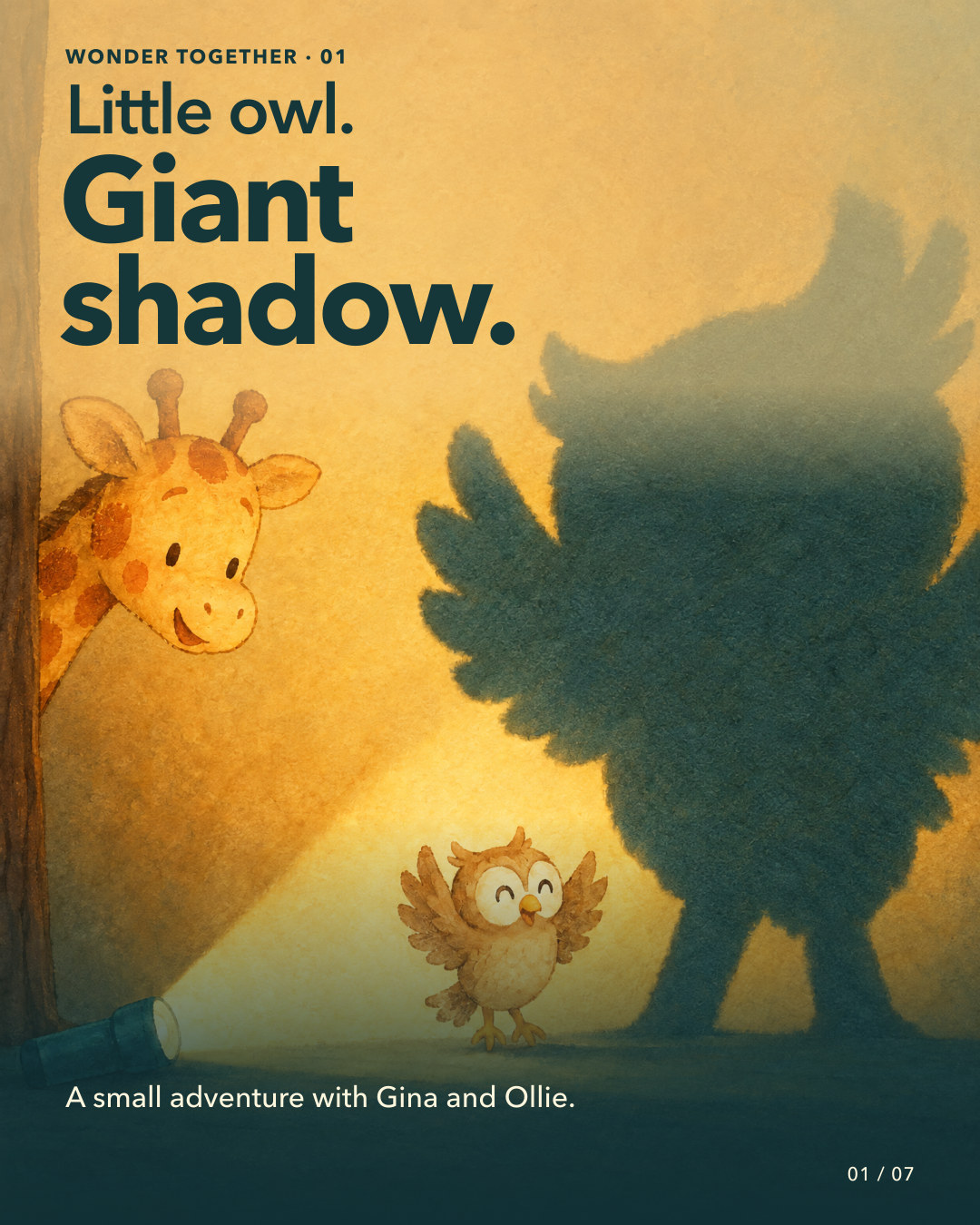
Page 1 · Little owl. Giant shadow.
WONDER TOGETHER · 01 Little owl. Giant shadow. A small adventure with Gina and Ollie. 01 / 07
Picture description: Ollie stands in a pool of warm flashlight light, with an enormous owl-shaped shadow on a wall. Gina leans in, curious. The small owl and his large shadow are visibly different.
Page 2 · Where should Ollie stand?
GUESS BEFORE YOU SWIPE Where should Ollie stand? To make his shadow smaller: near the flashlight, or near the wall? Pick a spot before Gina turns on the light. 02 / 07
Picture description: Before the test, the same teal flashlight sits switched off on the same low brown box shown in the next two slides. Ollie waits between the two test positions and no projected owl shadow is visible. Gina invites a prediction: should Ollie stand near the flashlight or near the wall to make a smaller shadow?
Page 3 · Near the light. BIG shadow.
GINA’S FIRST TEST Near the light. BIG shadow. Ollie steps closer to the flashlight. Same owl. Same flashlight. Same wall. 03 / 07
Picture description: In a fixed side view, Ollie stands close to a low flashlight aimed at a wall. His owl-shaped shadow is much larger than he is. Gina watches from outside the beam.
Page 4 · Near the wall. Small shadow.
NOW, TRY THE OTHER WAY Near the wall. Small shadow. Gina guides Ollie farther from the light. Only Ollie’s position changes. 04 / 07
Picture description: A matched view of the same flashlight, wall and Ollie. Ollie stands nearer the wall and farther from the flashlight, making a smaller owl-shaped shadow.
Page 5 · Ollie didn’t grow. His shadow did.
THE PART TO REMEMBER Ollie didn’t grow. His shadow did. Ollie blocks some light. His shadow falls on the wall. Move the owl. Change the shadow. 05 / 07
Picture description: An intimate watercolor scene shows small Ollie beside his larger projected silhouette. Gina notices the difference. A shadow is blocked light, not a separate creature or a growing owl.
Page 6 · Make a giant. Then make it tiny.
YOUR CHILD IS THE DIRECTOR Make a giant. Then make it tiny. Adult: hold a flashlight still, aimed at a wall. Put a hand in the beam. Keep its shape. Let your child choose where to move it. Ask: “What changed? What stayed still?” Aim away from eyes. Keep enough room light to move safely. 06 / 07
Picture description: A clean diagram shows a flashlight, a five-finger hand and an enlarged matching hand shadow in an ochre beam. With an adult holding the light still and the same hand shape, let the child choose how to make the shadow big and then small. The child may direct the adult. Aim away from eyes and keep the room safely lit.
Page 7 · Little questions. Big discoveries.
KEEP THE WONDER GOING Little questions. Big discoveries. Read Gina and the Light Chase together. Parents: explore the story in Kiddos Books. Kiddos Books · Read with confidence. 07 / 07
Picture description: Gina and Ollie settle together over a picture book in a warm, softly lit storybook setting. Parent invitation to read Gina and the Light Chase together in Kiddos Books.
Where the explanation comes from.
Related storybooks invite further reading. The factual sources below support the investigation; illustration diagrams simplify what happens.