From story to discovery
Try it together.
Four things. Many details.
Gather
One large clean sock and one folded cloth napkin. One rigid empty plastic cup and one large wooden spoon. A clean floor cloth or stable surface.
Adult setup — read before trying
Adult selects the four large safe objects and clears a reachable surface. Adult selects large safe objects and a stable reachable surface. No glass, sharp items, small loose parts, blindfolds or climbing. Looking, pointing and directing an adult are welcome. No speed test or required spoken response.
- Adult selects the four large safe objects and clears a reachable surface.
- Look and, if comfortable, feel each one. Adult can describe its feel; no blindfold is needed.
- Child makes a soft group and a hard group. Place each of the four objects once.
- Ask the child to show or explain one choice using the shared rule.
- Child chooses a different rule, such as a visible shape or something they use the objects for. Adult tries that rule.
- Accept more than one reasonable grouping when the rule is clearly explained and used consistently.
- Keep the same
- same four object designs; all four objects retained; soft/hard rule for the demonstration.
- What changes
- Placement into two groups; later home extension may use an explicitly new rule.
- Look for
- For the shown feel rule, the cloth sock and napkin are the soft group; the rigid plastic cup and wooden spoon are the hard group. Other groups may be reasonable under a clearly explained different rule.
Make sense of what happened
Use one clear rule to group four familiar objects, then invent and explain another fair grouping. For the shown feel rule, the cloth sock and napkin are the soft group; the rigid plastic cup and wooden spoon are the hard group. Other groups may be reasonable under a clearly explained different rule.
Soft and hard describe these selected materials. Another clearly stated rule may give different groups; some objects do not fit a simple either/or category.
Full grown-up notes, setup details & honest limits
Ask “What is your rule?” before judging a different arrangement.
Soft and hard describe these selected materials. Another clearly stated rule may give different groups; some objects do not fit a simple either/or category.
These are shared activities inspired by Benny’s story world. Suggested ages and times are editorial starting points; they are not standardized assessments or measured learning outcomes.
A conversation, not a quiz
Leave room for their idea.
Ask “What is your rule?” before judging a different arrangement.
What rule are we using?
A cue for the grown-up
How these particular objects feel: soft or hard.
Where does the napkin go for this rule?
A cue for the grown-up
With the soft cloth sock.
Could another rule give different groups?
A cue for the grown-up
Yes. Name the new rule and check each choice against it.
A simple way in
Use two very different objects and sort together. Touching is optional; offer a description or demonstration.
Another thing to notice
Let the child suggest a new rule and explain one surprising but reasonable choice. Discuss objects that do not fit neatly, without forcing a false binary.
Come back to it
Try the same game another day with one adult-approved change. Ask what helped you notice this time.
For teachers
A small-group discovery.
Flexible 15-minute small-group sequence; prepare materials first, and shorten or pause as needed.
Prepare the named materials and adult setup above. One adult-led demonstration is a useful option.
- 2 min
Notice
Introduce the question and invite a first idea.
- 4 min
Read and compare
Read the clues and pause before the reveal; compare together.
- 6 min
Try together
Model the household game, then let pairs take turns with adult-selected objects.
- 3 min
Show your thinking
Place each object once using the named rule, then show one placement under a new rule. Accept pointing, showing or directing an adult; an informal observation, not a score.
What to listen for
Place each object once using the named rule, then show one placement under a new rule.
Answer guidance
For the shown feel rule, the cloth sock and napkin are the soft group; the rigid plastic cup and wooden spoon are the hard group. Other groups may be reasonable under a clearly explained different rule.
Ways to take part
Accept pointing, showing, words in a home language or directing an adult. Use two very different objects and sort together. Touching is optional; offer a description or demonstration.
Record an observation with a drawing, a gesture described by an adult or a sentence. No timed performance or winning prediction is needed.
All the story words.
Read aloud, enlarge the browser text, or use this text alongside the pictures.
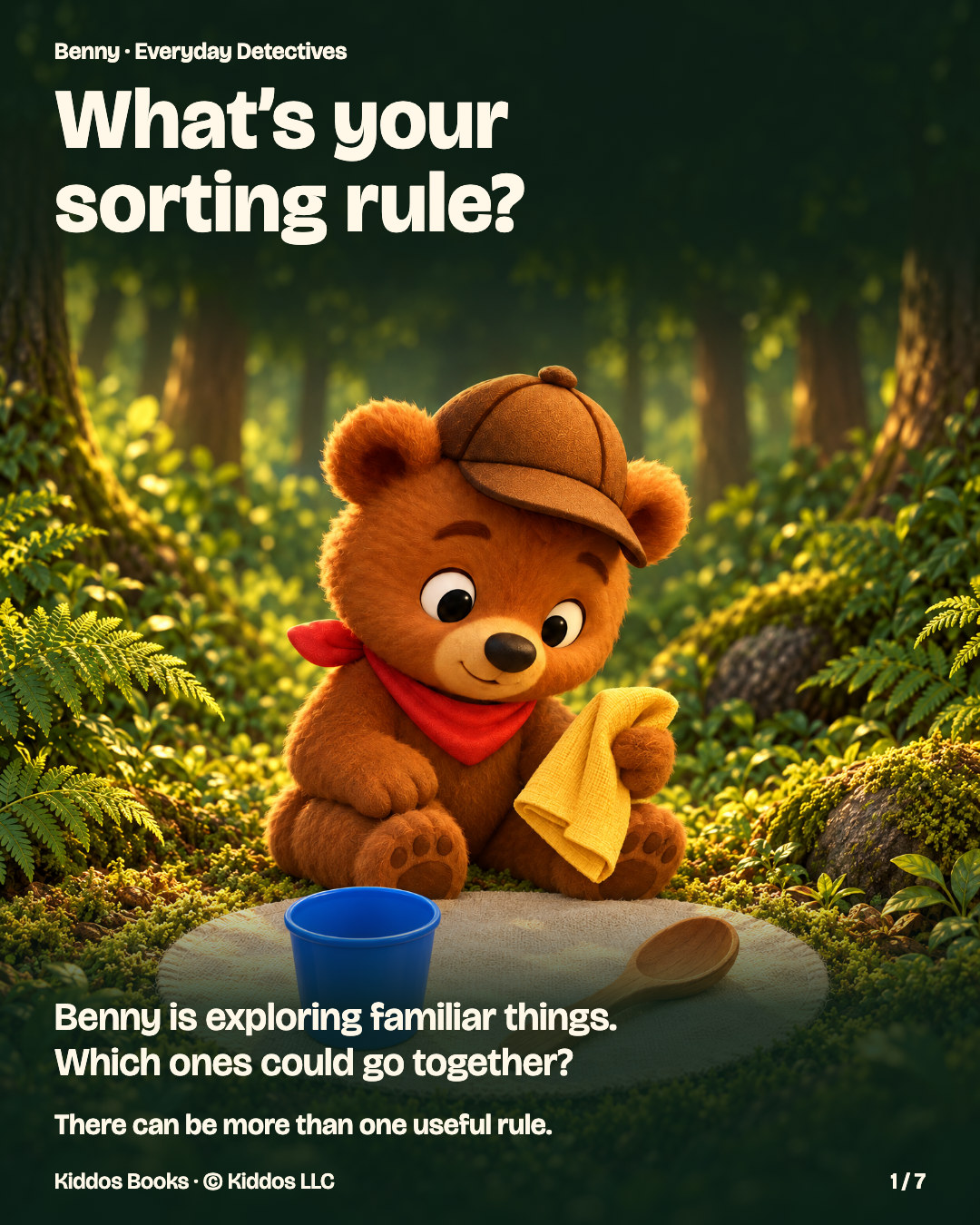
Page 1 · What’s your sorting rule?
Benny · Everyday Detectives What’s your sorting rule? Benny is exploring familiar things. Which ones could go together? There can be more than one useful rule. Kiddos Books · © Kiddos LLC 1 / 7
Picture description: Page 1 of 7. Benny explores a soft cloth napkin. An empty blue cup and wooden spoon rest on a cloth in the mossy clearing. Text: What’s your sorting rule? Benny is exploring familiar things. Which ones could go together? There can be more than one useful rule.
Page 2 · Four things. Many details.
01 / MEET THE THINGS Four things. Many details. A sock, a napkin, a cup, a spoon. What do you notice? Look, point, or feel with a grown-up. Kiddos Books · © Kiddos LLC 2 / 7
Picture description: Page 2 of 7. A plain blue sock, yellow cloth napkin, blue plastic cup and wooden spoon lie separately on a pale cloth beside Benny. Text: Four things. Many details. A sock, a napkin, a cup, a spoon. What do you notice? Look, point, or feel with a grown-up.
Page 3 · Soft or hard? Let’s use that rule.
02 / CHOOSE ONE RULE Soft or hard? Let’s use that rule. The cloth feels soft. The wooden spoon feels hard. A grown-up can describe the feel, too. Kiddos Books · © Kiddos LLC 3 / 7
Picture description: Page 3 of 7. Benny holds the soft napkin and the hard wooden spoon. The sock and cup remain on the cloth. Text: Soft or hard? Let’s use that rule. The cloth feels soft. The wooden spoon feels hard. A grown-up can describe the feel, too.
Page 4 · Two groups. One shared rule.
03 / TRY THE SORT Two groups. One shared rule. Sock and napkin: soft. Cup and wooden spoon: hard. Every object has a place in this sort. Kiddos Books · © Kiddos LLC 4 / 7
Picture description: Page 4 of 7. The sock and napkin form one group on the left. The rigid cup and wooden spoon form another group on the right. Text: Two groups. One shared rule. Sock and napkin: soft. Cup and wooden spoon: hard. Every object has a place in this sort.
Page 5 · Our rule makes the groups.
SOFT HARD 04 / REMEMBER Our rule makes the groups. We grouped these things by feel. A new rule can make new groups. Say or show the rule you are using. Kiddos Books · © Kiddos LLC 5 / 7
Picture description: Page 5 of 7. Close views labelled SOFT and HARD show the cloth pair and the rigid cup with the wooden spoon. Text: Our rule makes the groups. We grouped these things by feel. A new rule can make new groups. Say or show the rule you are using.
Page 6 · Try a sort at home.
05 / TRY IT TOGETHER Try a sort at home. Adult: use a sock and cloth napkin, wooden spoon and rigid plastic cup. Child, sort them into soft and hard. Grown-up, ask about one choice. Point, touch, or tell. No speed test. Kiddos Books · © Kiddos LLC 6 / 7
Picture description: Page 6 of 7. Benny sits beside the four objects arranged into soft and hard groups. Text: Try a sort at home. Adult: use a sock and cloth napkin, wooden spoon and rigid plastic cup. Child, sort them into soft and hard. Grown-up, ask about one choice. Point, touch, or tell. No speed test.
Page 7 · Now choose a new rule.
06 / YOUR TURN TO LEAD Now choose a new rule. You choose a new sorting rule. Grown-up, try your rule. Explain or show one choice. Same things. A new way to group them. Kiddos Books · © Kiddos LLC 7 / 7
Picture description: Page 7 of 7. Benny invites the child to choose and explain a different sorting rule. Text: Now choose a new rule. You choose a new sorting rule. Grown-up, try your rule. Explain or show one choice. Same things. A new way to group them.
Where the explanation comes from.
Related storybooks invite further reading. The factual sources below support the investigation; illustration diagrams simplify what happens.