From story to discovery
Try it together.
Six spoons. Two plates.
Gather
Six matching large spoons or six other large safe objects of one kind. Two plastic plates or two clear spaces on a cloth.
Adult setup — read before trying
Adult sets out six large safe objects and two plates or spaces. Count the six together. Adult selects large safe materials and a stable reachable surface. No glass, sharp objects, small loose parts, blindfolds or climbing. Pointing, showing and directing an adult are welcome; no speed test or required spoken response.
- Adult sets out six large safe objects and two plates or spaces. Count the six together.
- Explain the goal: put the same number in each place.
- Child gives one object to the first place, then one to the second.
- Repeat, one for each place, until all six are used.
- Count each group or pair one object from each group. Three in each, with none left over.
- Swap roles. Try four objects and two places, or revisit the six-object setup in a new arrangement.
- Keep the same
- six spoons total; two plates; spoon design and scale; same view and light for sharing.
- What changes
- Move one spoon to each plate per round until none remain.
- Look for
- Six spoons shared equally between two plates give three spoons on each plate, with none left over. The goal here is equal counts, not a claim that every real-life fair decision means identical amounts.
Make sense of what happened
Share six objects between two places one at a time, then check that both groups have the same number. Six spoons shared equally between two plates give three spoons on each plate, with none left over. The goal here is equal counts, not a claim that every real-life fair decision means identical amounts.
Six whole objects divide equally between two places as three in each. This game compares equal counts; it does not claim every real-life fair decision requires identical amounts.
Full grown-up notes, setup details & honest limits
State the equal-count goal, then let the child distribute and choose how to check it.
Six whole objects divide equally between two places as three in each. This game compares equal counts; it does not claim every real-life fair decision requires identical amounts.
These are shared activities inspired by Benny’s story world. Suggested ages and times are editorial starting points; they are not standardized assessments or measured learning outcomes.
A conversation, not a quiz
Leave room for their idea.
State the equal-count goal, then let the child distribute and choose how to check it.
How many spoons are there before we start?
A cue for the grown-up
Six.
After giving one to each plate, how many are still waiting?
A cue for the grown-up
Four.
How do we know both plates have the same number?
A cue for the grown-up
Count three on each, or make three pairs with one from each plate.
A simple way in
Use four objects, give one to each place together, and repeat once. Check two in each place.
Another thing to notice
Try six objects with three places. If the child proposes a number that leaves leftovers, notice the remainder without forcing objects to disappear or dividing unsafe materials.
Come back to it
Return to the game another day with one adult-approved change. Ask which clue or checking method helped this time.
For teachers
A small-group discovery.
Flexible 15-minute small-group sequence; prepare materials first, and shorten or pause as needed.
Prepare the named materials and adult setup above. One adult-led demonstration is a useful option.
- 2 min
Notice
Introduce the question and invite a first idea.
- 4 min
Read and compare
Read the clues and pause before the reveal; compare together.
- 6 min
Try together
Model the household game, then let pairs take turns with adult-selected objects.
- 3 min
Show your thinking
Make two groups of three from six and verify both counts or three complete pairs, with no missing or extra object. Accept pointing, showing or directing an adult; an informal observation, not a score.
What to listen for
Make two groups of three from six and verify both counts or three complete pairs, with no missing or extra object.
Answer guidance
Six spoons shared equally between two plates give three spoons on each plate, with none left over. The goal here is equal counts, not a claim that every real-life fair decision means identical amounts.
Ways to take part
Accept pointing, showing, words in a home language or directing an adult. Use four objects, give one to each place together, and repeat once. Check two in each place.
Record an observation with a drawing, a gesture described by an adult or a sentence. No timed performance or winning prediction is needed.
All the story words.
Read aloud, enlarge the browser text, or use this text alongside the pictures.
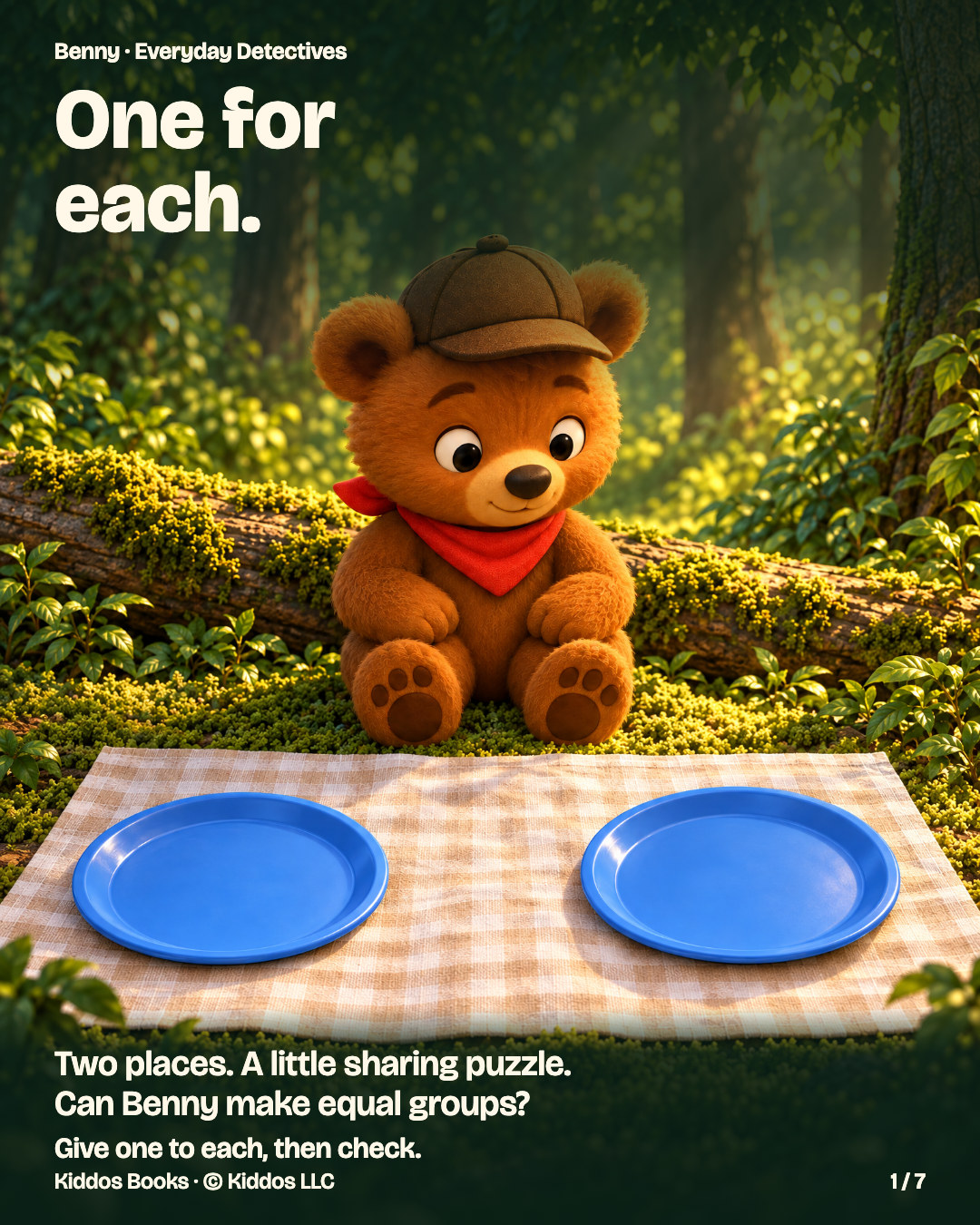
Page 1 · One for each.
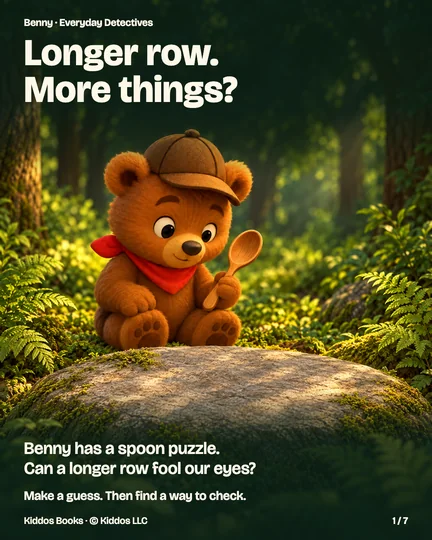
Benny · Everyday Detectives One for each. Two places. A little sharing puzzle. Can Benny make equal groups? Give one to each, then check. Kiddos Books · © Kiddos LLC 1 / 7
Picture description: Page 1 of 7. Benny sits beside two empty blue plates on a pale cloth in the forest. No spoons are shown in this opening invitation. Text: One for each. Two places. A little sharing puzzle. Can Benny make equal groups? Give one to each, then check.
Page 2 · Six spoons. Two plates.
01 / MEET THE PUZZLE Six spoons. Two plates. We want the same number on each. How could we share them out? Count the six before you begin. Kiddos Books · © Kiddos LLC 2 / 7
Picture description: Page 2 of 7. Exactly six wooden spoons wait between two empty blue plates, separated into two rows of three. Benny sits behind the cloth. Text: Six spoons. Two plates. We want the same number on each. How could we share them out? Count the six before you begin.
Page 3 · One here. One there.
02 / ONE AT A TIME One here. One there. One spoon is on each plate. Four are still waiting. Keep going: one for each. Kiddos Books · © Kiddos LLC 3 / 7
Picture description: Page 3 of 7. One spoon rests on each blue plate. Four more spoons remain between the plates, making six altogether. Text: One here. One there. One spoon is on each plate. Four are still waiting. Keep going: one for each.
Page 4 · Three here. Three there.
03 / CHECK THE GROUPS Three here. Three there. Both plates have the same number. No spoons are left over. Count each group to check. Kiddos Books · © Kiddos LLC 4 / 7
Picture description: Page 4 of 7. Three separate wooden spoons rest on each plate. There are six in total, with no spoons left between the plates or in Benny's paws. Text: Three here. Three there. Both plates have the same number. No spoons are left over. Count each group to check.
Page 5 · Equal groups. All six used.
THREE THREE 04 / REMEMBER Equal groups. All six used. Three spoons on each plate. Six spoons altogether. One for each. Then check. Kiddos Books · © Kiddos LLC 5 / 7
Picture description: Page 5 of 7. Exact detail views show three spoons on the left plate and three on the right plate. Both groups are labeled Three. Text: Equal groups. All six used. Three spoons on each plate. Six spoons altogether. One for each. Then check.
Page 6 · Share six things at home.
05 / TRY IT TOGETHER Share six things at home. Adult: choose six large safe objects and two plates or clear spaces. Child, give one to each place. Repeat. Count both groups together. Use empty plastic plates. No food needed. Kiddos Books · © Kiddos LLC 6 / 7
Picture description: Page 6 of 7. Benny sits beside two blue plates, each holding three separate wooden spoons. No spoons are left over. Text: Share six things at home. Adult: choose six large safe objects and two plates or clear spaces. Child, give one to each place. Repeat. Count both groups together. Use empty plastic plates. No food needed.
Page 7 · You share. We check.
06 / YOUR TURN TO LEAD You share. We check. Child, give one to each place. Grown-up, help check the groups. Swap roles and share again. One for each. Then check. Kiddos Books · © Kiddos LLC 7 / 7
Picture description: Page 7 of 7. The opening two empty plates return as the child is invited to share real objects and check the groups together. Text: You share. We check. Child, give one to each place. Grown-up, help check the groups. Swap roles and share again. One for each. Then check.
Where the explanation comes from.
Related storybooks invite further reading. The factual sources below support the investigation; illustration diagrams simplify what happens.